

Regent honeyeaters were once kings of flowering gums. Now they're on the edge of extinction. What happened?
- Written by: Rob Heinsohn, Professor of Evolutionary and Conservation Biology, Australian National University
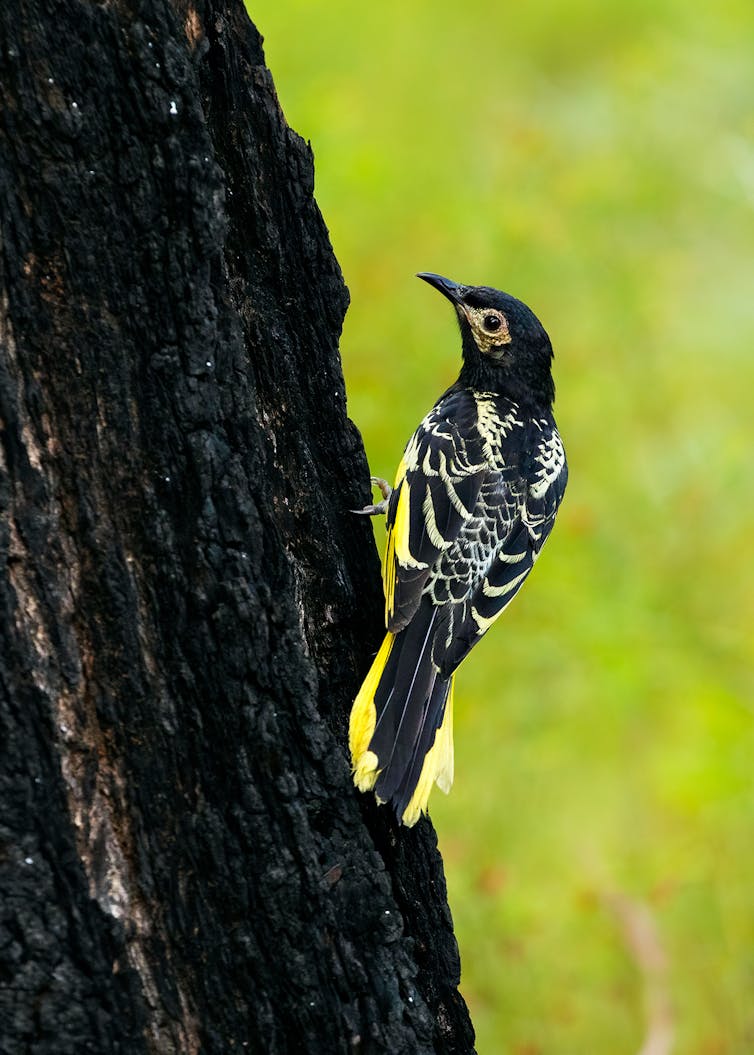
Less than 80 years ago, regent honeyeaters ruled Australia’s flowering gum forests, with huge raucous flocks roaming from Adelaide to Rockhampton.
Now, there are less than 300 birds left in the wild. Habitat loss has pushed the survivors into little pockets across their once vast range.
Sadly, our new research shows these birds are now heading for rapid extinction. Unless we urgently boost conservation efforts, the regent honeyeater will follow the passenger pigeon into oblivion within the next 20 years.
If we let the last few die, the regent honeyeater will be only the second bird extinction on the Australian mainland since European colonisation, following the paradise parrot.
How did it come to this?
With vivid yellow and black wings, embroidered body and warty faces, these honeyeaters are among Australia’s most spectacular birds.
John Gould, one of Australia’s earliest European naturalists, observed these birds in “immense flocks amongst the brushes of New South Wales”. He described the regent honeyeater as “the most pugnacious bird he ever saw”, noting they “reigned supreme in the largest, most heavily-flowering trees.” Their success in securing nectar supplies made them vital pollinators.
Read more: Only the lonely: an endangered bird is forgetting its song as the species dies out
The world Gould saw is sadly a thing of the past. Regent honeyeater populations have plummeted, with the loss of over 90% of their preferred woodland habitats to farmland.
You might wonder how this could be, given there are still large tracts of forest in Australia. But these are invariably on poorer soils and hilltops. Our remaining forests do not yield the rich nectar regent honeyeaters require for breeding.
As their habitat has declined, the surviving regent honeyeaters have been forced to compete with larger species – without the safety of their huge flocks. The result? The once common species no longer reigns supreme.
Gone within 20 years
Unless conservation actions are urgently stepped up, our research shows these birds will be extinct within 20 years.
We’ve known about the decline of regent honeyeaters since the late 1970s. In response, a recovery team including BirdLife Australia and Taronga Conservation Society launched a long-term recovery effort to protect habitat, plant new trees and release zoo-bred birds. These efforts have slowed but not arrested the decline of these birds.
In 2015, we began a large-scale survey to better understand their population decline. Regent honeyeaters are a notoriously difficult bird to study in the wild. As nomads, they wander long distances throughout their vast range in search of nectar in their favoured tree species. Finding these birds is hard enough, let alone monitoring the population in detail.
After six years of intensive fieldwork, and with data from research in the 1990s and long term bird banding, we have finally gathered enough information to be able to understand the challenges for the few remaining wild birds. We now know their breeding success has declined because their nests are raided and the chicks killed by aggressive native species, with noisy miners a particular problem.
We also know the wild birds are losing their song culture because of a lack of older birds for fledglings to learn their songs.
Our fieldwork has given us accurate estimates of vital breeding data, such as how many young birds fledge for each adult female, how many birds are breeding and how well juveniles are surviving. We combined this with data from the decades of monitoring of zoo-bred and released birds to create population models, which allow us to predict the future for the wild population under different conservation scenarios.
Habitat is king
What do the models show? That time is critical. To have any chance of getting the regent honeyeater back, we must build its numbers up enough for them to be able to roam in large flocks for protection.
How? First, we have to nearly double the nesting success rate for both wild and released zoo-bred birds. Too many young birds are dying early. That means we have to find nesting birds early in the breeding season and protect them from noisy miners, pied currawongs and even possums.
Next, we have to boost the numbers of zoo-bred birds released in the Blue Mountains, and maintain these numbers for at least twenty years. Staff at Taronga Conservation Society are preparing zoo-bred birds for the trials of the wild by exposing them to competition in flight aviaries, song tutoring young males and improving husbandry practices in zoos to increase survival in the wild.
Finally, our models clearly show regent honeyeaters will only become self-sustaining if we do much more to secure their habitat. Their remaining pockets of habitat are simply too small. We must protect all remaining habitat, restore degraded habitat and control noisy miners.
Without habitat, other conservation efforts will be pointless. The honeyeater will simply never reach flock sizes large enough to muscle their way back into the surprisingly competitive business of drinking nectar.
Unfortunately, we continue to destroy essential regent honeyeater habitat in some areas even as we attempt to restore lost habitat elsewhere. For example, if the Warragamba Dam in the Blue Mountains is raised it will flood essential habitat and make it even harder to bring back our iconic honeyeater.
The status quo is not enough
For decades, conservationists and researchers have worked to save the regent honeyeater. Despite this tireless work, the species is inching towards the exit. If we maintain the status quo, we will lose it.
We must think bigger. Nest protection and release of zoo-bred birds can help get flock sizes up, but these efforts will be pointless if there are no blossoms for them to drink from.
Like the regent honeyeater, the passenger pigeon sought safety in numbers. We now know its extinction could have been predicted, if modern risk assessments had been available. Those same assessments and models tell us very clearly what will happen to the regent honeyeater.
It is too late for the passenger pigeon. It is not too late to save the regent honeyeater. But only if we act now.
Monique Van Sluys (Taronga Conservation Society) and Dean Ingwersen (Birdlife Australia) contributed to this article
Authors: Rob Heinsohn, Professor of Evolutionary and Conservation Biology, Australian National University


 Daily Bulletin


