

What's a pulse oximeter? Should I buy one to monitor COVID at home?
- Written by: Stuart Marshall, Associate Professor, Department of Critical Care, The University of Melbourne
Having a low level of oxygen in the blood is an early sign of worsening COVID. But not everyone gets obvious symptoms. For instance, some people can have low oxygen levels without getting short of breath or feeling otherwise unwell.
So some people are buying their own device – a pulse oximeter – to monitor their oxygen levels at home. Other people are routinely supplied pulse oximeters as part of their COVID home-care package.
The idea is that by monitoring your own oxygen levels at home, you can be reassured your lungs are adequately oxygenating your blood. Alternatively, detecting low levels of oxygen may indicate you need urgent medical care.
So what is a pulse oximeter? And if you can get hold of one, how do you actually use one to monitor COVID at home?
What is a pulse oximeter? How does it work?
A pulse oximeter is a routine clinical monitor that’s been in use in and out of hospital for years.
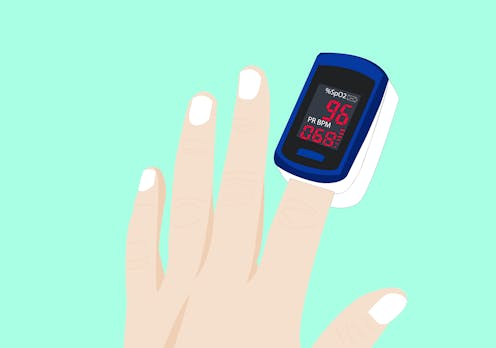
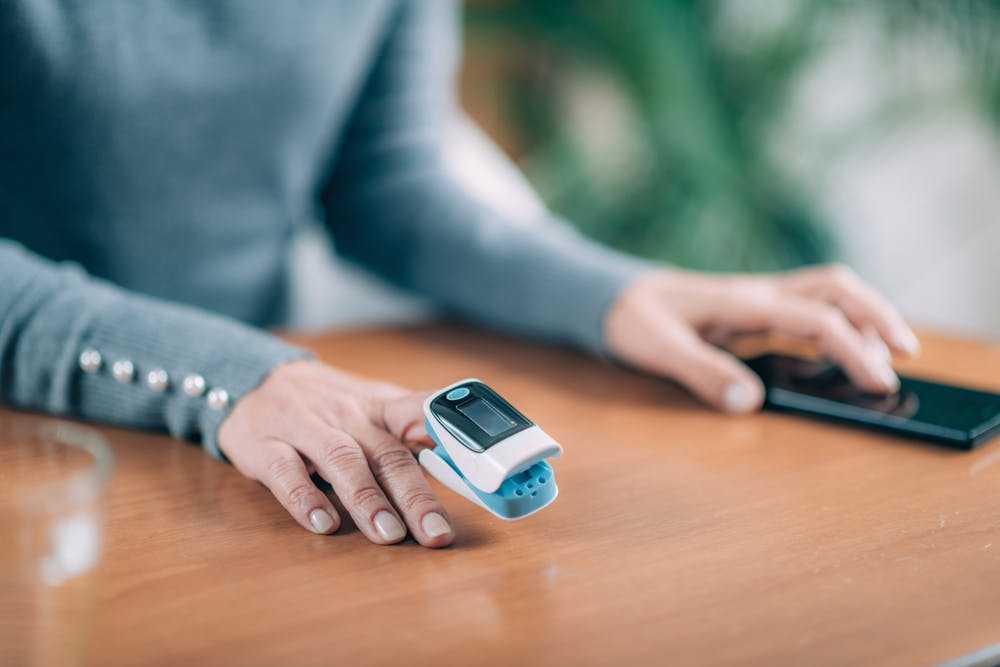
Most types you can buy for use at home are designed like a large clothes peg you clip onto your fingertip.
One side of the clip shines a light through your finger to a sensor on the other side of the clip.
This gives a measure of the colour of your blood. Blood carrying more oxygen (oxygenated blood) is a brighter red than the bluer de-oxygenated blood.
The oximeter interprets the colour of the blood (via the amount of light absorbed) to provide a number – the percentage of oxygen in the blood compared to the maximum amount that can be carried.
This percentage is the “oxygen saturation” level. For healthy people this is 95% to 100%.
As the oximeter measures blood from the pulse in your finger, it will also display your heart rate (heart beats per minute).
Read more: What should my heart rate be and what affects it?
How are people using them now?
Most people with COVID do not need to be in hospital. So services have been set up for some to be monitored by health professionals at home and only come to hospital if they start to become very unwell.
People who do not qualify for this type of hospital-in-the-home type monitoring will still need to monitor their own symptoms at home and seek medical care if needed.
One of the most important early signs of COVID deteriorating is a fall in the level of oxygen in the blood. This happens as the lungs become inflamed and less efficient at absorbing oxygen. This may happen even before the person feels particularly ill.
Read more: I've tested positive to COVID. What should I do now?
Australian guidelines state that when oxygen saturation levels fall to 92%-94% at rest, admission to hospital should be considered.
Whether someone needs to go to hospital also depends on if there are other warning signs such as rapid breathing, older age, not being fully vaccinated, if there are other medical problems, and if someone has limited social supports.
For children, the number is at or below 95%.
If possible you should contact your GP or regular doctor who will advise based on your individual circumstances.
If that’s not possible, you can phone:
Read more: COVID can worsen quickly at home. Here's when to call an ambulance
Are the readings accurate?
Oxygen saturation readings are generally very accurate. However, poor circulation, or cold or moving fingers can make it difficult for the device to find the pulse or may trick the probe into measuring the movement as a pulse.
If you have cold fingers or poor circulation you might have to try another finger, or warm your hands by rubbing them together before retaking a reading. You’ll also need to keep still and reduce your hand movement while taking a measurement. This might be a challenge for taking readings on small children!
Nail polish, particularly dark colours, can cause misleading oximeter readings and is why we ask people to remove it before having a general anaesthetic in hospital.
However, nail polish has less of an effect compared to acrylic nails. So it’s best to remove nail polish or acrylic nails on the fingers you’ll use for testing.
Read more: What are the symptoms of omicron?
What if I have darker skin?
More controversial is the inaccuracy of some pulse oximeters in people with darker skin. Due to software problems, darker skin increases the risk some pulse oximeters over-estimate oxygen levels.
It’s an issue Australia’s Therapeutic Goods Administration (TGA) is concerned about. However, it said it didn’t have the evidence to recommend particular devices.
But with the type of monitoring we are seeing in the community, we consider any discrepancies are not clinically significant. The changes are small and wouldn’t influence the type of care people need to receive. Observing readings over a period of hours or even days can also give a better understanding of the severity of the disease.
So if you have darker skin, you can still use a pulse oximeter at home. In the meantime, manufacturers of pulse oximeters are addressing the software issues.
Read more: More health inequality: Black people are 3 times more likely to experience pulse oximeter errors
So, should I buy one?
If you can afford it, yes. The concern many health professionals have is that, just like rapid antigen tests, oximeters may become difficult to access as numbers of cases in the community accelerate.
Just as most households have a thermometer, a simple low-cost oximeter will allow us all to monitor our health and seek help if things change.
Pulse oximeters are currently available online and from pharmacies from about A$23 but can be over $100. Expect these prices to rise as supplies become limited.
You can use the same one for multiple people in a household, including both adults and children. However, you do need to clean the oximeter before using it on the next person. You can do this with an antiseptic wipe.
Are some types better than others?
It’s best to get a pulse oximeter that has a “waveform” display so it can be timed with your pulse and ensure the oxygen readings are accurate. Look for one with a set of horizontal bars on the display like a phone battery charge indicator. Or you can buy one that displays a waveform (wiggly line to indicate the pulse) on the advert or packaging.
Some smart watches and phones also have an oximeter function. There is emerging evidence some of these devices are accurate enough for home monitoring use. However, the evidence is not strong and they are generally not yet licensed for this use. So if you can get hold of a pulse oximeter, that would be best.
Authors: Stuart Marshall, Associate Professor, Department of Critical Care, The University of Melbourne
Read more https://theconversation.com/whats-a-pulse-oximeter-should-i-buy-one-to-monitor-covid-at-home-174457


 Daily Bulletin


