

Civilians are being killed in Ukraine. So, why is investigating war crimes so difficult?
- Written by: Ben Saul, Professor of International Law, Sydney Centre for International Law, University of Sydney
The prosecutor of the International Criminal Court, Karim Khan, is opening an investigation into whether war crimes may have been committed in Ukraine. He is urgently seeking to preserve evidence as the fighting rages on.
War crimes are serious violations of international humanitarian law, which seeks to regulate the conduct of war and the treatment of civilians and prisoners during war.
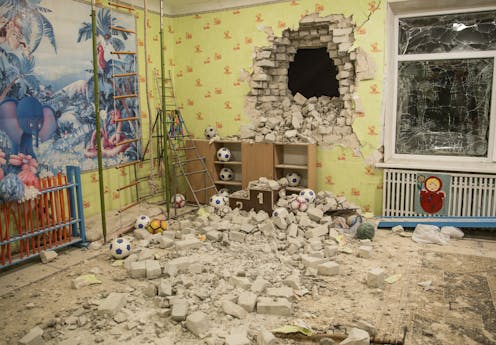
As Russian troops have reached major cities, there have been increasing reports of strikes on civilian objects, such as apartment buildings, schools, kindergartens, hospitals, and oil and electricity facilities.
With the fighting now moving deeper into urban areas – and Russian forces becoming frustrated by Ukrainian resistance – the harm to civilians could become much greater.
Ukraine is not a party to the Rome Statute of the ICC, but it has twice accepted the court’s jurisdiction over any international crimes committed in its territory. This could include offences committed by pro-Russian separatists or Russian or Ukrainian military forces.
It does not matter that Russia is not a member of the court and has not accepted its jurisdiction. But it does mean Russia, like the US, is very unlikely to cooperate with the court.
What is a war crime?
In considering whether war crimes have been committed, the devil is in the legal detail. This is why forensic criminal investigations are so important to uncover the truth and cut through propaganda or the understandable emotion involved in conflicts where civilians are hurt.
International humanitarian law does not absolutely prohibit harm to civilians or their property, and tolerates some collateral damage to civilians.
However, the law is unambiguous when it comes to deliberate attacks on civilians or civilian objects. These are war crimes, unless a civilian object is also being used for military purposes and thus becomes a military target.
Read more: Is international law powerless against Russian aggression in Ukraine? No, but it's complicated
Disproportionate attacks are also war crimes. These are attacks that cause excessive civilian casualties relative to the military advantage of attacking a military target. So, for instance, this could include a missile strike on an apartment building that Russian forces knew would cause significant civilian casualties for little military gain.
International law also prohibits indiscriminate attacks. These could include using certain weapons against military targets in dense urban areas, such as artillery, cluster munitions or thermobaric “vacuum” bombs, whose wide effects also risk hitting civilians.
Russian troops have already been accused of using cluster munitions and vacuum bombs in civilian areas in Ukraine. Both were also used by Russian forces in the devastating Chechen wars in the 1990s.
Other war crimes include killing detainees, torture, hostage taking, illegal detention and wanton property destruction.
It is also a war crime to kill or injure anyone when dressed in the military uniform of the other side (such as possible Russian saboteurs wearing Ukrainian uniforms), or when dressed as a civilian without any military insignia (this could potentially include Ukrainian civilians who throw Molotov cocktails).
Crimes likely to have occurred
This is not the first time the ICC has looked into alleged crimes in Ukraine. A preliminary examination by Khan’s predecessor, Fatou Bensouda, in 2020 found “a reasonable basis to believe” war crimes and crimes against humanity had been committed in eastern Ukraine and Crimea since 2014.
Bensouda did not indicate who was responsible, though much of the conduct is likely to have been committed by Russian forces (in Crimea) and pro-Russian separatists (in eastern Ukraine).
The prosecutor’s office had not yet sought permission from judges to open a full-scale investigation. But Khan has now confirmed those findings and wants to launch such a formal investigation, expanded to include the current conflict.
In Crimea, the allegations include everything from wilful killing and torture to the conscription of Ukrainian civilians into the Russian army and forced transfer of civilian prisoners from occupied territory.
In eastern Ukraine, the alleged war crimes include murder, torture, rape and launching attacks causing disproportionate civilian casualties.
Khan is satisfied these alleged crimes are grave enough to justify ICC prosecution, and that Ukraine and Russia are either unable or unwilling to investigate themselves. Ukraine cannot take suspects into custody in areas it does not control, while Russia is uninterested in prosecuting anyone.
However, the ICC does not have jurisdiction over the international crime of aggression – that is, to prosecute Russia’s unlawful attack on Ukraine.
Ukraine has made a claim with the International Court of Justice that Russia is invading on the pretext of stopping genocide by Ukraine, but this is a speculative gambit. And the ICJ does not have jurisdiction to directly hear any claim that Russia is committing aggression.
Challenges make prosecutions unlikely
The ICC investigation sends an important signal to Russia that impunity for international crimes will not be tolerated. It contrasts with the court’s position on Afghanistan, where the investigation into alleged war crimes by the US and other foreign forces was controversially “deprioritised” last year.
But significant hurdles still remain. Once a formal investigation is launched, it will take many years to progress. This is due to the difficulty of obtaining and preserving evidence (both physical and digital) in the middle of live combat and a rife propaganda war. Russia will also be uncooperative.
Even then, realistically, it is unlikely many prosecutions will happen – if any at all. For one, establishing which Russian military or political leaders are responsible for specific crimes will be complex and difficult. Then, arresting them in Russian-occupied territory, or obtaining their extradition from Russia, will be virtually impossible. The ICC has only convicted 10 people in two decades, despite the prevalence of international crimes in many conflicts.
At most, anyone ultimately indicted may think twice about travelling outside Russia or occupied Ukraine, as they could be arrested in 123 countries that are members of the court.
There is also the possibility Putin’s regime will eventually fall and a new Russian government may be more open to seeking justice for its past. Collecting and preserving evidence is therefore essential for any future accountability efforts.
Having failed to prevent the conflict, the least the international community can do now is better resource the prosecutor’s office to undertake its important investigations, and share relevant evidence and intelligence.
Authors: Ben Saul, Professor of International Law, Sydney Centre for International Law, University of Sydney


 Daily Bulletin


