

Remembering the past, looking to the future: how the war in Ukraine is changing Europe
- Written by: Matt Fitzpatrick, Professor in International History, Flinders University
Both sides in this war have plundered history. Vladimir Putin claims to be replaying the second world war by “denazifying” Ukraine, while his forces desecrate the Holocaust site of Babyn Yar.
Putin’s opponents have their own analogies. Putin is variously Hitler, Stalin or Tsar Peter the Great.
On social media, memes mine the medieval period to remind the West that when Kyiv was a flourishing metropolis in the 11th century, Moscow was still a wilderness.
Historians are uninterested in these debates. They know both sides can produce maps and histories to “verify” their claims. These need not shape present realities. As the Kenyan representative to the UN said about the African situation, where colonial era borders continue to chafe:
Rather than form nations that looked ever backwards into history with a dangerous nostalgia, we chose to look forward to a greatness none of our many nations and peoples had ever known.
Instead, historians are looking at the rapidly shifting present. They realise history is being made, not replayed in Ukraine. In the process, it is changing the face of Europe.
Germany changes course
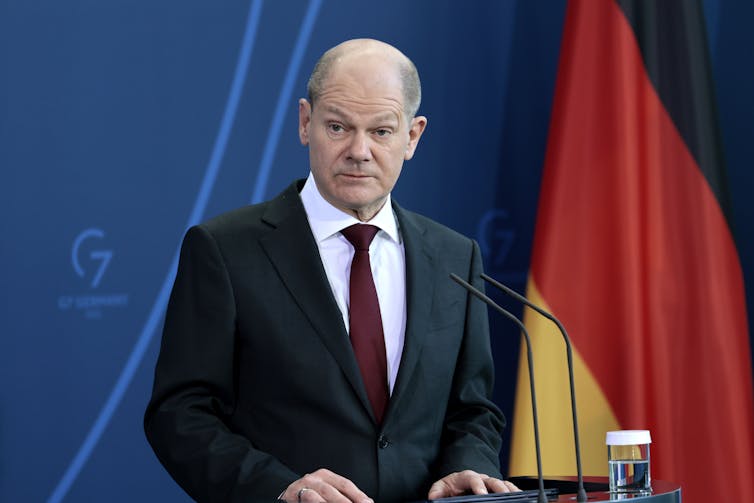
In the space of one week, some of the old certainties about Europe have been thrown out the window. Most spectacularly, Germany, whose Nazi past has seen it avoid becoming a significant military power, has now committed itself to dramatically increasing its military spending. An initial injection of €100billion (A$153billion) will be followed by a guaranteed sum of at least 2% of GDP to be spent in each budget.
In contravention of its standing policy prohibiting the sale of armaments to war zones, German Chancellor Olaf Scholz has announced his country will join the rest of Europe in providing weapons to the Ukrainians. German troops are now heading for Lithuania and Slovakia, while air and sea deployments have been made to Romania, the Baltic and the Mediterranean.
On top of this, Germany’s Merkel-era approach to energy security, which had until days ago rested on the promise of plentiful Russian gas, has been scuttled.
Read more: What can the West do to help Ukraine? It can start by countering Putin's information strategy
The rush to NATO
Elsewhere, NATO has also rushed eastward, and the Baltic states of Latvia, Lithuania and Estonia have become a hastily agreed-upon forward post for NATO troops.
Having been firmly against joining NATO for decades, public opinion in Finland has suddenly shifted, with a citizen petition forcing a parliamentary debate on the issue. Alongside the Finns, non-NATO Sweden has been granted special access to NATO intelligence to help co-ordinate European responses to the war.
Now scotched rumours had even abounded that Poland, Slovakia and Bulgaria were to donate their fighter planes to Ukrainian fighter pilots, stretching the line between military aid and active participation.
Even Switzerland, whose neutrality has lasted since the Napoleonic Wars, has suddenly joined the EU’s economic sanctions targeting Russian banks and assets.
Europe’s southeast moves too
Other European states are also altering their political course. Bosnia is mulling over a bid to formally join NATO, while Kosovo is making a pitch to secure a permanent US base on its territory.
Both of these moves would have been viewed as unthinkable provocations to Russia a week ago, and would still represent risky options for NATO. But, with NATO declaring Europe stands at the dawn of a “new normal”, such earlier taboos are giving way to a desire for “more support to countries like Georgia, Moldova, and Bosnia and Herzegovina”.
Meanwhile, French troops have been sent into Romania as part of Europe’s “strategic solidarity” with Ukraine’s neighbours.
Events have swept aside the earlier careful discussions about the consequences of NATO enlargement in Eastern Europe.
In the southeast, Turkey’s President Recep Tayyip Erdogan, who has tried to walk a middle road between Russia and NATO, has also succumbed to the pressure of his NATO allies and activated the 1939 Montreux Convention. This effectively closes the Turkish Straits to warships, significantly hampering Russia’s ability to move more ships from the Mediterranean into the Black Sea and on to Crimea and Odessa in southern Ukraine.
Not everything is different
While it appeared Poland and Hungary, along with Bulgaria, Romania and Moldova, had reversed their notoriously anti-refugee policy by opening their eastern borders, it has since emerged these openings are still along racial lines. This means the borders are easily traversed by European Ukrainians, but are still very real barriers to the Arab, Asian and African refugees forced to flee their work and studies in Ukraine.
Some alliances with Moscow have remained firm. The story of Belarus President Alexander Lukashenko is well-known. His fate has been publicly tied to Russia since massive protests broke out after a fraudulent election destabilised his grip on power. He has used the conflict to increase his grip on power through a dubious referendum.
Less well understood outside the Balkans, however, is the position of Serbia’s President Aleksandar Vucic, who has declared his qualified support for Putin, so as to keep Russian support for Serbian objectives in Kosovo and Bosnia. “Serbia respects the norms of international law,” he has declared, “but Serbia also understands its own interests.”
Forgotten histories
Contrary to some reporting, this is not the first major war in Europe since the second world war. The Balkans spent much of the 1990s engulfed in a war that saw the disintegration of Yugoslavia, horrific ethnic cleansing, Serbian genocide, the NATO bombing of Belgrade and the ongoing garrisoning of Kosovo. Indeed, Putin has never forgotten NATO’s actions in the Balkans.
So too, the military conflict between Russian and Ukraine, ongoing since 2014, was preceded by the Russian-Georgian War of 2008.
Elsewhere, Iraqis have pointed out that Russia’s attack on Ukraine echoes the 2003 US invasion of Iraq, an invasion that also brought into question the robustness of international law.
However, historians are aware these past wars in Europe and beyond did not trigger the kind of rapid and united European action being seen now. Nor did they lead to the threat of nuclear conflict that has re-emerged as Europe walks the tightrope between military aid and becoming an active belligerent that could trigger the kind of nuclear consequences threatened by Putin. This nuclear dilemma was not one faced in the times of Hitler, Stalin or the tsars.
Authors: Matt Fitzpatrick, Professor in International History, Flinders University


 Daily Bulletin


