

3 ways Russia has shown military ‘incompetence’ during its invasion of Ukraine
- Written by: James Dwyer, Associate Lecturer and PhD Candidate, School of Social Sciences, University of Tasmania
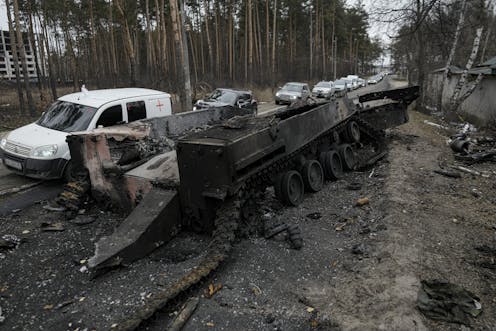
Two weeks into Russia’s invasion of Ukraine, it has become apparent Russia’s military is experiencing failures – both technical and strategic – that are perhaps unexpected from one of the world’s largest military forces.
There are multiple issues one could look at in relation to Russia’s poor military performance in Ukraine to date, such as being unable to effectively counter Ukrainian drones, or failing to deliver on the kind of cyber warfare expected.
But failings in three specific categories warrant a closer look.
Organisational failures
The first issue that became quickly apparent was the poor performance of Russia’s armed forces. There has been, at times, a complete lack of logistical support for Russia’s forces on the front lines – bogging down the Russian advance and at times completely stalling it.
There have been numerous reports of Russian tanks and armoured personnel carriers running out of fuel, leading Russian soldiers to request, commandeer and steal diesel to continue progress.
Russian soldiers, many of them conscripts, have been forced to forage for food, with reports of soldiers being forced to steal chickens, and special forces soldiers breaking into shops to loot food.
Rations provided to Russia’s troops have reportedly only been sufficient for a few days, and video has emerged claiming some rations seven years out of date.
Russia had a significant amount of time to prepare its invasion and move logistical support into place, with months of open buildup. But scenes of enormous, stalled convoys being unable to progress speak volumes to Russia’s astonishing mismanagement.
This series of logistical failures are as embarrassing for Russia as they are beneficial for Ukraine.
There have also been extraordinary communication failures, both between military units, and to soldiers prior to the conflict. Reports emerged following the initial stages of the invasion, revealing many Russian soldiers were completely unaware they were invading.
Rather, captured Russian soldiers claim they were under the impression it was a military exercise, up until the moment they came under fire from Ukrainian units.
Many Russian communications have also been transmitted over unencrypted mediums. Russian bombers transmitting over open high-frequency radio have had their conversations listened in on by amateur radio enthusiasts.
Even communication between Russian units on the ground are being transmitted in the open, leading to easy interception by Ukraine. Overall, this paints a clear picture of Russian incompetence.
To top it all off, the lack of morale (with many Russian soldiers surrendering or abandoning vehicles and equipment) has only exacerbated the effects of Russia’s poor military performance.
Read more: Ukraine: the world's defence giants are quietly making billions from the war
Lack of air superiority
One of Russia’s most significant failures, and potentially the most damaging to its campaign, has been its inability to achieve air superiority.
In military terms, this refers to a state having a sufficient degree of dominance to conduct aerial operations (such as close air support or air strikes) without significant interference from opposing forces and air defence systems.
Before the invasion began, it was widely anticipated Russia would quickly achieve air superiority. This is because on paper Russia’s air force is vastly superior to Ukraine’s.
Prior to the invasion, Ukraine possessed Europe’s seventh-largest air force. While this sounds potent – and in relative terms, it is – it amounts to some 200 aircraft of all types (fighters, close air support, helicopters, transport aircraft and others). In comparison, Russia possesses about 1,500 combat aircraft alone.
The backbone of Ukraine’s air force are older Soviet era fighters, namely 50 MiG-29s and 32 Su-27s. Meanwhile, Russia employs modern versions of Soviet aircraft, such as the Su-30, Su-33 and Su-35 (updated variants of the Su-27 Ukraine operates).
Russia also has modern strike aircraft such as the Su-34 (another update on the Su-27, optimised for strike operations) as well as long-range strategic bombers like the Tu-22, Tu-95 and Tu-160.
However, images have emerged suggesting Russia’s strike aircraft are reliant on generic, consumer-grade GPS units. If this is true, it only reinforces Russia’s lack of capability.
Just prior to the war, US Intelligence anticipated an invasion would commence with a blistering assault by Russia on Ukraine’s air power.
Yet two weeks into the conflict, Ukraine still reportedly possesses the bulk of its air and missile defences. This has raised questions about why Russia did not make full use of its air power. Is it holding back in case the conflict broadens?
Regardless of the reason, Russia’s lack of air superiority early in the conflict may be one of its most significant strategic errors, to the benefit of Ukrainian defenders.
Russian aircraft are struggling to provide the support needed by Russian ground forces, giving Ukrainian forces an opening to counter Russia’s advance.
Weapons performance and failures
Russia’s high-tech offensive capabilities have also demonstrated lacklustre performance.
The initial stages of the invasion included a strategic bombardment of Ukrainian targets using cruise missiles and Iskander short-range ballistic missiles.
Reports indicate that as of March 1, Russia had fired as many as 320 missiles, the majority being Iskander short-range ballistic missiles – making this the largest and most intense short-range ballistic missile bombardment between two states.
The Iskander is estimated to have a range of 500km and an accuracy of 2-5 metres. Prior to the invasion, it was expected to be an effective and devastating weapon system. Intriguingly, its performance has been lacking.
For example, Iskanders were used to attack Ukrainian air bases, to destroy runways and prevent Ukraine’s air force from operating effectively. But as can be seen below, the previously vaunted accuracy of the Iskander appears far less impressive than what was anticipated.
As the conflict has progressed, Russia has made more frequent use of lower-tech weapons systems, such as unguided “dumb” bombs and cluster munitions. This might indicate Russia has either expended its limited number of high-tech weaponry, or is holding back reserves in case the conflict escalates.
The Ukrainian air force remains in the fight, despite all odds. Russia will no doubt learn from its issues and attempt to correct. Unfortunately, it does still have the advantage with numbers, in terms of both troops and equipment.
However, it’s likely the conflict can’t be sustained for long on Russia’s part, particularly with the impact sanctions are having on the Russian economy. For Ukraine, the delays caused by Russia’s errors may well lead to better outcomes.
Read more: How do anti-tank missiles work – and how helpful might they be for Ukraine's soldiers?
Authors: James Dwyer, Associate Lecturer and PhD Candidate, School of Social Sciences, University of Tasmania


 Daily Bulletin


