

How much do mainstream media matter in an election campaign? (Spoiler: more than you might think)
- Written by: Denis Muller, Senior Research Fellow, Centre for Advancing Journalism, The University of Melbourne
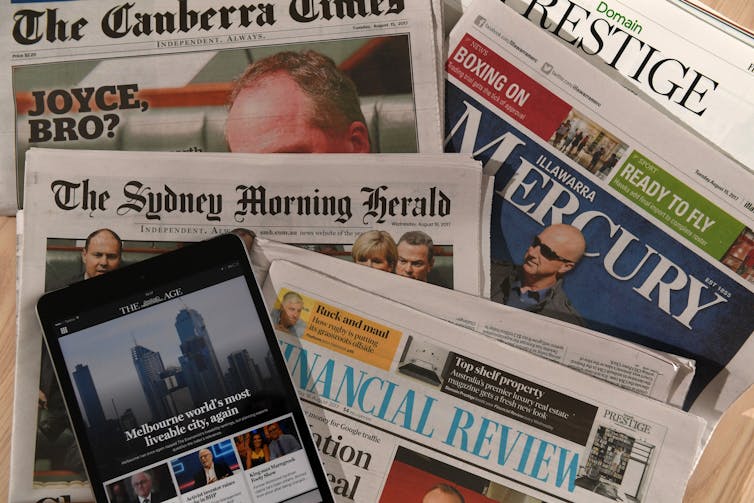
Despite the seismic changes that have convulsed media communications and journalism since the turn of the millennium, the mainstream media remains a formidably relevant force, including at election time.
Data on where people get their news make this clear. In 2021, about 61% of Australians accessed television news in an average week, and 47% used online news platforms.
These are dominated by the established media organisations. The top ten digital news titles over the 12 months to December 2021 were all mainstream media.
At the top was news.com.au, followed by the ABC, nine.com.au, The Sydney Morning Herald and 7News. All except the Daily Mail (which lost ground heavily) showed year-on-year growth.
While just 20% of people used print-based media, reflecting the decline of newspapers since the digital revolution really got going in 2006, the data from Roy Morgan Research indicate the slide might be slowing, at least in some markets.
The data are preliminary, but they show a quite remarkable 10.4% growth in The Australian’s print audience, growth of 8.2% in the Daily Telegraph’s and 3.1% in The Sydney Morning Herald’s.
There was growth too in the print audiences of the Courier-Mail in Brisbane (2.3%), the West Australian (5.5%) and the Adelaide Advertiser (0.4%).
Notably, however, the print audiences of the two main Melbourne papers, The Age and the Herald Sun, continued to decline, The Age’s by 1.3% and the Herald Sun’s by 1.9%.
Read more: Outrage, polls and bias: 2019 federal election showed Australian media need better regulation
A striking feature of these figures is the growth in audiences of the News Corporation newspapers across the country, except in Melbourne.
This raises interesting questions about the kind of news Australians seem to want.
News Corporation makes no bones about using its news reporting to push its own agendas. Its internal code of conduct states:
Comment, conjecture and opinion are acceptable in reports to provide perspective on an issue, or explain the significance of an issue, or to allow readers to recognise what the publication’s standpoint is on the matter being reported.
So much for impartiality in news reporting and for separating news from opinion – principles that are explicitly required by the codes of The Sydney Morning Herald, The Age and The Australian Financial Review, by the editorial policies of the ABC, and by The Guardian, whose magisterial former owner-editor C. P. Scott’s enduring dictum was, “Comment is free but facts are sacred”.
For decades, surveys have shown Australian media consumers prize impartiality in news reporting very highly, rating it second only to accuracy as the attribute they value most in news content.
A report for the Australian Communications and Media Authority in 2020 cited a Morgan survey from 2018 showing the attributes people considered most important when deciding which news media to trust. The top two were accuracy in reporting (93%) and impartiality (90%).
So is this changing?
Is it possible people’s extensive exposure to social media and their use of it as a source of news is altering their taste in news and their assessment of which attributes matter?
After all, at 52%, social media is now the second most accessed source of news for Australians, not far behind the 61% for television.
Or could it be that in an age of intense political polarisation, people prefer news that promotes the perspectives of their tribe at the expense of impartiality?
Social media news content, much of which comes nowhere near meeting journalistic standards of impartiality, unquestionably provides this, creating the well-established phenomena of filter bubbles and echo chambers.
At the same time, the feedstock for social media news content is to a significant extent drawn from the mainstream media. This is especially so in an election campaign, where the media “pack” travelling with each of the main parties’ leaders is comprised of mainstream media - it is they who are given the accreditation and direct access to the leaders.
Social media takes this raw material and gives it various treatments – memes, altered contexts and distortions of multiple kinds – to entertain, enrage or mobilise.
In this way, mainstream news influences what goes on in social media, adding to mainstream media’s reach and relevance yet along the way commonly losing the attributes of accuracy and impartiality that people say they value.
Contradictions abound.
People say they base their trust in media on whether the reporting is accurate and impartial. Trust in mainstream media remains higher than trust in social media as a source of news, yet social media has grown in importance as a source of news while mainstream media, especially newspapers, has been declining.
It would be a heavy irony indeed if a recovery in the audience reach of mainstream media was driven by their aping social media, abandoning the impartiality that people say is a cornerstone of their trust.
Not just an irony, but a disaster for democracy.
For one thing, democracy depends on voters having a bedrock of reliable, accurate and impartial information on which to base political, social and economic choices. A focus on gaffes and political theatre, of the kind we have seen in this campaign so far, does not deliver that.
For another, highly partisan news media help drive the polarisation that is undermining the democratic consensus, the consequences of which were shown by the assault on the Capitol in Washington on January 6 2021.
Yet the audience growth of the News Corp newspapers, as indicated in the Morgan data, shows that abandoning impartiality in news reporting might be a successful corporate business strategy.
It might also be a successful corporate political strategy as its mastheads barrack hard for a return of the Morrison government.
Mainstream media is certainly not dead as a force in elections and the form its journalism is taking, with its impact on Australia’s democratic processes, are large and important questions for the country’s future.
Authors: Denis Muller, Senior Research Fellow, Centre for Advancing Journalism, The University of Melbourne
&media=https://www.dailybulletin.com.au/https://images.theconversation.com/files/458507/original/file-20220419-12683-yclruz.jpg?ixlib=rb-1.1.0&q=45&auto=format&w=754&fit=clip&description=How%20much%20do%20mainstream%20media%20matter%20in%20an%20election%20campaign?%20(Spoiler:%20more%20than%20you%20might%20think) "Pin It")

 Daily Bulletin


