

Ukraine refugees need urgent, ongoing health care. We've worked in refugee camps and there's a right way to do it
- Written by: Darryl Stellmach, Lecturer in Emergency Management, University of Tasmania
The war in Ukraine puts the plight of refugees and displaced people back in the headlines. From February 24, more than 5 million people have crossed Ukraine’s borders. A further 7.7 million are estimated to have been been displaced internally.
Sadly, these are only the most recent additions to the flow of refugees, displaced people and other forced migrants globally in 2022. Many will have had limited access to health care, safe drinking water or nutritious food.
Over the past 25 years, we have worked to deliver essential health care in wartime, natural disasters and epidemics. We have been on the ground in situations of forced displacement in Darfur, Myanmar, Thailand, Uganda, Afghanistan, Syria, South Sudan and Colombia. Survivors have taught us about their experiences, abilities and needs.
As humanitarian workers and health researchers, we can draw lessons from past events on what works, and what doesn’t, when dealing with mass displacements and forced migration.
Labels don’t matter to us
States may classify individuals fleeing war as refugees, internally displaced persons, or something else. However, these distinctions are largely irrelevant to humanitarian workers.
The medical imperative is to treat the person based on need, regardless of legal or social status. This tenet of medical ethics is doubly important in wartime.
Humanitarian medics are protected by international law, but in turn must practice strict neutrality.
What health issues do forced migrants face?
Like any population, forced migrants are a diverse group with equally diverse health needs. Health interventions in situations of mass displacement are only effective if designed and implemented to meet individual context, informed by understanding of patients’ lives within their community and culture.
In “classic” refugee emergencies after the second world war, infectious disease and under-nutrition were major killers. So humanitarian agencies specialise in interventions that most impact these: basic health care, routine immunisation, nutrition, shelter, water, sanitation and hygiene.
Humanitarian agencies learned in more recent conflicts, such as in Syria, to offer a wider array of health services.
Read more: Australia's resettlement of Syrian refugees is tinged with déjà vu
Syria had a middle-income economy. Pre-war, its health-care system offered complex treatments for chronic and non-communicable diseases.
As a result, patient demographics and disease profiles were different. Humanitarian medics were faced with dilemmas not previously encountered – for example, ensuring insulin supply during conflicts. We can expect a similar dynamic in Ukraine.
John F. Ryan, from the European Commission’s health policy body DG SANTE, said:
In a crisis of this kind, many people think of casualties and injuries, but they do not necessarily think of the problem of cancer patients, people with diabetes, people with HIV, people suffering from COVID.
Many Ukrainians on the move will have left behind complex care for conditions such as cancer, diabetes, heart or kidney disease. At some point on their journey – better sooner than later – those therapies will need to be resumed.
Read more: Ukraine: war has an impact on people's health beyond bullets and bombs
Evacuation is often a last resort
This highlights an important point: evacuation is often a last resort. Very few people willingly abandon home. The most effective health intervention is the one that prevents the need for displacement in the first place.
Using the levers of society and politics to address the root causes of conflict and displacement is more impactful than medically treating its after-effects. Humanitarian health-care providers have just as much a responsibility to advocate for this as providing care.
While preventing or ceasing war is the most effective health intervention, in Ukraine and more than a dozen other current conflicts around the globe this seems unlikely in the short term.
Read more: Ukrainian refugees might not return home, even long after the war eventually ends
What needs to happen next
When affected populations can’t return, the next best option is rapid integration in a host community. This means new arrivals can access the same, or very similar, health care, education and employment opportunities as members of the host community.
Integration offers better health and social outcomes for people who have been forced to displace. It may equip people to return home after the conflict ends. When done well, integration provides short- and long-term benefits to the host country through entrepreneurship and the influx of skilled and unskilled essential workers.
Even rapid integration takes time, however, particularly if host countries frustrate entry and access to essential services such as health care, accommodation or employment. As a result, many fleeing conflict will be forced to spend time in a camp or similar accommodation. Some face barriers and never integrate, returning to their home countries when they are able.
Refugee camps
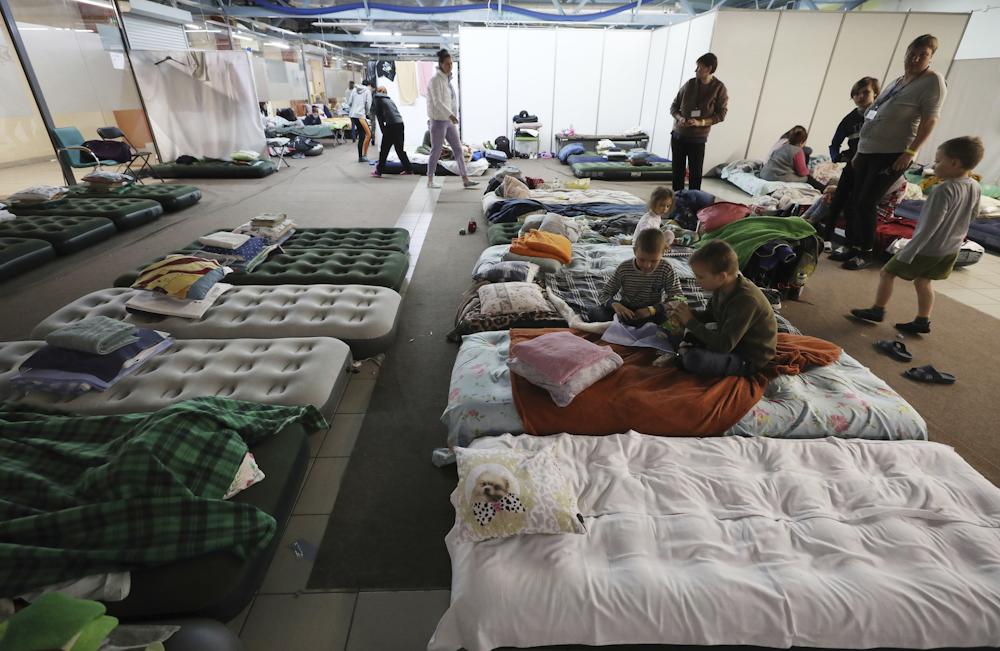
The camp is perhaps the image that most comes to mind when hearing the word “refugee”. Refugee camps provide for the basic needs of thousands in the wake of conflict and displacement.
Although they enable the delivery of basic services at scale, camps are often crowded and provide limited opportunities for education or employment. They also take a toll on people’s physical and mental health.
Camps should be a temporary solution: transit accommodation to facilitate movement to more stable arrangements. So, ideally, camps should permit freedom of movement, allowing people to seek outside employment, health care or government paperwork. Yet, at times, camps are effectively places of detention.
Read more: How do you self-isolate in a refugee camp?
Forced detention is the worst option
Forced detention is, from a humanitarian practitioner’s perspective and that of medical ethics, the worst option for displaced people.
Extended immigration detention is widely practiced around the world. There is also evidence some non-white refugees fleeing Ukraine have been placed into forced detention.
Read more: Ukraine refugee crisis exposes racism and contradictions in the definition of human
While any journey of displacement is harmful to health, there is abundant evidence forced detention actively compounds harm. In addition to proven damage to physical and mental health, forced detention limits capacity to provide effective health care. Detention settings, by their nature, are difficult to access, so medical care can only be practiced under constrained conditions.
Read more: Death in offshore detention: predictable and preventable
There are enormous challenges ahead
Responders and policymakers have evidence and effective tools to address Ukrainians’ health, but there are immense challenges.
Some issues, such as gender-based violence or childhood trauma, are particularly acute in wartime.
Other challenges are novel, for example, the spectre of a radiation event in a wartime humanitarian setting.
Ultimately, no medical intervention – nothing humanitarian health workers can do – is as beneficial for displaced people’s health as preventing the conditions that led to them leave their homes in the first place. So conflict prevention and reduction should be policymakers’ and citizens’ focus.
Authors: Darryl Stellmach, Lecturer in Emergency Management, University of Tasmania


 Daily Bulletin


