

Alcohol marketing has crossed borders and entered the metaverse – how do we regulate the new digital risk?
- Written by: Sally Casswell, Professor of public health policy, Massey University
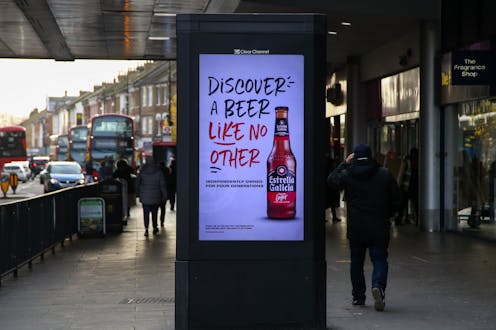
The World Health Organization’s newly released report on regulating cross-border alcohol marketing raises the alarm for countries like Australia and New Zealand, given their light touch towards alcohol advertising.
Alcohol is widely consumed in Australasia but there is ongoing tension over how much restraint, if any, should be placed on the marketing of these products.
Australia and New Zealand are at the unrestrained end of the marketing continuum. Both countries rely on industry-led policy in the form of voluntary codes – an approach identified as insufficient by the WHO report.
What is cross-border alcohol marketing?
Alcohol marketing, created and disseminated in one country and spread across borders into others, is commonly used by multinational corporations striving to increase sales and normalise alcohol as an everyday product. Much of this advertising is taking place in the digital media sphere.
The increased use of these media platforms by alcohol corporations allows them access to cheap advertising opportunities. For as little as US$2, an advertising campaign based in Australia could reach a thousand young people profiled as interested in alcohol, for example.
Marketing across digital media has also increased the impact of those messages.
Brands interact with users on social media platforms, encouraging the posting, sharing and liking of branded images and messages. Higher user engagement is associated with more drinking.
Targeting the individual
The increased power of these advertisements reflects the effectiveness of “personalised marketing”. Companies can now target individuals and “look alike” audiences.
This approach is made possible thanks to the enormous amount of data collected as we interact together, purchase products and indicate our interests and passions through our clicks and likes.
This data is extremely valuable to marketers and alcohol corporations. It gives them insight into the best time of day, the best brand of alcohol and the best type of marketing message to send our way.
Read more: Alcohol advertising has no place on our kids' screens
All groups across society are vulnerable to being bombarded by messages encouraging the purchase and consumption of alcohol.
Digital advertising can target everyone: teenagers looking for brands which exemplify their identity; young adults, the heaviest “occasion drinkers” in Australia and New Zealand, some of whom are developing drinking habits that may be hard to change in later life; and adults of all ages who wish to reduce their consumption, often for health reasons.
Digital media has become an all-encompassing marketing environment in which the “buy” button – with home delivery and often no checks on age or intoxication – provides a seamless marketing and distribution system.
In New Zealand, online sales increased significantly during the COVID-19 lockdowns, particularly among heavier drinkers.
Entering the metaverse
The alcohol industry is now showing its initiative by entering the emerging metaverse. To understand the metaverse, according to one commentator, you should
take today’s social media, add a splash of sophisticated 3D, fold in a plethora of options for entertainment and gaming, garnish it all with data-driven personalisation, and you are all set to take away your order of a supersized social media network, the metaverse.
In terms of marketing, this provides a new opportunity. The biometric data essential to a virtual reality experience is also available to develop “biometric psychographics”, allowing for the even greater personalisation of advertising.
Virtual alcohol brands created and used by avatars in the metaverse support the development of brand allegiance in real life, and virtual reality will transform e-commerce experiences and increase the power of sponsorship.
AB InBev, the largest global alcohol corporation, was an early adopter of the metaverse. One of its brands, Stella Artois, is sponsoring the Australian Zed Run platform on which virtual horses can be raced, bred and traded. The Zed Run platform experienced 1,000% growth in early 2021.
Regulating to reduce alcohol harm
The digital world is extremely dynamic. It is also opaque to most policy makers and public health practitioners. It is telling that there is no reference to the metaverse as a cross-border alcohol marketing opportunity in the WHO report.
There is an urgent need for debate regarding how policy makers should better understand the risks involved with the targeted marketing of hazardous products such as alcohol.
The WHO report outlines various partial and unsuccessful approaches to regulating marketing in the digital media.
Attempts, such as Finland’s regulation of user-shared branded material, have failed because they did not interfere with the basic architecture of the social media platforms, which is predicated on engagement via sharing and liking.
The most successful examples offered by the WHO report have been countries like Norway, which have imposed a complete ban on alcohol marketing including in the digital media.
Read more: Children's health hit for six as industry fails to regulate alcohol ads
The report emphasises the need for surveillance and enforcement, suggesting ways in which alcohol companies could be penalised for marketing breaches.
The support provided by international agreements such as the Framework Convention on Tobacco Control is identified as a possible template for future discussions.
The response to tobacco marketing provides a good and largely effective model for officials and policy makers. That said, the public health goal for alcohol is not equivalent to the smokefree goal. Advocates are not trying to eliminate alcohol altogether.
However, there are parallel arguments in favour of creating a healthier media environment through regulation to prevent the promotion of alcohol products via increasingly sophisticated technological and psychological tools.
These products are significant causes of reduced well-being, and this marketing increases consumption and therefore harm. The messages of the WHO report are timely and should be heeded.
Authors: Sally Casswell, Professor of public health policy, Massey University


 Daily Bulletin


