

'It's almost like a second home': why students want schools to do more about mental health
- Written by: Christine Grové, Fulbright Scholar and Adjunct Senior Lecturer, School of Educational Psychology & Counselling, Monash University
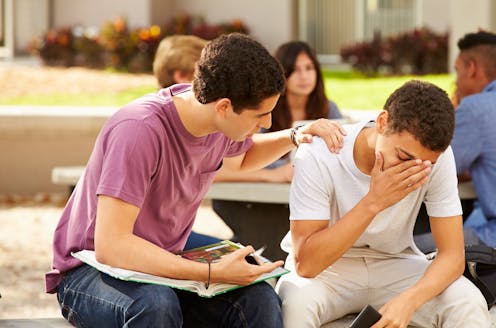
Psychological distress is on the rise among young people in Australia. The implications of COVID-19 and the strain on the training and availability of psychologists are likely to add to the mental health challenges and hinder young people’s ability to get help.
Social isolation, loneliness and uncertainty due to COVID-19 have contributed to a decline in the mental health of Australian youth. Young people in our research and other studies do not feel well equipped to manage their mental health. This is concerning as the onset of mental illness peaks at 14.5 years of age, and about one in seven Australian youth experience mental illness.
Currently, schools address mental health and well-being through a social and emotional learning curriculum. Some have school counsellors or psychologists to offer students individual or group support.
However, research shows more than a third of young people with mental health problems do not seek professional help. This is due to limited mental health knowledge and awareness of how to seek help, and negative attitudes towards mental illness.
There is a need to address youth mental health through preventive approaches such as mental health literacy programs. Mental health literacy is the knowledge and awareness of mental health, help-seeking options and positive mental health behaviours. Mental health literacy programs aim to increase skills to achieve and maintain good mental health.
Schools are one setting to base such programs. Young people spend much of their childhood and adolescence in school where the environment is already geared towards supporting learning and development.
Young people need to be included in the development of these programs. Neglecting their voice in research leads to a risk of misinterpreting their needs and misguided approaches.
We used online group discussions as a forum for young people to give their perspective on current mental health education in the curriculum and whether it’s meeting their mental health literacy needs. Thirteen young Australians took part in these discussions in 2021.
What did the students tell us?
Our study participants expressed concern that they do not receive enough information about mental health in school. They also find it difficult to identify appropriate help sources. They told us:
“I haven’t been happy with […] how little they talk about mental health.”
“They don’t really talk about how you can help other people deal with it [mental health], so, like, then it […] is harder to help your friends.”
Informal sources of help such as family, friends and the internet were the most common avenues for seeking help. Young people were less likely to go to formal sources such as a mental health professional or general practitioner.
Young people are not confident about supporting a friend who may be experiencing mental health challenges for fear of crossing a boundary or saying the wrong thing.
Stigma is still a big problem
Stigma and negative attitudes towards mental illness exist despite many mental health initiatives and campaigns to normalise mental health challenges.
Young people described mental health as a “hush-hush topic”, with language relating to the issue often framed negatively.
A lack of mental health knowledge was seen as contributing to stigma. As one young person said:
“When people don’t understand something […] they become afraid of it.”
The youth in our study suggested discussing mental health in schools and normalising mental health difficulties can reduce this stigma.
Though mental health can be a sensitive topic, young people believe it is important to understand and learn about it at school with others that are experts on mental health.
Schools are the right place to learn about mental health
Young people want schools to teach them how to recognise mental health challenges and practical coping strategies. They observed that discussions of mental health in school are often in response to crises or a stressful time such as exams. These discussions are usually rushed and not comprehensive.
There is a need to proactively talk about mental health with students throughout their schooling. This will build their mental health literacy, as one young person told us:
“If you’re equipped with everything you need to know prior to that experience [mental health issues] you could better tackle that and you could better bounce back from that difficult time in the future if you’re equipped with the knowledge of how to overcome that issue.”
Youth want to learn about mental health at all year levels. Some felt frustrated that they didn’t learnt appropriate coping skills before entering secondary school.
Students see schools as a safe place for supporting their mental health, suggesting schools have an obligation to provide a holistic education that includes mental health.
“It’s [school] almost like a second home, and within that second home mental health needs to be the safe discussion topic.”
Read more: Youth anxiety and depression are at record levels. Mental health hubs could be the answer
Good education includes mental health literacy
From the perspectives of the young people in our study, more needs to be done in schools to improve mental health literacy.
There is evidence that preventive mental health approaches are effective. School-based mental health literacy programs are one way to overcome the lack of mental health education in Australia.Schools exist to support the learning and development of young people, which should include fostering good mental health and increasing mental health literacy.
Authors: Christine Grové, Fulbright Scholar and Adjunct Senior Lecturer, School of Educational Psychology & Counselling, Monash University


 Daily Bulletin


