

Emergency departments are clogged and patients are waiting for hours or giving up. What's going on?
- Written by: Robyn Clay-Williams, Associate Professor, Macquarie University
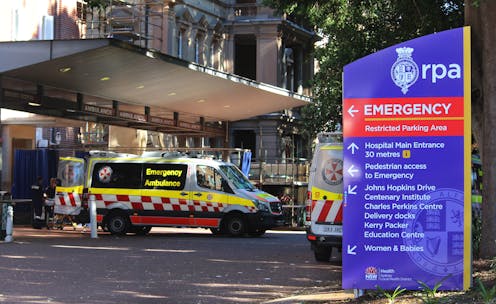
Around 25,000 people visit hospital emergency departments across Australia every day. Many of them are reporting waiting for hours to be seen. Some give up and leave, only to have their condition deteriorate.
“Ambulance ramping” – where ambulances queue outside hospitals to hand over patients – has become more common and means some people wait long periods before they even arrive at emergency.
Of the 8.8 million presentations at emergency departments each year, one in three people wait more than four hours to be treated and admitted to a ward for further care, or to be discharged.
Our fragile public health system and its staff need urgent attention before emergency departments can recover.
Not a new problem
Demand for urgent hospital care is increasing Australia-wide, placing prolonged strain on the acute care services provided by emergency departments. But demand has been building over decades, not months.
According to the Australian Institute of Health and Welfare, the number of people presenting at public emergency departments increased by 3.2% on average each year from 2014–2019, mostly due to an ageing population that is experiencing more complex health issues.
Perhaps surprisingly – and despite ups and downs in some cities over shorter periods – overall demand on emergency departments decreased during the peak COVID period as people chose to stay home or were in lockdown. Volumes have only recently recovered to normal levels.
Two key issues stand in the way of people getting emergency care.
First, the public health system is already at capacity, so even small increases in demand send it into gridlock.
Second, with more and more staff unable to work due to illness, including COVID infection, burnout and now influenza, there are not enough staff to look after patients.
Read more: Hospital emergency departments are under intense pressure. What to know before you go
No slack in the system
Emergency departments are in the business of preparing for the unexpected, whether it’s a surge in COVID infections or mass injuries from natural disasters, large-scale accidents or a terrorist attack.
The surge becomes magnified when the event also affects health-care staff or facilities, taking away care capacity as demand increases. We are currently facing an early influenza surge, with rates around what’s typically seen in late June.
Systems can cope with unexpected events by allowing “slack” or holding excess capacity in normal times. Unfortunately, our health-care systems have been stripped of excess capacity. Cuts in the name of efficiency have been implemented by successive governments, without fully appreciating the implications on health-care supply in times of need.
Working harder comes at a cost
During COVID, extra capacity was created by ambulance and hospital staff working faster and longer. Longer term, this results in burnout.
Because burnout is harder to see than ramped ambulances, it’s less likely to make the evening news – but it’s a more critical and complex problem.
Around 20,000 Australian nurses left the profession in 2021, many citing stress and abuse suffered on the job.
Around 8% of paramedics suffer post-traumatic stress disorder, twice the average for Australian workers. Almost one third are diagnosed with depression.
Read more: Bad for patients, bad for paramedics: ambulance ramping is a symptom of a health system in distress
Just add beds?
The addition of “more beds” sounds like a practical solution – but hospital beds rely on staff (particularly nurses) to take care of the patients in them.
Addressing hospital staff shortages is less straightforward. There is a long lead time to train additional nurses and we can’t rely solely on importing them from overseas. New Zealand is already concerned we’re going to take many of its nurses to help our aged care sector and other countries are competing for skilled hospital staff.
In an attempt to relieve pressure, governments want to divert those with less severe illnesses or injury away from emergency departments to urgent care centres or 24-hour GPs. This may improve access to care for some patients, but it may not substantially reduce emergency demand. New South Wales data shows surprisingly few people went to emergency when they could have gone to a GP.
Improving flow
The long-term solution to emergency department blockages is to increase throughput.
Imagine the hospital as a bathtub, and the patients as the water streaming into the bath. Increasing the bath size is a temporary fix. If you can’t turn off the tap, it will quickly fill. We need to work on the drainage system – increasing the size of the drain and unblocking any pipes that are clogged.
Hospitals have a duty of care to discharge patients to a safe environment. To quicken hospital discharges, we need more community capacity to house people with disability, people with mental health conditions who need supported care, older people who can no longer live alone without assistance, and homeless people.

Working with patients
Processes often follow a “one size fits all” model, yet patients are diverse in their preferences and needs. Some groups have more complex needs, which mean they may spend longer in the emergency department.
We know, for example, emergency departments perform worse for older adults with multiple health conditions, people who have a disability or mental health condition, people who are Aboriginal and/or Torres Strait Islander, or who come from a culturally and linguistically diverse background.
We are about to embark on a project with three large Sydney hospitals. We will work with patients, clinicians and community groups to co-design emergency care improvements and reduce wait times. Examples might include strengthening connections between GPs and the emergency department, and greater use of technology to streamline care pathways and help patients navigate the journey.
For now, everyone can help alleviate stress on emergency departments by taking better care of their health, addressing problems early with their GP, and taking advantage of immunisation programs such as for COVID and influenza.
Authors: Robyn Clay-Williams, Associate Professor, Macquarie University


 Daily Bulletin


