

Timber shortages look set to delay home building into 2023. These 4 graphs show why
- Written by: Flavio Macau, Associate Dean - School of Business and Law, Edith Cowan University
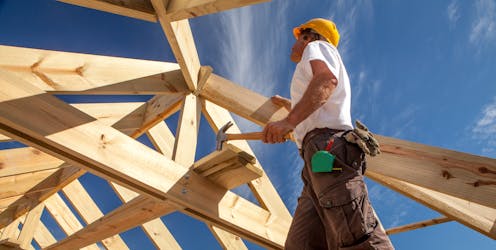
If you’re building or renovating a home, and frustrated with huge delays, you’re not alone.
Australia’s builders are struggling to find timber. For items such as laminated veneer lumber – used for frames and beams – they’ve reported waiting up to four months. For trusses – used to build walls and roofs – up to nine months.
Fears these shortages could send builders bust have been exaggerated, but the pain of delays and escalating price is real enough for tradies and clients.
There’s no easy fix to this crisis. It has been caused by the confluence of four factors: government stimulus for the building industry; increasing reliance on imported lumber; the pressure placed on global shipping by the pandemic; and the effect of Russia’s invasion of Ukraine on the world market.
Government (over)stimulus
If one had to choose a specific date for when the crisis began, it would be June 3 2020 – the day the Morrison government announced its A$688 million Homebuilder scheme.
This scheme provided up to $25,000 towards building a new home or renovating an existing one. State governments also subsequently offered building grants.
Read more: Government to give $25,000 grants to people building or renovating homes
There were reasons to fear the pandemic would devastate home construction. The Master Builders Association in 2019 had forecast new-dwelling starts would decline 3.5% in 2020/21. In April 2020, during the initial phase of the COVID panic spiral, it tipped the decline would be 40%.
The following graph shows what actually happened. Approvals for all new dwellings increased more than 25% in 2020-21. Approvals for new houses rose more than 40%.
Obviously there were multiple factors driving these increases. The Reserve Bank of Australia cut interest rates from 0.75% to 0.25% in March, and again in November to 0.1%. Billions of dollars were being pumped into the economy in other ways.
Higher demand, lower supply
Higher housing starts means higher demand for lumber.
Freestanding houses in particular use larges quantities of lumber – softwoods for roof and lightweight framing, hardwoods for joinery and flooring. Carpentry typically represents about 20% of the cost of the average new home.
However, domestic lumber supply in Australia is going the other way. Logging of native forests is in decline while domestic plantation production has plateaued.
The following graphs shows trends in the volume of wood logged from Australia’s native forests or harvested from plantations.
You can see hardwoods (shown in dark green and dark blue) overwhelmingly come from native forests. These volumes have been falling in line with action to conserve what’s left of native forests. Supply will fall further when Queensland and Western Australia end native logging in 2024, and Victoria in 2030.
Softwoods mostly come from commercial plantations. The volume of softwood harvested has increased by about 40% over the past 20 years, but the amount of land plantations has been stable for about a decade.
Minimal new plantations have been established in recent years. Eastern Australia’s 2019-20 bushfires also affected about 130,000 hectares of commercial plantations.
Waiting for costlier imports
This means Australian builders are more reliant on imported timber – at a time most global supply chains are strained and energy prices are driving up transportation costs.
Wood products are typically shipped in containers, which have been in short supply during the pandemic (due to extra demand). If you can actually find a container, the transport cost may still be more than double than before COVID-19.
Another issue is that Russia is a major wood exporter – second to Canada in all sawn-wood exports, but the top exporter of softwood lumber. While a relatively unimportant source for Australia overall, it dominates in specific products such as laminated veneer lumber.
Australia will impose a 35% tariff on “conflict timber” from Russia (and Belarus) in October.
Read more: Weakening Australia's illegal logging laws would undermine the global push to halt forest loss
What next?
Should Australia do more to become self-sufficient? This is a hard question to answer.
Even if you think yes, bear in mind even the fastest-growing softwood tree takes at least 20 years to grow.
Bringing forward production is complicated. Forestry businesses must forecast demand and lock in production for decades to come. They cannot be expected to respond to short-term crises in the same way as an oil producer or toilet paper manufacturer can.
The hard truth is that the construction industry will have to weather the storm the best it can – likely until at least 2023. By then the home-building boom should be at an end, with higher interest rates likely to slow the pace of housing construction.
Authors: Flavio Macau, Associate Dean - School of Business and Law, Edith Cowan University


 Daily Bulletin


