

Read The Times Australia

Daily Bulletin

How to save $50 off your food bill and still eat tasty, nutritious meals

  • Written by: Clare Collins, Laureate Professor in Nutrition and Dietetics, University of Newcastle

How to save $50 off your food bill and still eat tasty, nutritious meals

Grocery prices have taken a hike upwards for a host of reasons, including the rising costs of petrol, fertiliser and labour.

You could “shop around” for cheaper groceries, but that would cost you more in fuel or travel, not to mention time.

Research shows a healthy diet costs low-income households 20 to 30% of their disposable income. But a healthy diet remains cheaper than one dominated by highly processed foods and drinks.

Cutting your grocery bill takes planning and flexibility – and knowing your budget.

Read more: Yes, $5 for lettuce is too much. Government should act to stem the rising cost of healthy eating

So how do you do it?

Start by checking which vegetables and fruits are in season, and find recipes that include these.

Swap some fresh veggies and fruit with canned and frozen varieties, and substitute very expensive items for cheaper alternatives.

Have a meat-free meal at least once a week.

Read more: Health Check: five must-have foods for your shopping trolley

Next, create a grocery list. This helps save money by reducing in-store impulse buys. Look at what you already have in the pantry, fridge and freezer, and only buy what you need. This will reduce food waste.

Check online catalogues for specials before heading to the shops. Once in store, compare prices and choose brands that are cheaper. This makes nutritious meals more affordable.

How much do households spend on groceries?

A 2021 survey found the average supermarket grocery bill was A$98 per week for a single person, $145 for two, $168 for three, $187 for four and $255 for five or more people.

An older survey from 2016 found the average household (2.6 people) spent $269 per week across all food ($237) and alcohol ($32) purchases, both at the supermarket and other outlets.

About half the money was spent was on “discretionary” items such as meals out or fast food ($80), with $20 spent on lollies, chocolate, savoury snacks and potato crisps, and $10 on cakes, biscuits and puddings. At the supermarket, $26 was spent a week on fruit and vegetables.

Man in mask looks at phone while shopping in the supermarket.
Sticking to a shopping list means you’re likely to spend and waste less. Shutterstock

A 2019 survey found the average person spent $300 a week for all food and drinks. This included groceries ($135), eating out ($52), alcohol ($31), take-aways ($22), barista coffee/tea ($13), food delivery services ($12), supplements ($12) and health foods ($11).

These surveys show it’s common to spend more on foods and drinks consumed away from home than on groceries and more on unhealthy items than healthy ones.

What about saving $50?
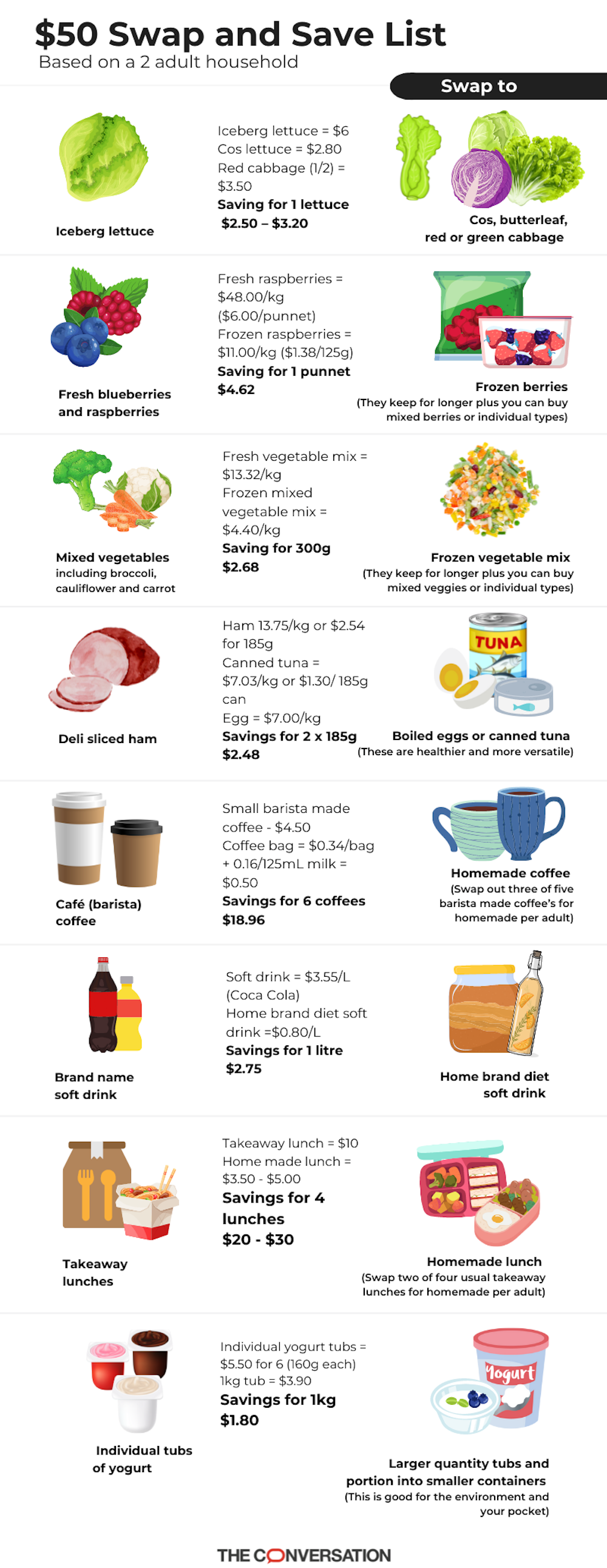
nomoneynotime.com.au 5 tips to help you save Putting all this together, here are five key tips to keep in mind when planning food for your household: 1) Have a food budget Total food budget dollars will be influenced by how many people you need to feed, their age and your household income. A rough rule of thumb is it shouldn’t cost more than one-third of your total household disposable income. Allocate target amounts in your budget for both core, nutritious foods and discretionary foods and drinks (softdrinks, chips, biscuits, cakes, lollies, pies, pastries and deli meats) and on foods away from home (coffees, fast food, pubs, clubs, bottle shops and restaurants). 2) Make a weekly plan for breakfast, lunch, dinner and snacks Write a matching grocery list. Check the pantry, fridge and freezer to see what you already have or whether any ingredients can be swapped to save a purchase. 3. Pack your lunch Buy a lunch box and pack it the night before. Put it in the fridge so you can grab and go in the morning. For ideas, see our $5 make-at-home lunches. If your mornings are too busy, pack in breakfast foods too. 4. Cook more meals at home Cooking more meals at home might include cheaper and healthier versions of some of your take-out favourites such as pizza and burgers. A study from the United States found those who cooked more at home spent half the amount of money on food eaten away-from-home than those who cooked infrequently. They also spent 17% less on food overall. Interestingly, both groups spent the same on groceries suggesting that infrequent home cookers either wasted more food, ate more, or both. Read more: Want to be happier, healthier, save money? It's time to get cooking 5. Cook double batches Cook greater quantities of meals like curries, soups and casseroles, and either freeze them or have the same meal twice. For those needing to shop on a significantly restricted budget, we’ve developed a $60 a week meal plan on our No Money No Time website. This free resource contains a meal plan with inexpensive recipes, designed to meet key nutrients needed for health. If you need help getting food right now, try the Ask Izzy website. By submitting your postcode, it shows support services, such as free meals, near you. The authors acknowledge the assistance of Hannah McCormick and Ilyse Jones from the No Money No Time Project team in preparing this article. Authors: Clare Collins, Laureate Professor in Nutrition and Dietetics, University of Newcastle

Read more https://theconversation.com/how-to-save-50-off-your-food-bill-and-still-eat-tasty-nutritious-meals-184152

Business News

The strategic rise of Bali as Australia’s next essential healthcare support hub

As Australian healthcare providers grapple with unprecedented operational bottlenecks, a new nearshore model is quietly transforming patient care delivery. Forward-thinking organisations,  including...

Daily Bulletin - avatar Daily Bulletin

Cost Savings and Benefits of Using Used Pallets in Logistics

In today’s competitive logistics and supply chain industry, businesses are constantly looking for ways to reduce operational costs without compromising efficiency and reliability. One of the most prac...

Daily Bulletin - avatar Daily Bulletin

How Fulfilment Services in Australia Help Businesses Scale Efficiently

The growth of e-commerce and modern retail has transformed customer expectations. Consumers now expect fast shipping, accurate order processing, and seamless delivery experiences regardless of where...

Daily Bulletin - avatar Daily Bulletin

Practical Ways Australian Workplaces Can Reduce Operating Costs

Reducing business costs doesn’t always mean cutting staff, shrinking services or making the workplace feel bare-bones. In many cases, the smarter savings are hiding in everyday operations: the light...

Daily Bulletin - avatar Daily Bulletin

Executive Recruitment Solutions That Help Organisations Secure Exceptional Leaders

Leadership has a direct impact on organisational performance, employee engagement, strategic growth, and long-term success. Businesses operating in increasingly competitive environments require experi...

Daily Bulletin - avatar Daily Bulletin

Why A WooCommerce Website Designer Matters For Online Growth

Running an online store today requires more than simply listing products and waiting for customers to arrive. Businesses need a website that is fast, reliable, easy to navigate, and designed to suppor...

Daily Bulletin - avatar Daily Bulletin

Turning Your Empty Tables into Revenue

The rise of AI demand tools in hospitality, the EatClub–CommBank partnership, and seven trends reshaping Australian dining  A growing number of Australian venues are turning to AI-powered demand ma...

Daily Bulletin - avatar Daily Bulletin

High-Impact Dental Marketing Strategies That Are Driving Real Practice Growth Today

The landscape of dental practice growth in Australia has shifted dramatically over recent years. Standard, broad-spectrum advertising campaigns no longer yield the return on investment they once did. ...

Daily Bulletin - avatar Daily Bulletin

How Telematics Helps Australian Companies Improve Productivity

Operating a commercial fleet in Australia is a uniquely demanding endeavour. Between the sprawling urban sprawl of cities like Sydney and Melbourne and the immense, unforgiving stretches of the Outb...

Daily Bulletin - avatar Daily Bulletin

The Daily Magazine

Lighting Shop in Perth: How The Right Lighting Can Transform Your Home And Business

The right lighting can completely change the look, feel, and functionality of any space. Whether it ...

Traffic Light System Solutions For Safer And More Efficient Traffic Management

Modern cities and growing communities rely heavily on effective traffic management to ensure safety...

Gold Migration Lawyers in Liquidation: How the Closure Affects Your ART Appeal

If your appeal was with Gold Migration Lawyers, a recent change to how the Tribunal decides cases ...

The pressure cooker: life in urban Australia in 2026

Australian cities have always been demanding. Long commutes, rising housing costs, busy schedules a...

What Actually Makes a Good Criminal Lawyer in Melbourne

Most people only think about this question once. That is usually too late. Most people charged wi...

Why Working With A Chatswood Tutor Can Improve Academic Performance

Academic expectations continue increasing for students across primary school, high school, and senio...

Is It Worth Getting Solar Panels in Melbourne?

The real question is not whether solar works in Melbourne. It works. The question is what it is co...

How A Diploma Of Project Management Builds Practical Skills For Modern Work Environments

Developing the ability to plan, execute, and deliver outcomes efficiently is a key requirement in to...

How to Choose the Right Football for Every Level

Choosing a football may seem straightforward, but the right option depends on who will be using it a...