

Australian Labor isn’t alone. Parties of the left are making a comeback
- Written by: Rob Manwaring, Associate Professor, Politics and Public Policy, Flinders University
One aspect of May’s federal election has been strangely overlooked: Labor’s win follows a pattern among the main centre-left parties in Europe and comparable countries. Traditional social democratic and labour-based parties are resurgent, and now hold office (on their own or in coalition) across all of Scandinavia and in Germany, Spain, Portugal and New Zealand.
Where the past decade has been dominated by talk of a crisis of the left, the debate is increasingly shifting to the crisis of the right.
The picture isn’t uniform, of course. Some countries have experienced the de facto demise of their main centre-left party. We might call this the “PASOKification” syndrome, after the sharp loss of support for Greece’s PASOK party, but it extends to other parts of Europe.
The Netherlands’ once-dominant Labour Party was placed sixth in last year’s election, with just 5.7% of the vote. France’s main party of the left, the Socialist Party, was reduced to just 6.4% in the first round of the 2017 presidential elections and just 1.7% this year.
British Labour, meanwhile, lost the 2010, 2015, 2017 and 2019 elections. Despite the toxicity that surrounds the Conservative government, Labour leader Keir Starmer remains unpopular and unlikely to win the next election.
In Belgium and Italy, the left’s situation is less bleak, though its main parties are far from hegemonic. In the highly fragmented Belgian system, the Flemish and Walloon socialist parties are part of the seven-party (yes, seven!) “Vivaldi coalition”. Italy’s Democratic Party is part of the current Draghi-led national unity government, and in more recent times has held the prime ministership.
Outside Europe, the new “pink tide” in South America has seen, for example, 35-year-old Gabriel Boric win Chile’s presidential election.
Why the bounce back?
Some common factors help us understand the partial return of the left.
First, the vote share of the two main centre-right and centre-left parties has declined in most of these countries, yet the centre-left can still assemble a majority where the electoral system enables it.
Australian Labor’s record low primary vote of 32.6% is part of that trend, with centre-left parties in Norway, Sweden and Spain now capturing between 25% and 30% of the vote. And even when parties win larger vote shares (as in Portugal), they have usually needed coalition partners. Nevertheless, centre-left parties remain a fixture in many party systems, and have found ways of getting back into office.
Second, the reinvigorated centre-left parties – including Anthony Albanese’s Labor – share common policy positions. We might sum them up as a “back to basics” strategy, with a clear focus on improved wages and conditions, job security and reinvigorated public institutions.
Albanese’s win has parallels with the victory of Olaf Scholz’s Social Democrat–led “rainbow coalition” in Germany. As one commentator described it:
Scholz ran an uncluttered campaign based on simple promises: a higher minimum wage, stable pensions, more affordable housing and a carbon-neutral economy.
Social democrats have sought to (mildly) rebuild public institutions. The Danish Social Democrats have pledged to increase public and welfare spending by 0.8% per year for five years. Jacinda Ardern’s NZ Labour government has increased the minimum wage. Antonio Costa’s recent majority government in Portugal was built on a coalition united in seeking to reverse the austerity measures that followed the eurozone crisis.
Common features …
This “new” minimalist social democracy has several entwined elements. First, the incoming governments have captured a mood, amplified by the pandemic, that centre-right governments have neglected key public goods.
Second, these centre-left governments have turned away from “third way” policies associated with leaders like Bill Clinton and Tony Blair. As catalogued here, centre-left parties have turned leftwards since the 1990s and 2000s. Many of their party manifestos have a renewed focus on tackling inequality and increasing welfare spending.
Third, the centre-left parties have been gradually “greening”. Many are seeking to make renewables part of their reinvigorated industry and manufacturing agendas.
As Albanese and his colleagues know, this is a delicate balancing act, aimed at protecting employees in fossil-fuel-intensive industries while setting out modest climate targets. This “balance” seems to be hitting the electoral sweet spot by capturing public demand for action while allaying fears about the speed of transition – even if the targets fail to keep up with the science.
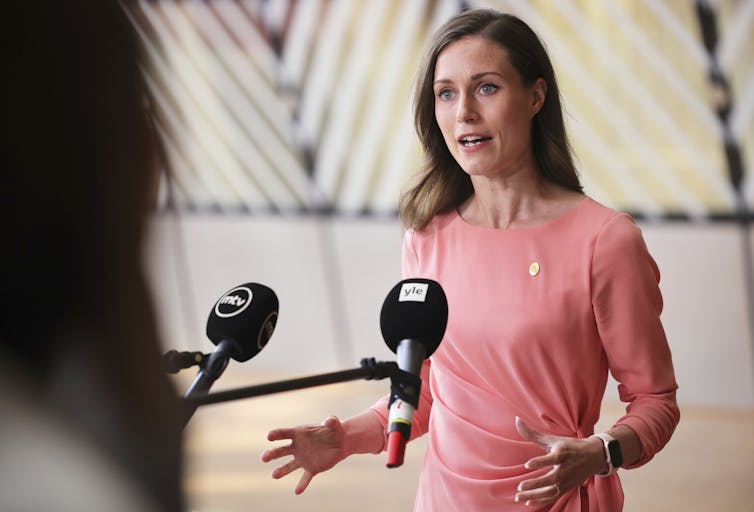
The final element is the longstanding “feminisation” of the parties. Many are reaping the rewards of the struggles by feminist MPs, allies and members to improve representation. It’s no coincidence that four of Scandinavia’s five current centre-left prime ministers are female. The centre-left parties look modern and representative, and most have strong gender policies, especially on issues like the gender pay gap.
… And one significance difference
It’s worth noting a key difference between Australian Labor and its resurgent counterparts. Many centre-left parties in Europe have made strong pledges to invest in their welfare states – in part to see off the welfare chauvinism of radical right challengers. In New Zealand, the Ardern government has announced a new unemployment insurance scheme.
The dynamics seem different in Australia, and Labor apparently sees little electoral value in shifting from its “modest” welfare agenda.
One important lesson for Labor is that in almost all the cases internationally, the centre-left has had to learn to govern in partnership with other key players. This will be a pressing issue for Albanese as he deals with a record crossbench in both houses. It could even determine how long Australia’s centre-left party governs.
Authors: Rob Manwaring, Associate Professor, Politics and Public Policy, Flinders University


 Daily Bulletin


