The Mint and Note Printing Australia make billions for Australia – but it could be at risk
- Written by: Peter Martin, Visiting Fellow, Crawford School of Public Policy, Australian National University
Briefly, in the days after the death of the queen, we were afforded a glimpse into the machine that makes Australia’s money.
Assistant Treasury Minister Andrew Leigh turned up at the Royal Australian Mint to explain the process by which a portrait of the King Charles will replace the portrait of the queen on the heads-side of coins minted from 2023.
(And yes, he noted “for the avoidance of doubt, for any conspiracy theorists out there, all coins bearing the face of Queen Elizabeth II will remain legal tender”.)
The Mint makes an extraordinary 120 million to 140 million coins per year (even more, as much as 175 million when Australians stocked up on cash during the first year of COVID), and it is a money-making operation in more ways than one.
20 cents to make a $2 coin
Usually it costs the Mint far less to make each coin than each one becomes worth the moment it is sold to a bank (before metal prices climbed, it cost the mint about 20 cents to make a $2 coin, and about 15 cents to make a 50 cent coin).
The profit – the huge markup – goes straight to the Commonwealth budget as non-taxation revenue, tens of millions per year. It’s called “seigniorage”, an ancient French word that refers to the profit only a seignior (feudal lord) can make from the exclusive right to mint coins.
Read more: The paradox of going contactless is we're more in love with cash than ever
This financial year the government expects A$59 million, next year $67 million.
That the government can keep making money from seigniorage appears to defy common sense. Surely we’ve got just about all the coins we need. Merely replacing coins as they get worn out doesn’t earn seigniorage.
But a previous head of the Mint, Ross MacDiarmid, let the cat out of the bag in 2014 when he told a Senate committee:
most of the coins that we provide are against coins that disappear down the back of chairs, down the back of car seats, into rubbish dumps and, in some cases, are taken overseas.
Asked whether he was seriously suggesting a hundred million or so coins per year disappear, MacDiarmid replied he was.
This means the government makes tens of millions per year replacing – at a huge markup – things we have lost.
And it’s just the beginning. The $5, $10, $20, $50 and $100 notes made by Note Printing Australia for the Reserve Bank have an astronomical markup.
32 cents to make a $100 note
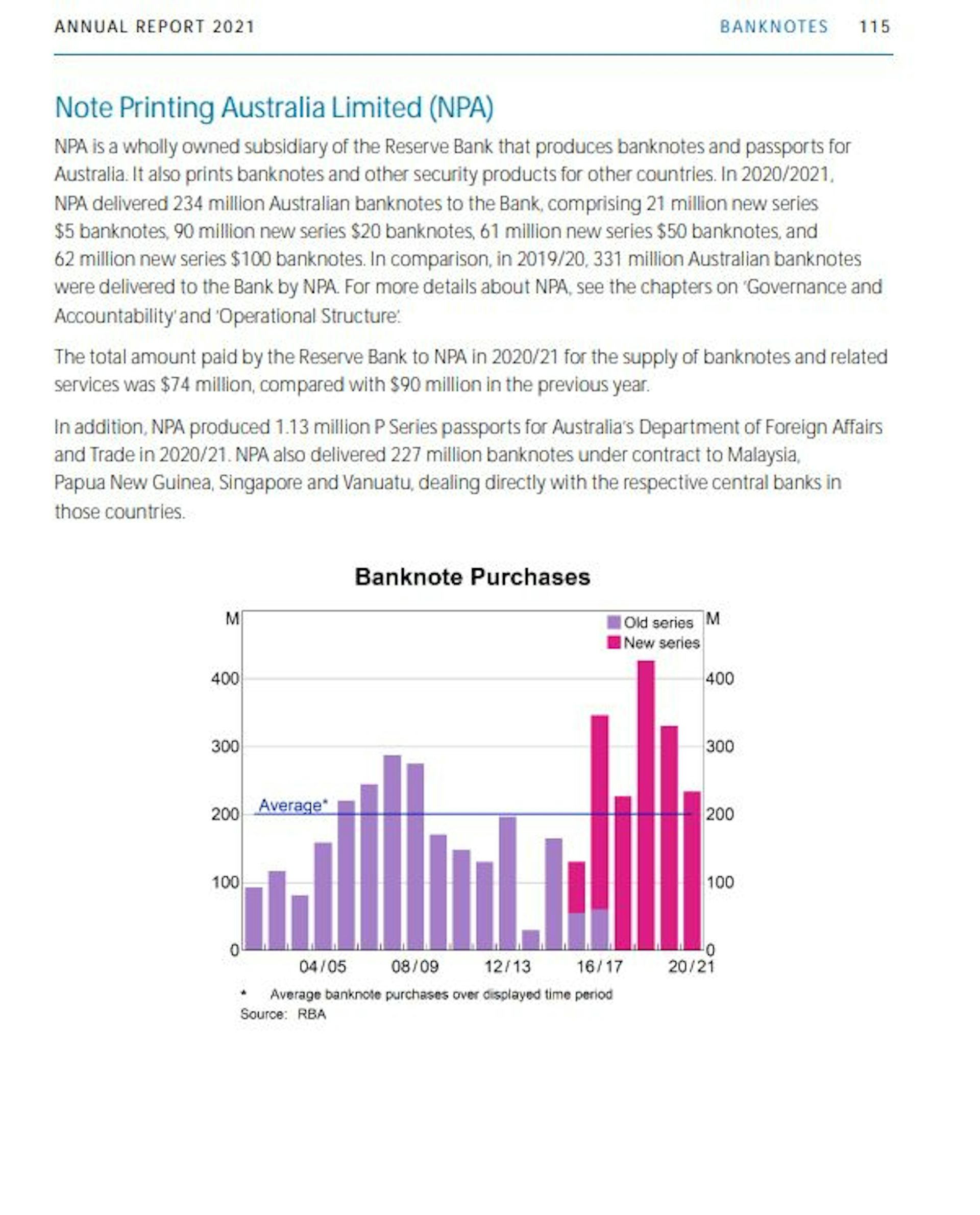
In 2020-21, Note Printing Australia delivered 234 million notes to the bank for a fee of $74 million, suggesting they cost about 32 cents each to make. Most were $50 and $100 notes, sold to private banks for $50 and $100 each.
That profit is accounted for differently to the profit for coins, and is hard to find.
One estimate, in an international study of 90 countries at the end of the 1990s, found Australia’s income from seigniorage of notes and coins to be low compared to other countries at 2.6% of government spending.
2.6% is an enormous amount. These days that’d be $16.3 billion, which is about what we spend on the Pharmaceutical Benefits Scheme.
$6-10 billion per year
The Reserve Bank measures seigniorage differently, using a formula that can produce odd results because it depends on the rate of interest. Before COVID, its view was that it only made about $1 billion per year from seigniorage, a figure it doesn’t usually calculate and doesn’t report to the government.
A simpler calculation would take the $6.8 billion of extra notes the bank supplied in 2020-21, deduct the $74 million it cost to print the notes and about as much again for the payments it makes to commercial banks to encourage them to hold sufficient stocks and return worn notes and come up with $6.6 billion.
A year earlier, as we stocked up on cash as COVID took hold, the bank would have made $10 billion.
An end to easy money?
The profits from printing notes don’t flow directly to the budget, except in part via Reserve Bank dividends, but they help by keeping the bank self-funding.
Profits from notes and coins are under threat. For the Reserve Bank it’s the threat of us one day wanting less cash – although for the moment, while we are using less cash in transactions, we are holding on to more for safekeeping than ever.
For the Mint, it’s the reality that we are using less cash. In 2020-21 it produced $82.2 billion worth of new coins, down from $114 billion a decade earlier.
Its other threat is the soaring price of metal. Mint chief executive Leigh Gordon revealed last week it was costing north of 12 cents to make each five-cent piece.
Earlier this year, after nickel prices soared in the wake of Russia’s invasion of Ukraine, he said even 20 cent coins were about to lose money.
Cheaper coins to the rescue?
Nickel prices have since come down, and one of the oddities of pricing is that it costs far less to make the largely copper and aluminium $1 and $2 coins (about eight cents each) than it does the nickel-heavy 10 and 20 cent coins (14-28 cents), but the Mint is preparing.
In 2016 the Mint developed a proposal to cheapen the metal content of its five, ten and 20 cent coins and shrink the size of its 50 cent coins, which it says was favourably received by retailers and banks who wanted coins that weighed less. The idea was submitted to the Treasury, but “not progressed”.
In the meantime it has partnered with Woolworths to produce limited edition “Olympic” and “Wiggles” coins that are delivered as change through cash registers rather than through banks, for which it charges a touch over $2.
There’s a lot that can be done, and every time there’s a crisis, we seem to rediscover cash. But eventually the money-making machine will stop.
Authors: Peter Martin, Visiting Fellow, Crawford School of Public Policy, Australian National University


 Daily Bulletin