

Explainer: Socrates and the life worth living
- Written by: Oscar Davis, Lecturer in Philosophy and History, Bond University
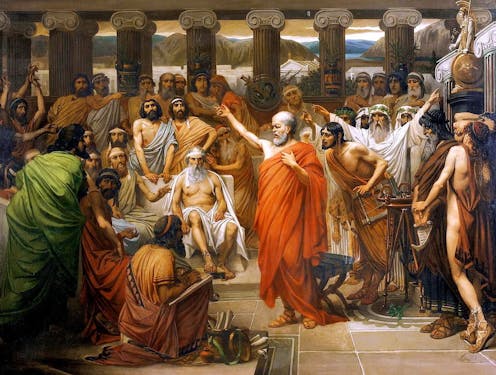
Socrates was notoriously annoying. He was likened to a gadfly buzzing around while one is trying to sleep. The Oracle of Delphi declared him the wisest of all human beings. His life and death would go on to shape the history of Western thought.
And yet he proclaimed to know nothing. The genius of Socrates lay in his professed ignorance of what it means to be human.
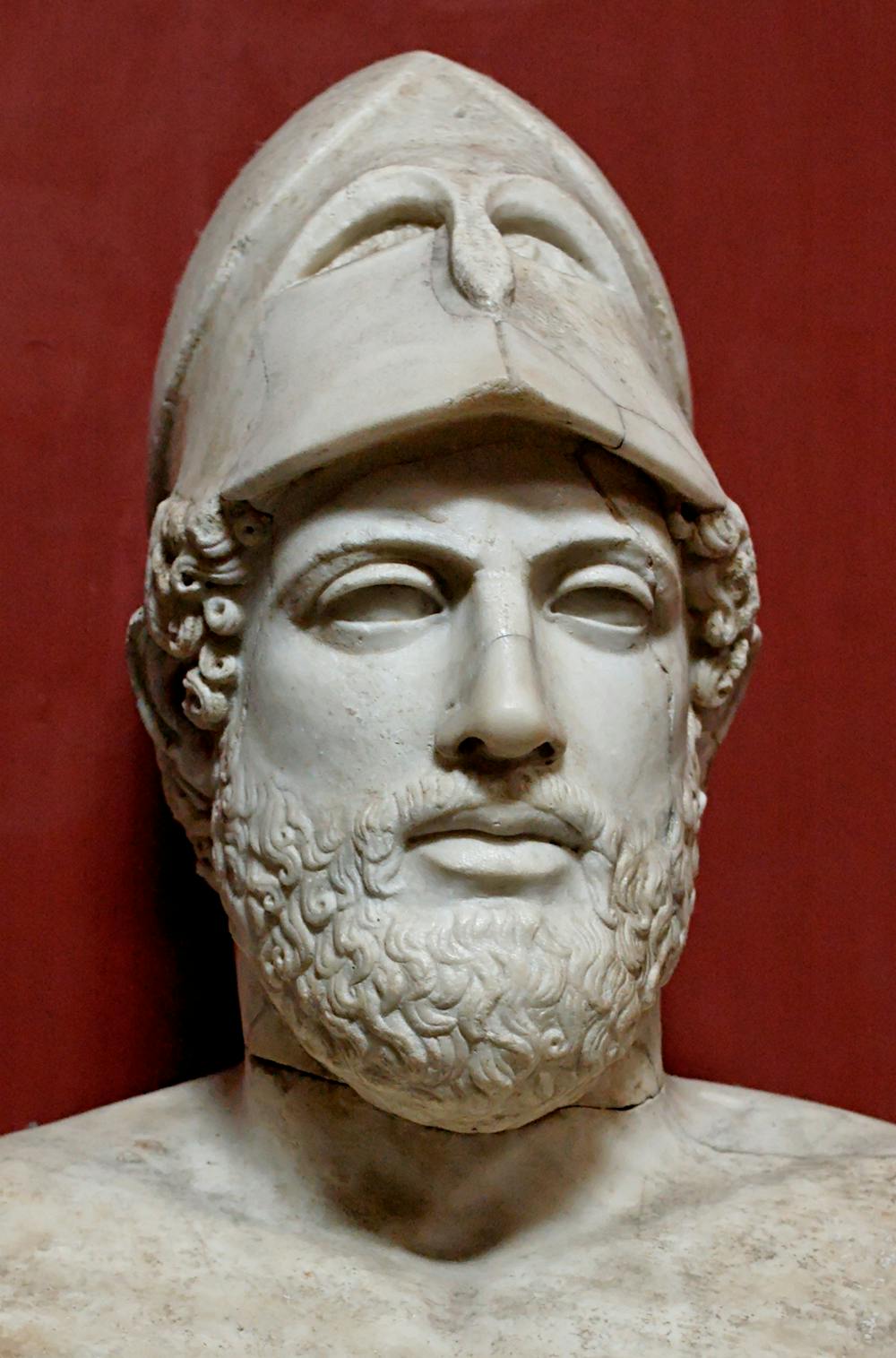
Socrates (469-399 BCE) grew up in Athens over two and half thousand years ago. At the time, the Athenians were recovering from a devastating war with the Persians. As they rebuilt, the military general and politician, Pericles, championed democracy as the form of government to bring Greece into its Golden Age.
The Athenians practised a direct (as opposed to representative) form of democracy. Any male over the age of 20 was obligated to take part. The officials of the assembly were randomly selected through a lottery process and could make executive pronouncements, such as deciding to go to war or banishing Athenian citizens.
The Athens of Pericles flourished. Bustling crowds of traders from around the Mediterranean gathered at the port of Piraeus. In the Athenian agoras – the central marketplaces and assembly areas – the active social and political lives of the Athenian citizens would inspire the mind of Socrates.
Socrates at war
Alcibiades, who would go on to become a prominent Athenian statesman and general, recounts a story of what might be a pivotal moment in the development of Socrates’ thinking.
One morning during the campaign of Potidaea, Socrates became transfixed by a problem that he could not seem to solve. An entire day passed and Socrates had still not moved. In awe, and probably curious to see how long he could keep it up, his fellow soldiers moved their beds outside to watch him during the night. It was not until dawn the next morning that Socrates said a prayer to the new day and walked away.
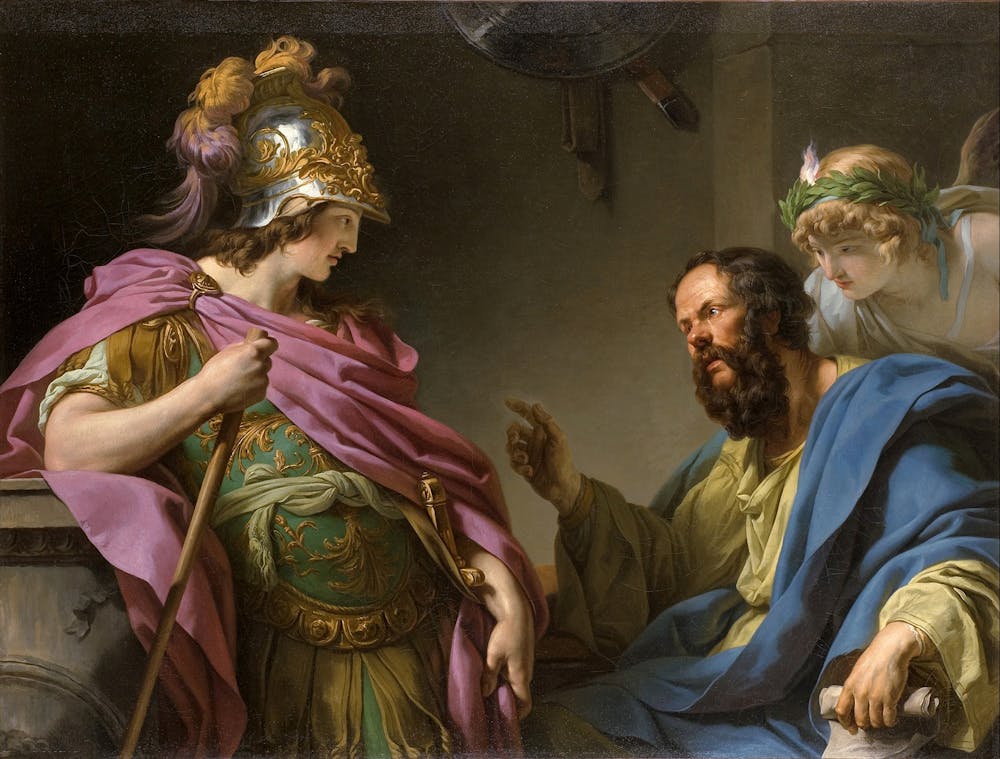 Alcibades being taught by Socrates – François-André Vincent (1776).
Public domain
Alcibades being taught by Socrates – François-André Vincent (1776).
Public domain
Jonathan Lear argues in his Tanner Lectures that Socrates is not just standing still because he is lost in thought; he is standing still because he cannot walk. He is standing “not knowing what his next step should be”. Socrates wants to move in the right direction, but does not know what direction that is.
We will never know what Socrates was thinking about. But after standing still and thinking, he appears to have become invigorated. Alcibiades tells us that in the battle that followed Socrates saved his life. For the remainder of the campaign, Socrates fought with a fierceness and bravery that exemplified true courage.
Socrates the gadfly
Socrates never wrote anything down. He hungered for the lively exchange of ideas and believed that writing only served to imprison a thought in letters. He argued that the written word shared a strange quality with paintings. Both appear to us “like living beings, but if one asks them a question, they preserve a solemn silence”.
Much of what we know of Socrates’ activities and conversations, and his death, was recorded by his devoted student Plato. Scholarly debate continues about just how much of Plato’s written record of Socrates’ interrogations we can attribute to Socrates himself. At some point in the Platonic corpus, Socrates becomes a mouthpiece for Plato’s own ideas, but no one can agree precisely when.
Socrates was unsure of what to make of being called the wisest of all human beings. He dedicated his time to questioning fellow Athenians about the nature of things, interrogating ideas such as friendship, love, justice and piety. He was searching for what he believed to be the highest good: knowledge.
The gadfly could show up anywhere. In Plato’s Euthyphro, for example, Socrates bumps into Euthyphro, who is on his way to court about to prosecute his father:
What strange thing has happened, Socrates, that you have left your accustomed haunts in the Lyceum and are now haunting the portico where the king archon sits?
Socrates is intrigued by Euthyphro’s legal case, and so begins his inquiry:
do you think your knowledge about divine laws and holiness […] is so exact that […] you are not afraid of doing something unholy yourself in prosecuting your father for murder?
Almost every Socratic dialogue is centred around Socrates’ recognition of his own ignorance. In Euthyphro, the subject he interrogates is piety. What follows adheres to a structure shared by most of the other dialogues, which is known as elenchus or the Socratic method.
Its basic form is as follows:
Socrates engages an interlocutor who appears to possess knowledge about an idea
the interlocutor makes an attempt to define the idea in question
Socrates asks a series of questions which test and unravel the interlocutor’s definition
the interlocutor tries to reassemble their definition, but Socrates repeats step three
both parties arrive at a state of perplexity, or aporia, in which neither can any further define the idea in question.
We can gain a sense of the frustration that this caused some of Socrates’ unwilling victims. Take the final lines of his encounter with Euthyphro as an example:
Socrates: Then don’t you see that now you say that what is precious to the gods is holy? And is not this what is dear to the gods?
Euthyphro: Certainly.
Socrates: Then either our agreement a while ago was wrong, or if that was right, we are wrong now.
Euthyphro: So it seems.
Socrates: Then we must begin again at the beginning and ask what holiness is. Since I shall not willingly give up until I learn. […]
Euthyphro: Some other time, Socrates. Now I am in a hurry and it is time for me to go.
In Meno, another of Plato’s dialogues, Socrates likens the sting of aporia to that of an electric stingray:
I find you are merely bewitching me with your spells and incantations, which have reduced me to utter perplexity. And if I am indeed to have my jest, I consider that both in your appearance and in other respects you are extremely like the flat torpedo sea-fish; for it benumbs anyone who approaches and touches it, and something of the sort is what I find you have done to me now. For in truth I feel my soul and my tongue quite benumbed, and I am at a loss what answer to give you.
Throughout the dialogues, Socrates demonstrates the disruptive and disorientating experience of aporia, which emerges from philosophical activity. Reflecting upon the declaration of the Oracle of Delphi, we learn that Socrates was wise because, unlike his interlocutors, he did not proclaim to know what he was ignorant of.
Read more: Leaders as healers: Ancient Greek ideas on the health of the body politic
Corrupting the youth and replacing the gods
In the early days of democracy and in a society which was rapidly expanding, one would think that a revolutionary thinker like Socrates would be a highly prized instrument of intellectual progress. But not everyone appreciated the disorientating sting of the gadfly’s thinking.
Plato would later comment on how the Athenians – and perhaps societies in general – react when faced with the disruptive force of critical reflection.
His famous allegory of the cave, which forms part of his Republic, is in many ways the story of a philosopher – the story of his great teacher, Socrates.
The allegory begins with prisoners locked in a cave. All the prisoners can see are the shadows of the passing guards reflected on the wall, and the echoes of the world behind them. This is the condition of a society content with the mere illusions of knowledge, a society that is unreflective and stagnant.
One prisoner manages to escape. Turned towards the entry of the cave, he first notices the brightness of the light – like knowledge, the light is uncomfortable and disruptive after years of contentment with shadows.
Escaping the cave, the prisoner
can see the reflections of people and things in water and then later see the people and things themselves. Eventually, he is able to look at the stars and moon at night until finally he can look upon the sun itself.
Only after he is able to look straight at the “sun itself” – i.e. knowledge of what is good – “is he able to reason about it” and what it is. The freed prisoner, argues Plato, would realise that life outside is far superior to being inside the cave. He would return and encourage the prisoners to free themselves and look around. But the comfort of their belief in the world of shadows and echoes is a strong force to overcome.
Plato says that the prisoners, fearing what awaits outside of the cave, would react violently towards the freed prisoner – even killing him in order to keep the peace.
This was Socrates’ fate.
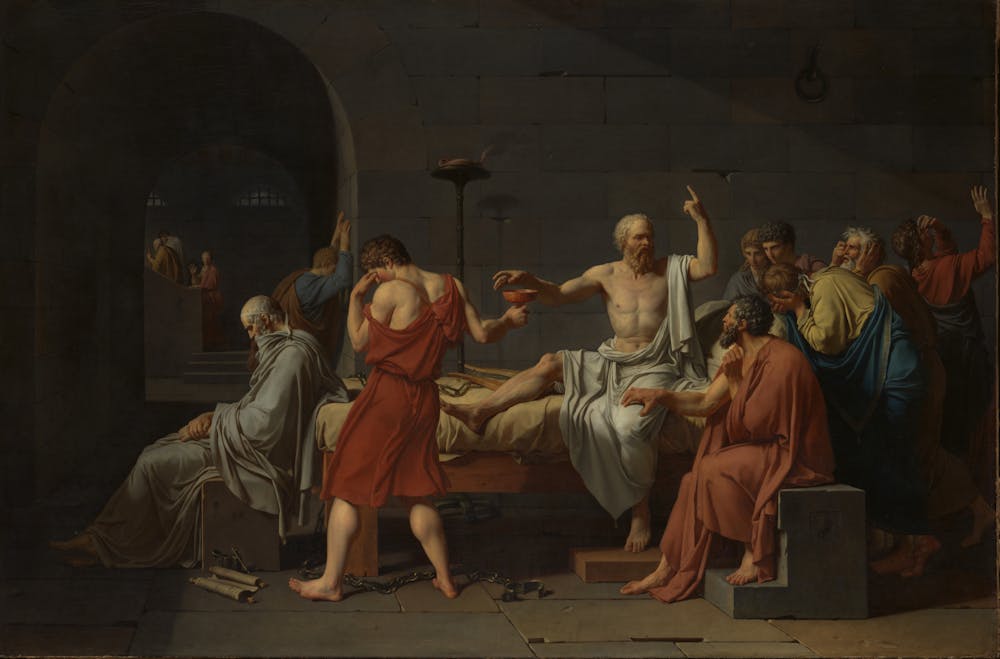 The Death of Socrates – Jacques-Louis David (1787)
Public domain
The Death of Socrates – Jacques-Louis David (1787)
Public domain
When the citizens of Athens had finally had enough of Socrates’ pestering questions, they banded together and accused him of corrupting the youth and attempting to replace the old gods.
He was imprisoned. His followers planned an escape, but he refused. Socrates questioned what was to be gained by escaping. Life itself is not ultimately valuable – surely, he says, it is a good and just life that we ultimately value. If he were to escape, he would only be tarnishing his good life with an act of vengeance against the misinformed Athenian citizens. He had nothing to gain by escaping. He could only preserve the harmony of his own soul by accepting his fate.
In his final stand in front of the Athenian judges, Socrates denies all charges. His only crime was forcing Athenians to think:
If again I say that to talk every day about virtue and the other things about which you hear me talking and examining myself and others is the greatest good to man, and that the unexamined life is not worth living, you will believe me still less.
If you are to put me to death, warns Socrates, you will not easily find another like me. Striking dead the gadfly of Athens is easy, but “then you would sleep on for the remainder of your lives, unless the god in his care of you gives you another gadfly”.
But the judges had made up their minds. The majority voted that Socrates would be executed by drinking hemlock.
Socrates teaches us that philosophical contemplation prepares us for the good life. The experience of aporia – in all of its discomfort and disruption – is the very catalyst of wonder. The philosopher, the lover of wisdom, is anyone who dares to escape the cave and look upon the sun, anyone who lives for the values Socrates died for.
Authors: Oscar Davis, Lecturer in Philosophy and History, Bond University
Read more https://theconversation.com/explainer-socrates-and-the-life-worth-living-189312


 Daily Bulletin


