

'We haven't built it, and they've come': the e-change pressures on Australia's lifestyle towns
- Written by: Julian Waters-Lynch, Lecturer in Entrepreneurship, Innovation and Organisational Design, RMIT University
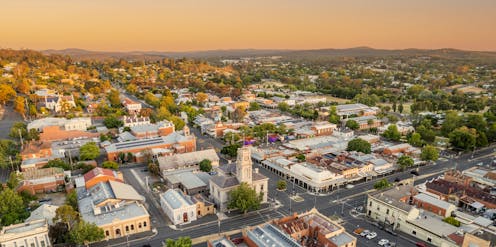
Michael and Karen moved from Melbourne to Castlemaine, about 130km northwest of Victoria’s capital, in mid-2020 – using, like tens of thousands of Australians, the shift to remote work to make a larger lifestyle change.
They sold the small two-room inner-urban apartment they had bought in 2018 and bought a large three-bedroom home on a 1,200 square metre block in the historic goldfields town (population about 10,000).
“There’s an orchard, an amazing garden for growing veggies, and a good shed out the back,” enthuses Michael. “I have a room now for full-time remote work and a third bedroom for the baby, which is on its way.” He plans to convert the shed into a studio for Karen, an artist.
But not everything was easy. “The internet connection has been dropping in and out, repeatedly and for large durations,” Michael says. “I’ve had to use my phone’s 3G hotspot as a backup.”
We’ve tracked the experience of Michael and Karen along with 20 other households in Victoria, New South Wales and Queensland to better understand how the influx of “e-changers” to “lifestyle towns” is affecting infrastructure and social cohesion.
This demographic shift has long been predicted – facilitated by technology and the population stresses in major cities. But the pandemic accelerated the trend.
Slow internet speeds are just the tip of the infrastructure pressures being placed on hundreds of towns within a few hours’ drive of cities – the sweet spot for e-changers looking to combine city jobs with country town lifestyles. Others include health and education services, water security and, most urgently, housing availability and affordability.
Helen Haines, the independent federal member for the rural Victorian electorate of Indi, has put it like this:
For a long time, when we talked about regional development, we said ‘build it and they will come’. Well we haven’t built it and they’ve come.
It’s a challenge that will require cooperation between federal, state and local policy makers to resolve.
Rise of the e-changers
In 2016 demographer Bernard Salt described living in a country town while keeping a city-based job as the ultimate Australian lifestyle choice:
“Move to a lifestyle town, telecommute using broadband, and come into the city perhaps once a week for face-to-face meetings. Sounds pretty damn good to many Australians.”
He estimated about one in six Australians were interested in doing this. The major obstacle: having a job they could do from home. But based on Australian Bureau of Statistics data, he predicted the proportion of the workforce able to work from home would double from 4% in 2016 to 8% by 2026.
COVID-19 has dramatically changed that trajectory, with up to 40% of the workforce working from home during the pandemic’s peak.
This, along with favourable interest rates, enabled tens of thousands to make the shift. Between July 2020 and June 2021 the population of regional Australia grew by about 70,900, while capital cities declined by 26,000 – the first time in 40 years that regional population growth outpaced the cities.
Most of this shift occurred in NSW and Victoria. Sydney’s population fell about 5,200, while the rest of the state increased by 26,800. Melbourne’s population declined by about 60,500, with the rest of the state picking up 15,700.
Indicative of the e-change trend was the decline in the median age of those migrating away from the cities (from 38 to 34 in South Australia, from 37 to 33 in NSW, and smaller changes elsewhere).
Looking at lifestyle hotspots
Our research mostly focused on e-changers moving to “hotspots” – towns within a few hours’ commute of a capital city. But we also included some towns further afield, such as Broken Hill in far-west New South Wales and Rockhampton in central Queensland.
We were interested in their experiences with remote work, given Australia’s fixed broadband speeds already lag behind most industrialised countries, ranking 65 of 182 countries on a current global index. Regional towns generally fare even worse.
Two households in our study did report better speeds but nine said slowness and bad connection limited their ability to use it for work. One recounted spending weeks chasing their service provider before it was discovered the copper wiring to their home had eroded. These problems are unlikely to get better in any area affected by heavy rainfall and flooding events.
Gentrification hurting low-income residents
A more fundamental issue for lifestyle towns is what growing populations mean for the attributes attracting e-changers in the first place.
In the Hunter Valley, Southern Highland and Shoalhaven regions of NSW, and in the Sunshine Coast and Gold Coast areas in Queensland, house prices rose more than 35% in the 12 months to January 2022.
This has contributed to an unprecedented rental crisis, displacing those on lower incomes and making it harder for local businesses to fill job vacancies.
A discussion paper published by the Regional Australia Institute in May 2022 noted that while regional Australia’s population grew by an average of 76,500 people a year in the decade to 2020, the number of homes approved for construction declined in five of those ten years. It argues that market forces alone are insufficient to address the problem.
Population influxes also risk altering the appealing character of lifestyle towns. The population surge in Torquay on Victoria’s Surf Coast, for example, has seen the once sleepy coastal town come to resemble an outer suburb of Geelong.
Investment urgently needed
Michael and Karen may not stay in Castlemaine. But they don’t plan to move back to Melbourne. They are considering Tasmania. They like working remotely, having more space and time for their young family, being closer to nature and the sense of community a country town offers.
All the evidence suggests hundreds of thousands more will follow their path, with hybrid and remote work here to stay.
Good planning and policy is needed to ensure this historic demographic shift does not overwhelm these towns. To maintain their livability and ability to accommodate remote work, they require urgent investment in telecommunications and transport infrastructure, health and education services and – most of all – housing.
Authors: Julian Waters-Lynch, Lecturer in Entrepreneurship, Innovation and Organisational Design, RMIT University


 Daily Bulletin


