

How we accidentally planned the desertion of our cities
- Written by: Rachel Gallagher, PhD Candidate, School of Earth and Environmental Sciences, The University of Queensland
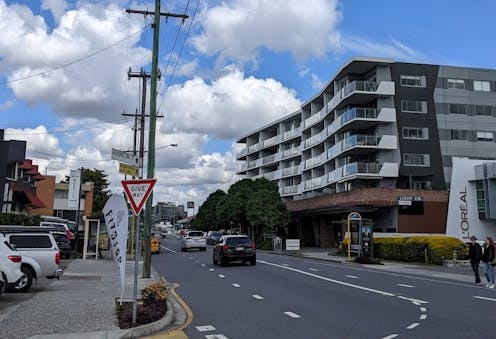
COVID-19 may have kick-started the decline of the Australian CBD, but our newly published research shows how planning decisions had already created cities that lacked resilience.
The changes in our work preferences have highlighted how vulnerable our cities are to economic shocks. Moves to entice (or compel) workers back to the office may be just a short-term fix for precincts now struggling with low levels of foot traffic.
Historic zoning practices created separate areas of residential, commercial and industrial activity in our cities. This practice created whole precincts like the CBD and residential suburbs dedicated to a single use.
The lack of diversity arising from this pattern of development ultimately reduces resilience when conditions change. It is arguably one of urban planning’s greatest failures.
Read more: How COVID all but killed the Australian CBD
The most resilient places during COVID-19 lockdowns were those that had a diverse industrial employment mix. It meant they did not rely on a single sector for jobs – and the lockdown impacts varied from sector to sector.
For example, Melbourne’s last remaining inner-city industrial zone, Port Melbourne, provides a diverse mix of production as well as commercial services. It was among the most resilient places of employment in Australia to COVID impacts. This example offers valuable insight into a truly “mixed use” precinct.
Areas with diverse land uses became the goal of new planning policies that emerged in the 1980s. By introducing zoning changes, policymakers hoped to replicate the vibrant, dense and localised environments of older cities that predated the rise of cars.
However, our research shows policies that aimed to increase land-use mix do the opposite in practice.
Read more: No need to give up on crowded cities – we can make density so much better
What does the research show?
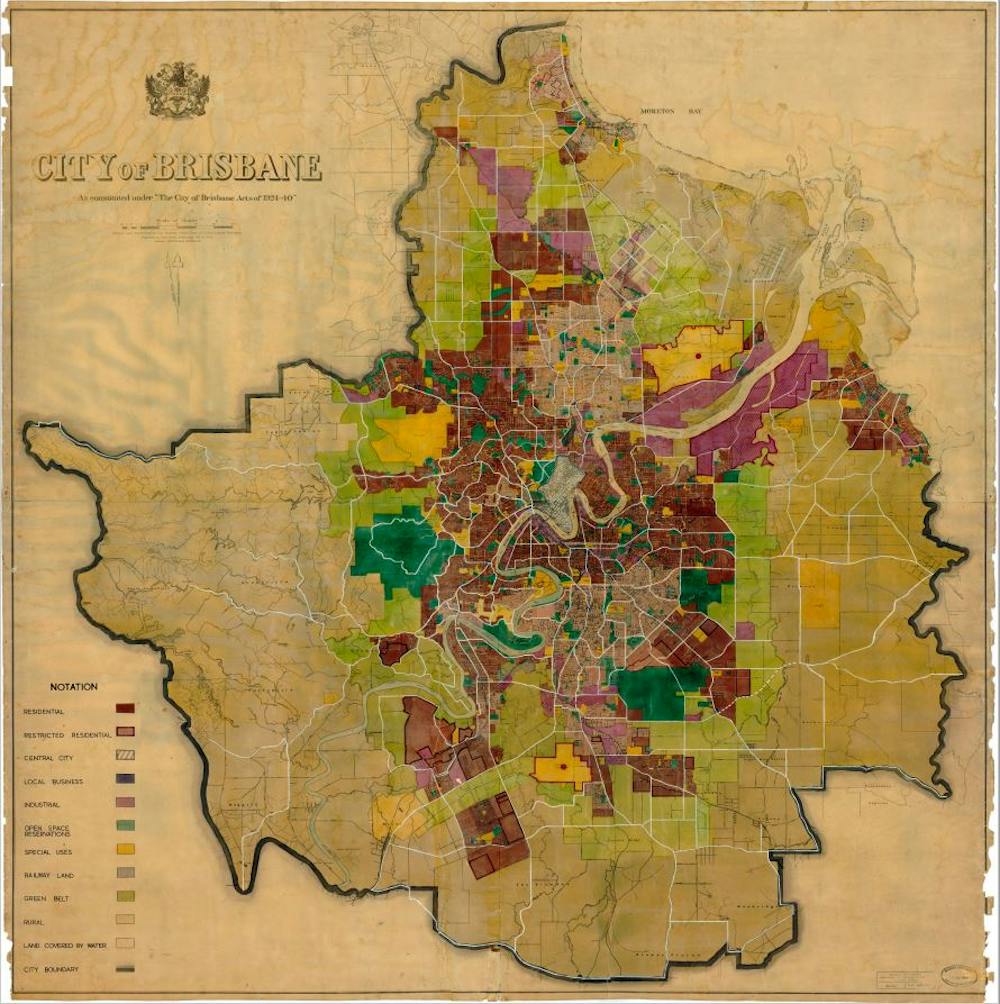
Our research tracked changes in land use and zoning for over 10,000 parcels of land in Brisbane from 1951 to 2021. We selected six precincts 1-10km from the city centre. These precincts are now zoned as mixed-use and high-density, with more diverse land use as the goal.
We created a comprehensive data set by digitising historic land use (1951) and zoning maps (1952 and 1987) and integrating this with data from 2021.
Our research found a large increase in commercially zoned land across all study areas. Rezoning former industrial precincts accounted for most of this increase. While residential use remained the dominant land use across all study areas, commercial use grew from 2.3% of combined land area in 1951 to 28.9% in 2021.
As a result, by 2021, commercial services provided almost all the jobs in these areas. Most of the land zoned as mixed use, which allows low-impact industry (such as vehicle repairers, shop fitters and printers), was used for housing, shops, gyms or offices.
By allowing open competition between commercial, residential and industrial uses, policy aiming to diversify land uses has the opposite effect of sidelining industrial use. One reason is that centrally located industrial sites are often large and under single ownership, which makes them a prime target for developers.
Policymakers have sought to minimise the connection between industrial decline and an economic growth model centred on property development. Instead, they often attribute this decline to globalisation or the changing economy.
Yet our research shows industrial zoning does protect industrial land. Areas that were zoned for heavier industrial uses in 1987 retain some kind of industrial use in 2021.
What sort of industry are we talking about?
Industry today, particularly manufacturing, is no longer characterised by large-scale industrial production with heavy machinery. Most Australian manufacturers are small businesses, ranging from micro breweries to clothing and textile producers and custom bike shops.
And inner-city locations attract manufacturers for the same reasons they attract services sector firms. These areas offer access to large markets, skilled labour and specialised suppliers.
Yet the remaining centrally located, industrially zoned sites, suitable for industrial equipment and containing loading docks and other supporting infrastructure, are vulnerable to displacement by residential and commercial development.
Read more: Can our cities' thriving creative precincts be saved from ‘renewal’?
How do we improve resilience?
The loss of revenue for businesses that rely on commuters has led to lobbying for government action to get workers back to the office. However, greater flexibility makes workers happier, and hopes of a return to pre-pandemic practices look increasingly unrealistic.
The idea that land should be put to its “highest and best use”, in an economy that values residential and commercial development above all else, undermines the city’s resilience.
If the role of planning authorities is to regulate land use in the community’s interest, it is questionable whether simply giving priority to its most lucrative use does that. Policymakers should reconsider planning that creates open competition between industrial and residential or commercial uses.
Our research contributes to the growing evidence that zoning can be used to protect diverse land use, rather than simply enable land-use conversions. More active planning is required to deliver the goals of truly mixed-use urban precincts.
Authors: Rachel Gallagher, PhD Candidate, School of Earth and Environmental Sciences, The University of Queensland
Read more https://theconversation.com/how-we-accidentally-planned-the-desertion-of-our-cities-190145


 Daily Bulletin


