

Read The Times Australia

Daily Bulletin

Australia's first Binar spacecraft just came down to Earth as a fireball. Here's what we learned

  • Written by: Fergus Downey, PhD Student, Curtin University
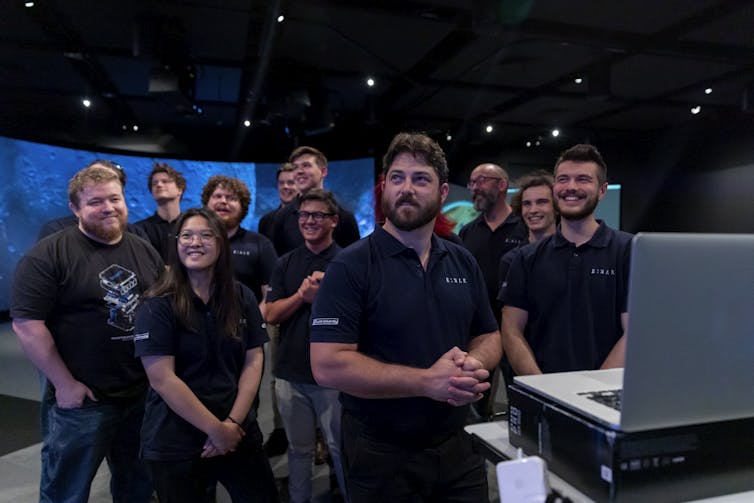
A team of scientists in dark crew shirts looking at a screen above their heads

This weekend marked a milestone for Western Australia’s Binar Space Program as its first satellite Binar-1 lived up to its name.

Binar is the word for “fireball” in the Noongar language spoken by the Aboriginal people of Perth. Binar-1 became a real “Binar” as it re-entered Earth’s atmosphere over the weekend. Although the chance of it being seen over Australia was low, with the right amount of luck it would have appeared as a shooting star in the night sky.

Binar-1 was built by a team of PhD students and engineers at Curtin University’s Space Science and Technology Centre. Its mission: a technology demonstration to test whether the innovative design – all systems integrated on a single circuit board at its core – would survive in space.

Although parts of the mission were not a complete success, owing to some last-minute design changes, that goal was still achieved.

Read more: Tiny satellites are changing the way we explore our planet and beyond

A tiny sky cube

Binar-1 is a 1U size CubeSat, meaning it measured just 10 centimetres across, roughly the size of a lunchbox. Don’t let the size fool you – the satellite was packed with microelectronics to optimise its volume for countless future science and education missions.

It was launched to the International Space Station on August 29 2021 aboard a SpaceX resupply mission, and deployed from the station’s Kibō module.

As a “technology demonstrator”, the spacecraft was flying its essential systems for the first time. The lessons learned from its fiery end will prepare the Binar Space Program for the next step: Binar-2, 3, and 4.

A team of scientists in dark crew shirts looking at a screen above their heads
Members of the Binar Space Program watch the live streamed deployment of Binar-1 in October last year. Curtin University

Five major takeaways from Binar-1

Lock down high-level mission objectives at the beginning

From the start of the mission, the team struggled to grasp what was achievable with the time and money available. This cost us valuable time, as redesigns were necessary every time we defined a new objective. Once we realised a technology demonstration was our true target, we could nail what we were trying to deliver.

Be prepared for delays

By having a plan for delays, we can be more agile when it comes to tight launch deadlines. With Binar-1, we assumed our test schedule would stick to the timeline, but this was never likely.

For our next launch, we’ve prioritised which tests we know are essential and which tests we can drop, so we can make better choices when it’s time to meet our deadlines.

A pair of hands in dark gloves working on computing chips
Installing the star-tracker camera payload into Binar-1. The star tracker was designed and developed by undergraduates at Curtin University. An improved version will fly on Binar-2, 3 and 4. Curtin University

Test as you fly

One of the challenges we faced was testing our designs in a manner that replicated the satellite’s behaviour in space. It may seem like an obvious lesson - but using the antennas to test your satellite systems, instead of that convenient USB port you had designed it with, makes a big difference.

Prepare for operation throughout the design process

You can’t learn this lesson without actually flying the satellite – but we certainly were not as prepared as we could have been for operations.

The number of tweaks to the ground station and command and control processes once our satellite was already flying made it clear that involving the operation plan from an early stage will prepare you for mission success.

Remove as many assumptions as you can

A few too many assumptions were made during the design, which certainly affected the assembly and testing of Binar-1. For example, we assumed the radio module we tested on the ground worked the same as the one we sent to space – but that wasn’t the case, leading to some frantic last-minute changes that eventually meant we didn’t get the images or data we hoped for from orbit.

For our future missions, all assumptions need to be vetted by the entire team to minimise the impact they can have on a mission if the assumptions are inaccurate.

Onward with the mission

The Binar Space Program and the Space Science and Technology Centre are now preparing for their first real science mission. On board our three CubeSats will be a radiation material test performed in collaboration with the CSIRO, a software experiment letting the spacecraft make decisions on its own, and a few others designed by undergraduate students at the university.

But the mission’s final piece of science won’t come until it too meets its fiery end – it’s our very own attempt to catch a falling star, a tracking system to identify exactly when each of the next spacecraft will become a Binar.

Our current spacecraft burn up before they reach the ground, but eventually, we hope to return one of our satellites to Earth in one piece, and this tracking system is just one of many small steps towards this massive goal. If you want to follow along and catch these fireballs with your own eyes in the future, you can read more on the Binar Space Program website.

Read more: Australia wants a space industry. So why won't we pay for the basic research to drive it?

Authors: Fergus Downey, PhD Student, Curtin University

Read more https://theconversation.com/australias-first-binar-spacecraft-just-came-down-to-earth-as-a-fireball-heres-what-we-learned-191677

Business News

The strategic rise of Bali as Australia’s next essential healthcare support hub

As Australian healthcare providers grapple with unprecedented operational bottlenecks, a new nearshore model is quietly transforming patient care delivery. Forward-thinking organisations,  including...

Daily Bulletin - avatar Daily Bulletin

Cost Savings and Benefits of Using Used Pallets in Logistics

In today’s competitive logistics and supply chain industry, businesses are constantly looking for ways to reduce operational costs without compromising efficiency and reliability. One of the most prac...

Daily Bulletin - avatar Daily Bulletin

How Fulfilment Services in Australia Help Businesses Scale Efficiently

The growth of e-commerce and modern retail has transformed customer expectations. Consumers now expect fast shipping, accurate order processing, and seamless delivery experiences regardless of where...

Daily Bulletin - avatar Daily Bulletin

Practical Ways Australian Workplaces Can Reduce Operating Costs

Reducing business costs doesn’t always mean cutting staff, shrinking services or making the workplace feel bare-bones. In many cases, the smarter savings are hiding in everyday operations: the light...

Daily Bulletin - avatar Daily Bulletin

Executive Recruitment Solutions That Help Organisations Secure Exceptional Leaders

Leadership has a direct impact on organisational performance, employee engagement, strategic growth, and long-term success. Businesses operating in increasingly competitive environments require experi...

Daily Bulletin - avatar Daily Bulletin

Why A WooCommerce Website Designer Matters For Online Growth

Running an online store today requires more than simply listing products and waiting for customers to arrive. Businesses need a website that is fast, reliable, easy to navigate, and designed to suppor...

Daily Bulletin - avatar Daily Bulletin

Turning Your Empty Tables into Revenue

The rise of AI demand tools in hospitality, the EatClub–CommBank partnership, and seven trends reshaping Australian dining  A growing number of Australian venues are turning to AI-powered demand mana...

Daily Bulletin - avatar Daily Bulletin

High-Impact Dental Marketing Strategies That Are Driving Real Practice Growth Today

The landscape of dental practice growth in Australia has shifted dramatically over recent years. Standard, broad-spectrum advertising campaigns no longer yield the return on investment they once did. ...

Daily Bulletin - avatar Daily Bulletin

How Telematics Helps Australian Companies Improve Productivity

Operating a commercial fleet in Australia is a uniquely demanding endeavour. Between the sprawling urban sprawl of cities like Sydney and Melbourne and the immense, unforgiving stretches of the Outb...

Daily Bulletin - avatar Daily Bulletin

The Daily Magazine

Lighting Shop in Perth: How The Right Lighting Can Transform Your Home And Business

The right lighting can completely change the look, feel, and functionality of any space. Whether it ...

Traffic Light System Solutions For Safer And More Efficient Traffic Management

Modern cities and growing communities rely heavily on effective traffic management to ensure safety...

Gold Migration Lawyers in Liquidation: How the Closure Affects Your ART Appeal

If your appeal was with Gold Migration Lawyers, a recent change to how the Tribunal decides cases ...

The pressure cooker: life in urban Australia in 2026

Australian cities have always been demanding. Long commutes, rising housing costs, busy schedules a...

What Actually Makes a Good Criminal Lawyer in Melbourne

Most people only think about this question once. That is usually too late. Most people charged wi...

Why Working With A Chatswood Tutor Can Improve Academic Performance

Academic expectations continue increasing for students across primary school, high school, and senio...

Is It Worth Getting Solar Panels in Melbourne?

The real question is not whether solar works in Melbourne. It works. The question is what it is co...

How A Diploma Of Project Management Builds Practical Skills For Modern Work Environments

Developing the ability to plan, execute, and deliver outcomes efficiently is a key requirement in to...

How to Choose the Right Football for Every Level

Choosing a football may seem straightforward, but the right option depends on who will be using it a...