

When is being Māori not enough? Why Māori politics are always personal
- Written by: Annabel Ahuriri-Driscoll, Senior Lecturer Above the Bar, University of Canterbury
The truism that the personal is political and the political personal is very much the case with Māori (identity) politics. We’ve recently seen several incidents in which Māori government ministers have criticised other Māori MPs or public figures in ways that, by implication, relate to who they are as Māori.
In May, Labour minister Willie Jackson referred to Act leader David Seymour as a “useless Māori” for his lack of advocacy for Māori. More recently, an opinion column Jackson wrote in 2010 resurfaced, in which he named several Māori media personalities and wrote, “it’s not just about a Māori face. More important is the Māori perspective.”
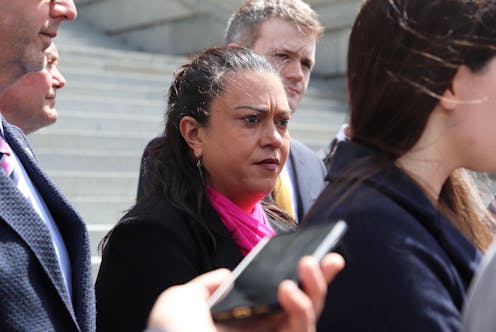
And last week in parliament, Labour minister Kelvin Davis accused Act MP Karen Chhour of seeing the world through “a vanilla lens” and telling her to move “into the Māori world”. He later apologised, but Chhour said the comments had offended her:
I found that quite hurtful, the personal attack on my identity and how I see the world, and I don’t think anybody should have to justify themselves like that and justify their culture and their heritage.
Measuring ‘Māoriness’
While on the surface these incidents might look like mean-spirited “Māori bashing” by Māori, there is considerably more to them. Who “counts” as Māori is something both Māori and Pākehā have been debating since the beginnings of colonisation, when Māori were first subjected to introduced concepts of race, blood quantum and racial hierarchy.
Māori were expected to justify their “Māoriness” in terms of the ratio of blood in their veins and their way of living. This was part of the settler government’s interest in monitoring their intended assimilation.
Read more: Tokenism and te reo Māori: why some things just shouldn’t be translated
Over time, Māori came to internalise these foreign ways of seeing and measuring themselves, at the same time as experiencing the devastating losses of land, autonomy, culture and identity.
Holding onto culture was one of the ways Māori could resist their demise and even thrive. The “Māori renaissance” of the 1970s spurred on the revitalisation of te reo and tikanga Māori, and those who had retained these taonga were a source of hope. A “traditional” way of being Māori, based on knowledge of and competencies in Māori language and custom, was highly prized and revered.
Being “on the waka” or fighting for social justice and Māori advancement was also critical to the renaissance, and this particular “sociopolitical consciousness” has only grown in importance with the rise of Kaupapa Māori practices and policies, “by Māori, for Māori”.
Biology and culture
What this means is, like it or not, our Māori authenticity is measured by a number of indicators: do we “look” Māori in terms of hair, skin, eye colour and shape, and facial features? What fraction of Māori blood do we have?
Do we speak te reo Māori and do we operate according to tikanga Māori? Are we Kaupapa Māori in our personal and/or political orientation? Do we resist the colonising status quo and strive for the reinstatement of tino rangatiratanga?
Yes, there are diverse Māori realities, and therefore diverse Māori identities and positions. However, there is a clear yardstick against which Māoriness is judged.
Carla Houkamau’s and Chris Sibley’s scholarly article, The Revised Multidimensional Model of Māori Identity and Cultural Engagement, reflects this. Their model includes key indicators relating to perceived appearance, sociopolitical consciousness, cultural proficiency, spiritual beliefs, and feeling and being part of Māori collectives.
Arguably, many of these indicators are dependent on our socialisation as Māori. But there are many who have not been raised by biological (including Māori) kin. As a Māori adoptee, I share that experience with Karen Chhour, and both my experience and research have shown this makes for a very complicated Māori identity.
Those who are trans-racially adopted and fostered, racially Māori but culturally Pākehā through being brought up as Pākehā, often report feeling terminally “in between worlds”. Measuring up in some respects, but not others, can lead to deep-seated feelings of inadequacy, only reinforced by the judgements of others.
In addition, a sense of loyalty to adoptive parents or caregivers may translate into feeling more oriented towards the status quo, and acceptance of the dominant cultural narratives in which we were raised. Activism may feel unsafe and fraudulent – and most importantly, disloyal.
Read more: Making te reo Māori cool: what language revitalisation could learn from the Korean Wave
The personal is political
But we do have whakapapa. And that is one of the first things we learn – that this, in itself, means we are Māori. However, this too presents a problem. Contrary to reductionist notions of blood quantum, whakapapa has never entailed only the biological element – whakapapa also includes the relationships (and responsibilities) that build out from that biological base.
For those of us who have lived much of our lives outside of whānau and Māori communities, we are without the shared history and relationships that give whakapapa its richness and fullness. We are also without the shared history that might compel activism.
Our whakapapa, while everything, is still not quite enough. As Karen Chhour alluded to, it can be a long and difficult journey to reconnect and reclaim our whakapapa, and to stand as Māori.
It is important to note that in none of the aforementioned incidents of criticism or name-calling were individuals’ whakapapa questioned. Nor were they found lacking for their appearance or even cultural proficiency.
What was questioned was whether, from their relative positions of power and influence, their standpoint will contribute to Māori enduring and thriving as Māori. Yes, that challenge is also personal, but maybe it has to be. History has shown that our survival as a sovereign people depends on us making the personal political.
Authors: Annabel Ahuriri-Driscoll, Senior Lecturer Above the Bar, University of Canterbury


 Daily Bulletin


