

Read The Times Australia

Daily Bulletin

NASA's asteroid deflection mission was more successful than expected. An expert explains how

  • Written by: Steven Tingay, John Curtin Distinguished Professor (Radio Astronomy), Curtin University
NASA's asteroid deflection mission was more successful than expected. An expert explains how

On September 26, after a nine-month journey through the Solar System, NASA’s Double Asteroid Redirection Test (DART) mission impacted an asteroid called Dimorphos.

NASA scored a bullseye, with DART – roughly the size of a vending machine – hitting Dimorphos within 10% of the 160-metre asteroid’s centre. The hit changed the orbit of Dimorphos around its bigger companion asteroid Didymos by more than 30 minutes, far exceeding the original goal.

This is the first time humans have deliberately changed the motion of a significant Solar System object. The test shows it’s plausible to protect Earth from asteroid impacts using similar future missions, if needed.

Read more: In a world first, NASA's DART mission is about to smash into an asteroid. What will we learn?

A grayscale rock suspended in air on a dark background
The Italian Space Agency’s LICIACube spacecraft acquired this image just before its closest approach to the Dimorphos asteroid, after the impact. Didymos, Dimorphos, and the plume of debris ejected from Dimorphos are clearly visible. ASI/NASA

An astonishing feat

The successful mission is an astonishing feat of science and engineering. In the final phases of approach before impact, DART autonomously steered itself to the impact site, processing images onboard the spacecraft and adjusting its trajectory without the intervention of humans.

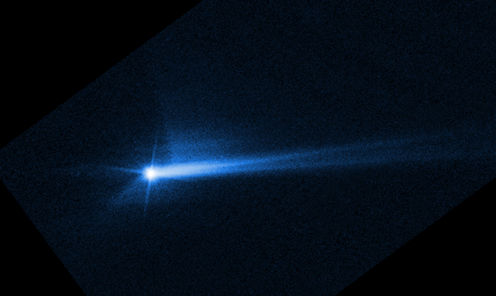
Many telescopes on Earth, and an Italian spacecraft that tagged along with DART, were able to obtain amazing images of the impact. Even small telescopes captured spectacular views, showing an enormous plume of debris from the impact that developed into a trail now following the asteroid through space.

The DART mission was the first test of planetary defence – the use of a spacecraft to change the trajectory of an asteroid.

In the future, such a technique could protect Earth from asteroid impact, if we detect an asteroid on a collision course with us. By changing the direction of an asteroid when it is far from Earth, a collision could be avoided.

A blue streak on a dark background with compass arrows showing North and East
NASA’s Hubble Space Telescope shows Dimorphos 285 hours after the impact, with a tail of debris generated by the impact. NASA/ESA/STScI/Hubble

How was DART so successful?

Dimorphos was chosen as the target for DART because it is part of a double asteroid system – it orbits a larger, 780-metre asteroid called Didymos. Before the impact, this orbit was very regular and could be measured by large telescopes from Earth. Measurements showed the period of the orbit was about 11 hours and 55 minutes.

The DART mission goal was to show the orbit of Dimorphos would be changed by the impact, which took place 11 million kilometres from Earth, with the spacecraft travelling at 25,000 kilometres per hour.

A zoomed-in view of the orbit of Dimorphos around Didymos. Astronomers can measure the orbit by detecting dips in the brightness of the light the asteroid pair reflect from the Sun. A small dip occurs when Dimorphos eclipses Didymos, and a bigger dip the other way around. NASA/APL/UMD

Telescopes on Earth measured the orbit before and after the impact. The minimum change to the orbit to declare mission success was 73 seconds.

The data are in and DART changed the orbit of Dimorphos by a whopping 32 minutes (plus or minus 2 minutes).

The change is large, partly because of the resulting debris plume. The act of throwing all that debris off the asteroid generated a recoil, like the recoil of a gun; the bullet is fired in one direction and the gun recoils in the opposite direction. It’s the same with the debris plume and the asteroid.

A glowing point of light on a dark background with a streak extending to one side
A side view of the streams of material from the surface of Dimorphos two days after impact. On the right, the material is forming a more than 9,500-kilometre-long comet-like tail, pushed into shape by pressure from the Sun’s radiation. CTIO/NOIRLab/SOAR/NSF/AURA/T. Kareta (Lowell Observatory), M. Knight (US Naval Academy)

Good news for planetary defence

By any measure, DART has therefore been a huge success. DART made a bullseye and showed that missions like this can alter the trajectories of asteroids. The idea has been around for a long time, and has inspired many asteroid movies. Now, engineering and science have caught up.

If, in the future, an asteroid is found to be on a collision path with Earth, and we have enough warning, a next-generation mission based on the DART experience could well save Earth and humanity from significant losses.

DART cost approximately US$324 million, and at this point it looks like money well spent.

As more data on the impact are analysed, planetary defence techniques can be refined. We will also learn a lot about asteroids from the data collected. A European mission is planned to go to the Didymos/Dimorphos system and take a close look at the impact crater, which will provide even more detailed information.

Read more: Don't look up: several asteroids are heading towards Earth – here's how we deal with threats in real life

Authors: Steven Tingay, John Curtin Distinguished Professor (Radio Astronomy), Curtin University

Read more https://theconversation.com/nasas-asteroid-deflection-mission-was-more-successful-than-expected-an-expert-explains-how-192334

Business News

How Telematics Helps Australian Companies Improve Productivity

Operating a commercial fleet in Australia is a uniquely demanding endeavour. Between the sprawling urban sprawl of cities like Sydney and Melbourne and the immense, unforgiving stretches of the Outb...

Daily Bulletin - avatar Daily Bulletin

Inside the Icon: The BridgeMuseum Officially Opens at the Sydney Harbour Bridge

A bold new way to experience one of Australia’s most recognisable landmarks has arrived, with BridgeClimb Sydney officially opening the all-new BridgeMuseum.  Located inside the Sydney Harbour Brid...

Daily Bulletin - avatar Daily Bulletin

Is Your Brand Showing Up in AI Search? Most Melbourne Brands Aren't.

The New Front Door Nobody Told You About Something changed. Quietly. Without a press release. The way buyers find businesses in Australia has been rewired. Not replaced, rewired. Google isn't dead...

Daily Bulletin - avatar Daily Bulletin

How Australian Businesses Can Measure SEO ROI

SEO can feel vague when you are staring at a dashboard full of numbers that do not clearly connect to revenue. The key is to measure the right signals in the right order, then tie them back to outcome...

Daily Bulletin - avatar Daily Bulletin

How Commercial Roller Shutters Improve Site Security Without Slowing Operations

Security upgrades can be frustrating when they make everyday work harder. A door that takes too long to open, creates bottlenecks at shift change, or fails at the worst time can turn “better protectio...

Daily Bulletin - avatar Daily Bulletin

Why a Document Destruction Service Still Matters for Modern Businesses

Businesses generate large volumes of information every day, from staff records and contracts to invoices, reports and customer files. While attention often focuses on how documents are stored, the way...

Daily Bulletin - avatar Daily Bulletin

Bicycle Rack Safety and Space-Smart Storage

Bike storage problems usually show up as small annoyances first: tangled handlebars, scratched frames, and bikes that topple when you pull one out. Over time, those issues become safety risks, especia...

Daily Bulletin - avatar Daily Bulletin

How to Tell if a Childcare Centre Is a Good Fit for Your Child

Choosing childcare can feel like you’re making a huge decision with limited information. Tours are short, centres are often on their best behaviour, and your child might act differently in a new space...

Daily Bulletin - avatar Daily Bulletin

Car Import Timeline: What Usually Happens at Each Stage

Importing a car into Australia can feel confusing because multiple agencies and checkpoints are involved, and the timeline is shaped as much by paperwork quality as it is by shipping speed. The most u...

Daily Bulletin - avatar Daily Bulletin

The Daily Magazine

Gold Migration Lawyers in Liquidation: How the Closure Affects Your ART Appeal

If your appeal was with Gold Migration Lawyers, a recent change to how the Tribunal decides cases ...

The pressure cooker: life in urban Australia in 2026

Australian cities have always been demanding. Long commutes, rising housing costs, busy schedules a...

What Actually Makes a Good Criminal Lawyer in Melbourne

Most people only think about this question once. That is usually too late. Most people charged wi...

Why Working With A Chatswood Tutor Can Improve Academic Performance

Academic expectations continue increasing for students across primary school, high school, and senio...

Is It Worth Getting Solar Panels in Melbourne?

The real question is not whether solar works in Melbourne. It works. The question is what it is co...

How A Diploma Of Project Management Builds Practical Skills For Modern Work Environments

Developing the ability to plan, execute, and deliver outcomes efficiently is a key requirement in to...

How to Choose the Right Football for Every Level

Choosing a football may seem straightforward, but the right option depends on who will be using it a...

What to Ask a Wedding Photographer Before You Book

Booking a wedding photographer can feel deceptively simple: you like the photos, you like the vibe...

Why Stress Relief For Dogs Is Essential For Emotional Balance And Long-Term Wellbeing

Managing emotional health is just as important as physical care when it comes to pets, which is why ...