

Friday essay: fame, male privilege and a media circus – revisiting Errol Flynn's rape trial 80 years on
- Written by: Patricia A. O'Brien, Faculty Member, Asian Studies Program, Georgetown University; Visiting Fellow, Department of Pacific Affairs, Australian National University., Georgetown University
Warning: this article contains descriptions of sexual and colonial violence.
Eighty years ago, the Pacific War felt close to Los Angeles. In October 1942, America was still reeling from the attacks ten months before on Pearl Harbor. Across the Pacific, Americans and Australians were locked in titanic battles against the Japanese on air, land and sea, especially in the Solomon Islands.
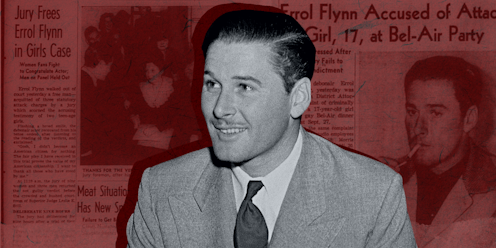
On October 17, as Japan launched a vicious attack on American forces on the island of Guadalcanal, news of an Australian-born man much beloved by Americans hit the papers. It was the first report of a stunning and dark LA story that would consume public attention.
Actor Errol Flynn was accused of raping a 17-year-old girl at a party in Bel-Air. Flynn’s woes multiplied four days later when two more charges were brought against him for twice raping a 15-year-old girl aboard his yacht a year earlier.
So began a salacious, high-stakes, Hollywood saga, opening a window onto a very different world of men than those fighting the war. In this privileged realm, sacrifice and suffering were nowhere to be found. And this test of the statutory rape laws involved arguably the biggest film star of the day.
Seven years earlier, Flynn had transformed from an Australian nobody – “a Warner Brothers stock player like a million others” – to a Hollywood idol thanks to his casting in the title role of the 1935 film Captain Blood. Flynn quickly became an iconic action hero. His was a mix of physical beauty, devilish charm, gallantry and a raw colonial masculinity enacted in fighting scenes. He was so often armed with swords he earned the sobriquet of “swashbuckler”.
By 1942, Flynn had made 19 films and was famous for his performances in Charge of the Light Brigade (1936), Robin Hood (1938), The Sea Hawk (1940), and as the US hero, George Armstrong Custer, in They Died With Their Boots On (1940).
He was also famous for embodying a new type of promiscuous, white masculinity rebelling against the suffocating confines of monogamous marriage. Flynn was a blend of eugenic perfection and frontier manhood familiar to both American and Australian audiences steeped in the national legends of conquest.
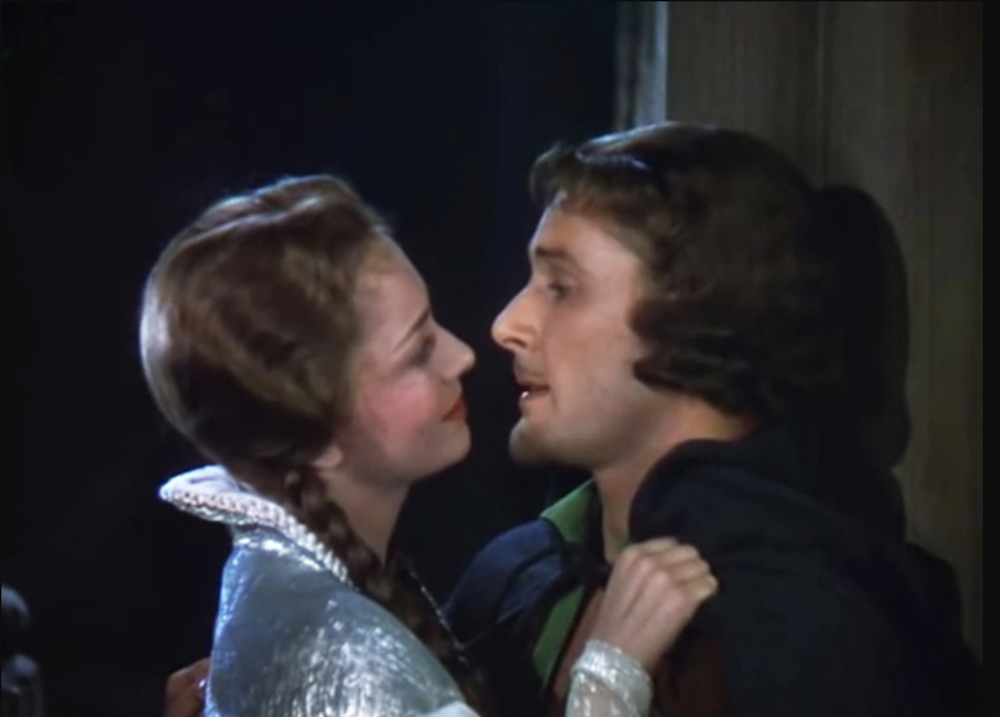
In late 1942, legal proceedings began against Flynn over the three charges of statutory rape in relation to the Bel-Air party and his yacht. At the same time, film-goers were watching him play an Australian air-force pilot, Terry Forbes alongside future US president, Ronald Reagan, in a stirring but improbable anti-Nazi drama, Desperate Journey.
As America’s war rapidly escalated, Flynn, along with hundreds and thousands of others had tried to enlist in the US armed forces. (Flynn had been granted American citizenship just before his trial). Rejected because he had tuberculosis, he was thus confined to performing war heroism on screen.
Colonial privilege
Flynn may have acted the soldier many times, but his colonial persona was drawn from real life. Born in Tasmania in 1909, Flynn’s childhood was scarred by his parents’ troubled marriage. He performed poorly at school and was expelled from institutions in Tasmania, London and Sydney. From age 18, Flynn spent almost six years in Australia’s colonies of Papua and New Guinea. Between 1927 and 1933, he tried to strike it rich in a range of occupations and enterprises, from government service to managing copra and tobacco plantations to running inter-island vessels, dynamite fishing, gold-seeking, and labour recruiting.
Unlike thousands of other men of his generation who became soldiers from 1939, it was only in New Guinea that Flynn was armed and ready to combat the local people, a standard practice in that parlous colonial world.
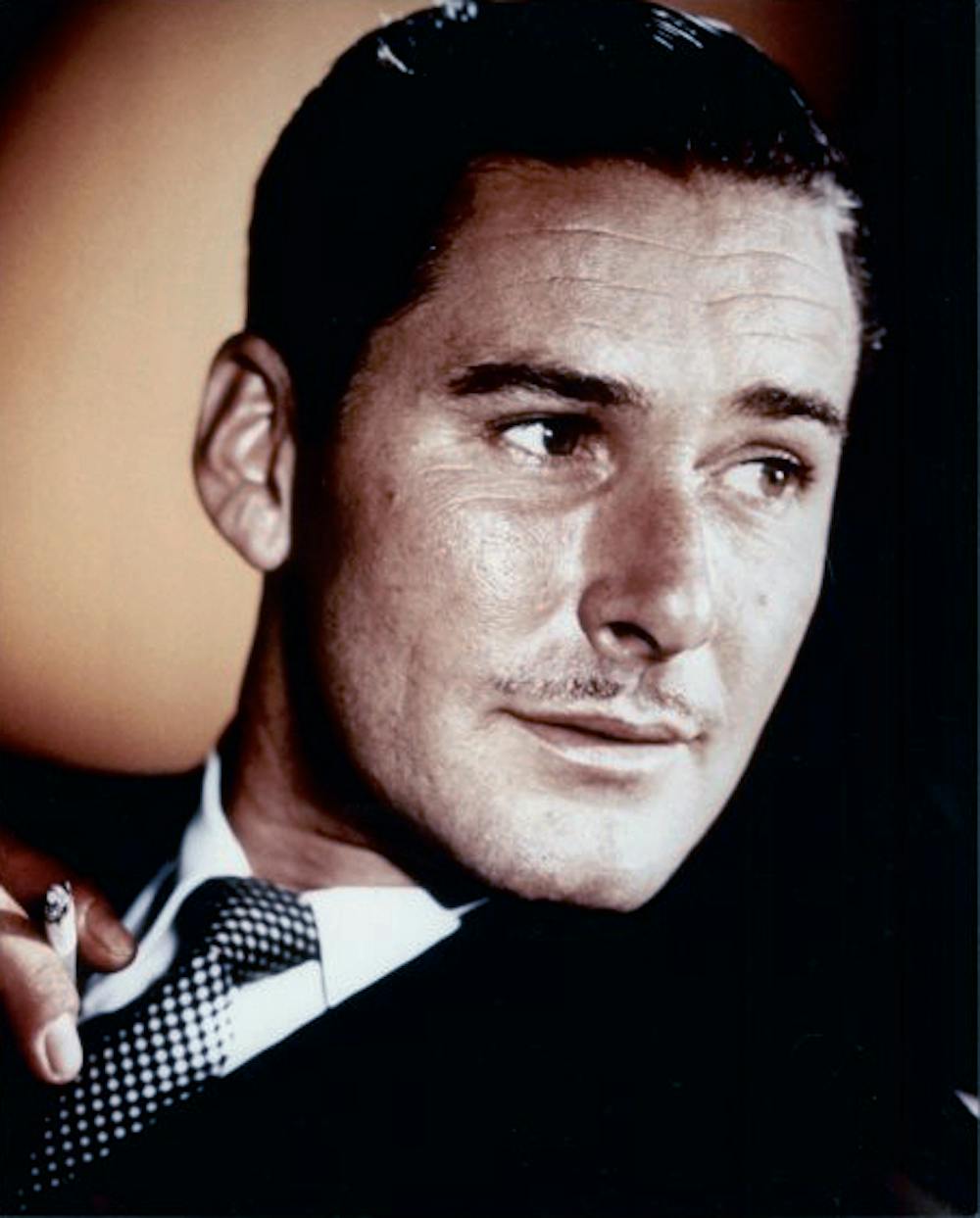 Errol Flynn pictured in 1940.
Wikimedia Commons
Errol Flynn pictured in 1940.
Wikimedia Commons
In the New Guineas, Flynn learned the creed of being a white colonial man and all the powers and privileges, especially sexual privileges in a violent setting, this afforded. Years after the fact, Flynn not only acknowledged numerous intimate encounters in New Guinea but that he had them with very young girls. He argued that age did not matter there.
Flynn was part of a colonial world where such intimacies were pervasive. And, as the New Guinea colony’s administrator once candidly put it, New Guinea women’s “like or dislike” of forming relationships with Australian men “was not of the least importance”. It was here that Flynn said he became a “man”. New Guinea cast a long shadow over Flynn’s identity and imagination, shaping his desire for young girls and sex infused with power.
When Flynn, aged 33, appeared in a Los Angeles court in October 1942 for his arraignment on three statutory rape charges, his two teenage accusers were drawn out of obscurity. In August 1941, 15-year-old Peggy Satterlee had been on day trips with her sister on Flynn’s boat, the Sirocco. He then invited her on a longer voyage during a shoot for Life magazine. Satterlee claimed on the first night, after he had spiked her drink with liquor, Flynn came to her room and raped her. The following night, she alleged, he lured her to another cabin and raped her again.
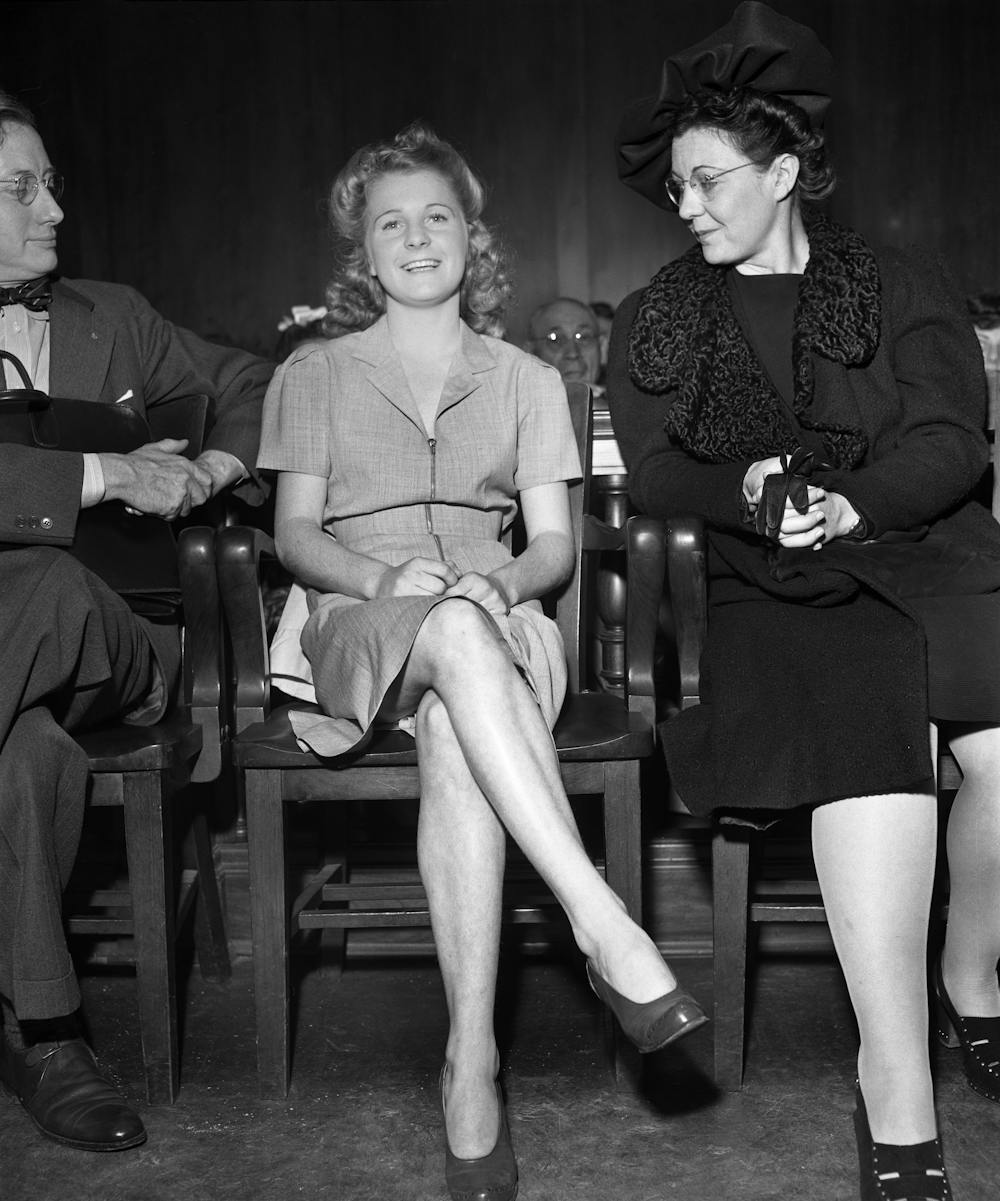 Betty Hansen (centre).
Getty
Betty Hansen (centre).
Getty
Betty Hansen, meanwhile, had graduated from high school in Lincoln, Nebraska in June 1942 before moving to LA, where her older sister lived. While working at a drug store, a Warner Brothers studio employee invited her to the Bel-Air Party to meet Flynn. He told her Flynn might be able to get her work in the movies “if she played up to him”.
Betty complied and after Flynn gave her a drink, she felt ill. He took her upstairs where she said he undressed her and had sex with her.
Yet it was deemed that both girls had committed “crimes”: one had later undergone an abortion and the other had performed an illegal “sex act” with another man and was in “protective custody” throughout the subsequent legal proceedings.
Flynn denied the charges, arguing instead that the girls were trying to get rich by making accusations against him. Flanked by his two attorneys, he walked a corridor “crammed with curious women” and fans to hear the evidence against him. Proceedings did not go his way and the case proceeded to a preliminary hearing on the three statutory “morals offenses”.
Immediately after this hearing Flynn started planting the seeds of a great conspiracy story involving studios and politicians in which he was framed, an argument he pushed once the case was over. “It is very strange,” he said, “that I am now charged with an alleged offense that supposedly took place more than a year ago.”
Appealing to the wartime patriotic mood, Flynn concluded,
recently I became an American citizen and have absolute and abiding faith in American principles of justice. I am confident my innocence will be demonstrated in court beyond any doubt.
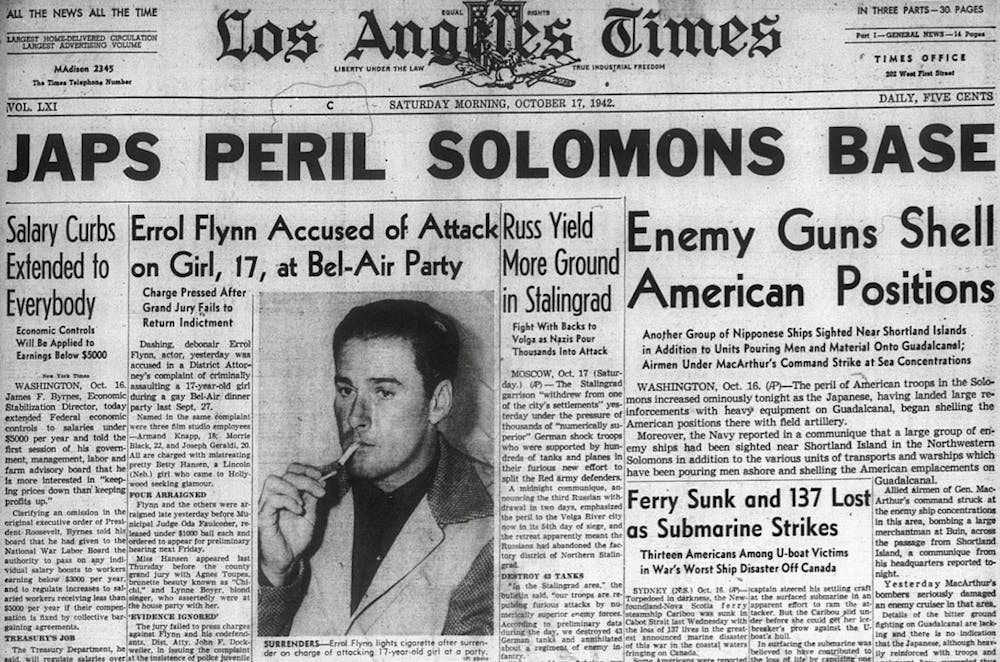 News of the rape allegations in the Los Angeles Times.
Author provided
News of the rape allegations in the Los Angeles Times.
Author provided
Smiles and glances
In November, a preliminary hearing was held into the three charges. Would Flynn’s legions of fans, especially women, desert him now he was accused of rape? Those questions were answered by the capacity crowds gathered outside the courtroom hoping to catch a glimpse of the star. Fortunate fans got seats inside the court to witness the proceedings, which would determine if Flynn would face a trial and a possible 50-year jail term.
His lawyers inflicted damage on contrary versions of events. But Satterlee vividly recalled Flynn “attacking” her on his boat in ways that were “so savage” she feared “he would murder me”. The judge thought he had a case to answer and sensationally, Errol Flynn was ordered to stand trial.
When Flynn’s trial opened on 11 January, 1943 his performance in the courtroom was arguably the most consequential of his career. The young accusers were photographed and subject to even greater scrutiny as they appeared in court without any measures to protect their anonymity. It was free public entertainment of the most titillating kind. Much of the testimony was deemed unprintable in family newspapers.
So sensational had this trial become that crowds of women, from girls to grandmothers, clamoured for entry into the courtroom. Medical teams were on hand “in case fans fainted and had to be resuscitated”. Barricades were erected to hold back crowds that began gathering two hours before the court doors opened. When they did open, identifications were checked to ensure no woman younger than 21 was permitted; so unsuitable was the content of the case for delicate female ears.
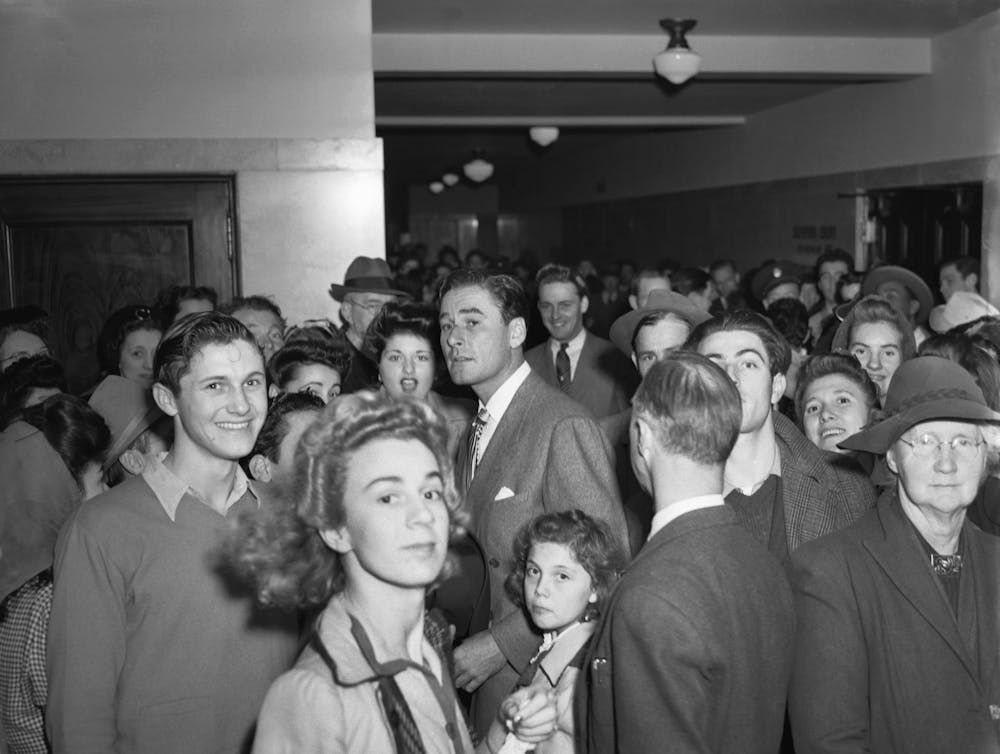 Crowds outside the courtroom.
Getty
Crowds outside the courtroom.
Getty
The much younger accusers were given no such protections at all as the prosecution, and the press, applied maximum pressure to the teenagers.
Outside, women crowded around the courthouse, grabbing at Flynn as he passed by, giving him words of encouragement, begging for autographs, even souveniring buttons ripped from his bespoke suits.
He received thousands of letters from adoring, mostly female, fans. His films had become sellouts, so Warner Brothers rushed his next film, ironically titled Gentleman Jim, through production. Flynn’s rape trial had not only added lustre to his star, it was “extraordinarily good for business,” one newspaper reported.
 The film Gentleman Jim, in which Flynn starred as heavyweight boxing champion James J. Corbett.
idmb
The film Gentleman Jim, in which Flynn starred as heavyweight boxing champion James J. Corbett.
idmb
Women played critical roles as accusers, witnesses and onlookers but arguably the most important women in this whole affair – for Flynn at least – became the jurors.
Flynn’s defence team wanted an all-woman jury, a tactic the prosecution opposed. A pool of potential jurors were questioned for nearly three days about whether they believed in a “Hollywood double standard – one for actors and actresses and another for non-professionals” (but notably not a sexual double standard for men and women) and whether they were willing to “waive their modesty for the duration of the trial”.
They were asked
if the complaining witnesses […] cried on the witness stand, would you sympathise with them or would that cause you to pity them.
A nine-woman and three-man jury was empaneled. Along with their names, occupations and street addresses, photographs of the jurors were published prominently. The women were housewives, the three male jurors were a retired grocer and insurance salesman, a retired civil engineer and a utility company employee.
Dressed in dark and dour attire as “respectable” middle-class ladies, at first glance the women jurors seemed unlikely candidates to empathise with Flynn. But he did his best to ensure their sympathies lay with him.
Across the courtroom, he exchanged “glances and smiles with the motherly ladies” as one newspaper reported, and as the trial progressed it became clear Flynn stirred something in these women, though they were “mature, to say the least, and many bespectacled and plain”.
Suspect virtue
Flynn’s lawyers went after the accusers with vengeance. The young women were nervous and stumbled over the forensic examination of events presented to them; they came across to the jury as scheming liars.
Also, the defence team was at pains to stress that these were working-class girls, poorly educated and supervised and their virtue very suspect.
Their short sexual histories were forensically examined (Flynn’s famously prolific sexual history was considered irrelevant) and used to sway the jury’s opinion about who was the innocent party.
The defence also hammered the notion that the charges against Flynn were a money-making scheme. The judge deemed the vivid account of Satterlee inadmissible. He therefore took the most relevant and revealing piece of evidence out of the case.
Witnesses at the Bel Air party gave conflicting accounts. Meanwhile, a medical examiner examined Satterlee after the yacht trip and reported “evidences of recent molestations” – but this was discounted in court because the doctor was a woman. A photographer also testified that Satterlee was distressed after the boat trip ended. But essentially, the case boiled down to the testimony of the girls against that of Flynn.
After his lawyers demolished the accusers, it was Flynn’s turn to take the stand. “Unsmiling and serious”, according to the Chicago Daily Tribune, Flynn did not deviate from his “firm, blanket denial” that he was guilty of any misconduct. He emphatically denied having sex with either girl though he acknowledged taking Satterlee on his yacht and meeting Hansen at the party.
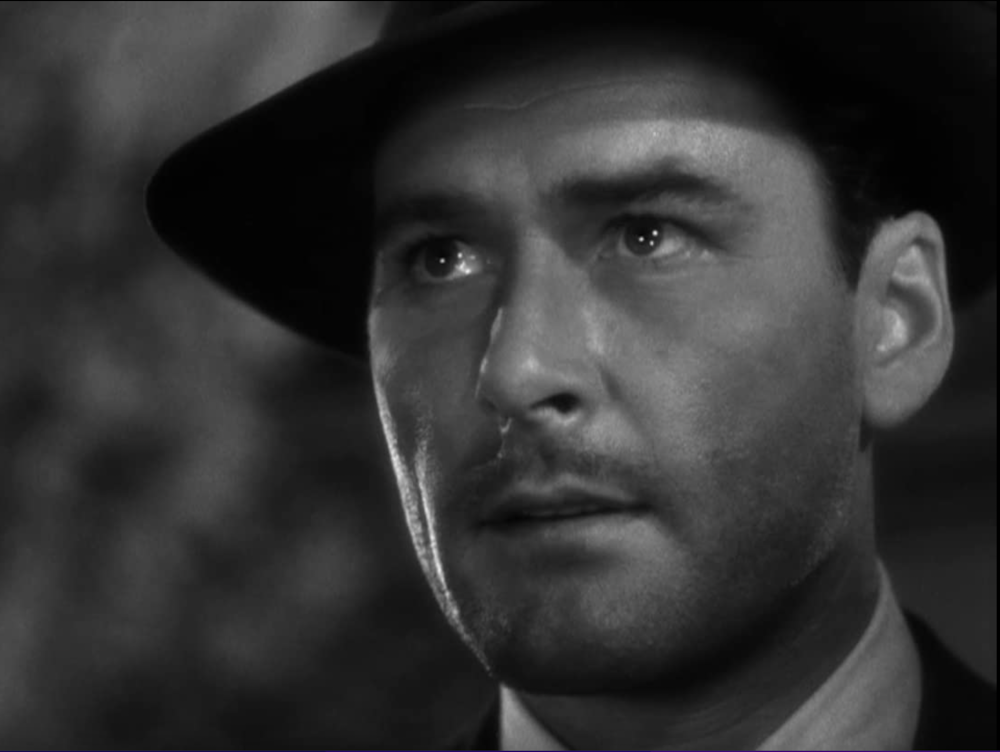 Flynn did not deviate from a firm, blanket denial.
imdb
Flynn did not deviate from a firm, blanket denial.
imdb
In dramatic cross-examination, Flynn’s lead attorney stood in the middle of the courtroom and “thunderingly” asked a series of short questions covering the allegations against him. Flynn “answered with dramatic, staccato negatives”.
Then it was the deputy district attorney’s turn to examine the witness. Despite “gruelling questioning”, Flynn did not “budge”. It was a brilliant performance.
When the prosecutor made his final arguments, he implored the jury to see through Flynn’s “charm”. Flynn “has used his great acting ability for reprehensible purposes”, he said, but he should be treated the same as every other man, and be sent to prison for his crimes.
Flynn’s lead attorney saved his grandest performance for the last. He urged the jurors to “set Flynn free and return him to Hollywood as one of its brightest stars”. Flynn was an honourable man “set upon by two scheming girls with their charges of statutory rape”.
According to AAP, the attorney Jerry Geisler shouted to emphasise his arguments. He even leapt into the witness box, squeezed his “plumpness into a chair” and “turned on a female impersonation act”, crossing his legs and aping one of the accuser’s diction.
The judge warned the jury it must regard the testimony of both accusers “with great care and caution”.
He also told the jurors that “a birth certificate was only prima facie evidence and not conclusive”, essentially arguing that Flynn was fooled into thinking the accsuers were older than they were, so carnal knowledge (even if it had happened) was not at issue. The jury was left with the clear assertion that these two young women were the predators.
On February 6, the jury returned its verdict.
When the three “not guilty” verdicts were read, Flynn leapt from his chair and rushed to the forewoman, before giving each juror, even the two elderly men who were the holdouts in his acquittal, his deepest thanks and gratitude.
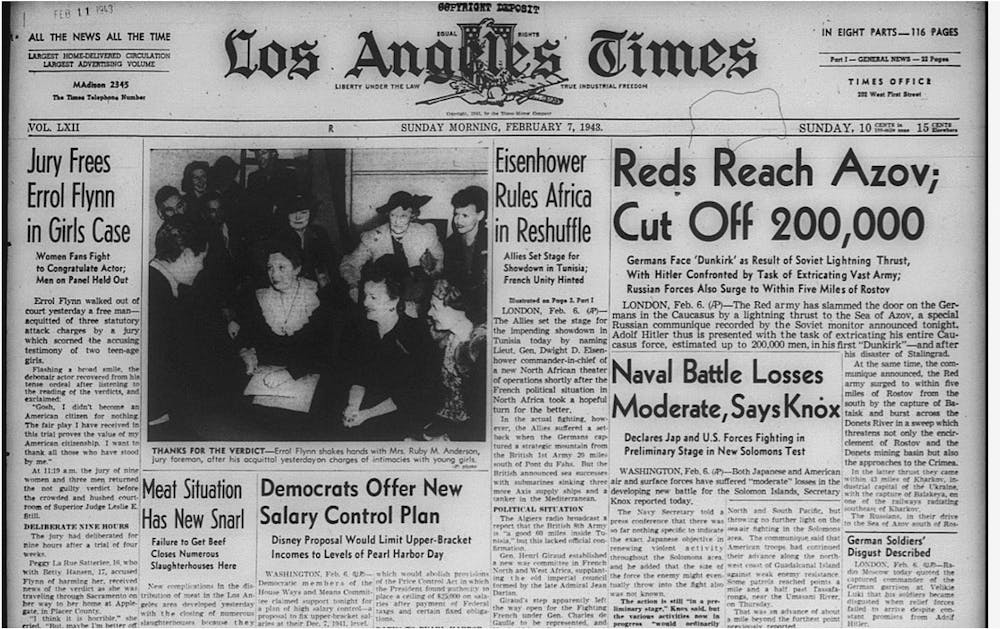 Flynn shakes hands with the jury after the verdict.
Author provided.
Flynn shakes hands with the jury after the verdict.
Author provided.
The courtroom erupted. A crowd of “semi-hysterical” women mobbed Flynn outside it. “My confidence now has been justified in essential American justice. I really mean it”, he declared. “I didn’t become an American citizen for nothing.”
Reading about Flynn’s trial today, one sees it through the lens of the resurgence of deeply conservative forces in America reacting to the gains in social empowerment women have made. Abortion, for instance, is once again a crime in numerous states.
The public spectacle also brings to mind Johnny Depp’s defamation case against Amber Heard. The legal issues in this recent trial were completely different – Depp was suing for defamation. But the case mobilised legions of Depp fans around the courthouse and on the internet who heaped scorn on Heard. Depp’s most beloved film role is the swashbuckling pirate, Jack Sparrow.
Read more: The Johnny Depp-Amber Heard defamation trial shows the dangers of fan culture
Errol Flynn was one of the first film stars to contend with fame on a mass and intense scale. His trial was a media circus, in which his male privilege was preserved. He had defeated what he termed, in echoes of colonial New Guinea, “the head-hunters of California”. His teenage accusers, lured to Hollywood’s bright lights, were compelled to participate in a traumatic court case in which the industry’s exploitation of young women was briefly exposed.
Though they were cast as scheming predators, the two girls tried to return to obscurity and rebuild their lives after the trial. It would take the #MeToo movement in 2017 – 75 years later – for the systematic abused embedded in Hollywood’s structures of power to be taken seriously.
Patricia O'Brien’s forthcoming book is a world history written through a biography of Errol Flynn.
Authors: Patricia A. O'Brien, Faculty Member, Asian Studies Program, Georgetown University; Visiting Fellow, Department of Pacific Affairs, Australian National University., Georgetown University


 Daily Bulletin


