

Think private renting is hard? First Nations people can be excluded from the start
- Written by: Wendy Stone, Professor of Housing & Social Policy, Centre for Urban Transitions, Swinburne University of Technology

Private rental housing provides homes, often long-term homes, for one in four Australian households. People can experience various forms of discrimination when seeking, living in or leaving a rental property, and for Aboriginal and Torres Strait Islander peoples it’s another one of many barriers they face. Our new research presents their views about what needs to change in Victoria’s private rental sector.
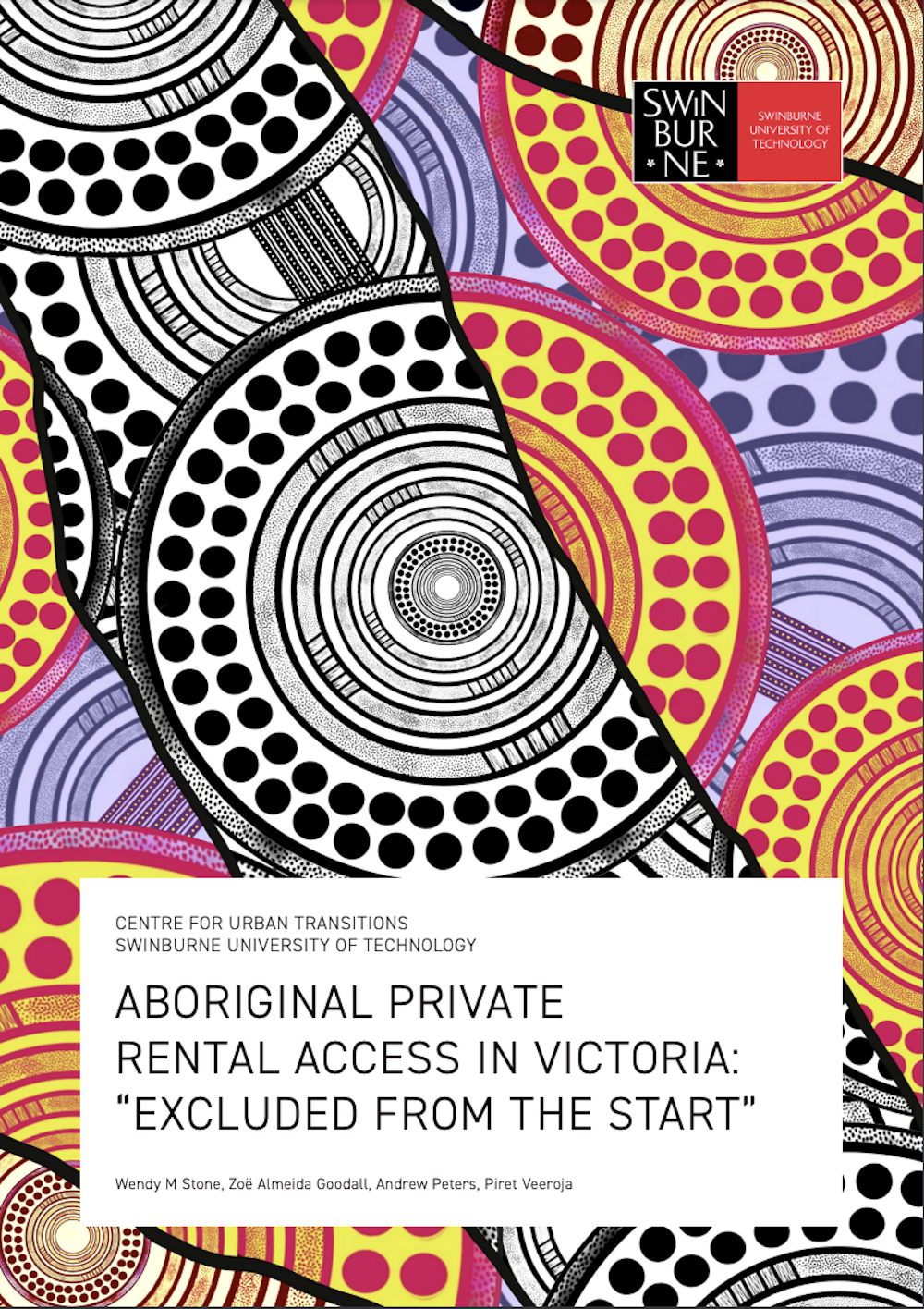
 The artwork for the cover of the report, ‘Kinship’ represents that although we are all on different paths in life, we are all extraordinary individuals connected as one to our community – and we all have the right to belong in our own unique way.
Artist: Mark Cleaver, Author provided (no reuse)
How was the research done?
The research stemmed from the recommendations of the Victorian Aboriginal Housing and Homelessness Framework, Mana-na woorn-tyeen maar-takoort. It is part of longer-term Victorian government consultation with Aboriginal peoples across the state.
Indigenous research methodologies informed the research - in particular, the use of yarning with Aboriginal participants. Research yarning privileges their story-telling and perspectives. Their experiences and perspectives informed the research.
We analysed findings and stories using the structure of the “Renter’s Journey”. It breaks down the renting process into eight stages: values and goals; need arises; searching; applying; securing; moving in; living; change.
We looked at each stage to identify both barriers and opportunities for change. Using a housing aspirations approach, we explored policy priorities shared by study participants.
Our research used four main methods:
reviews of existing evidence and approaches
yarning circles with 26 representatives of Aboriginal housing-related organisations across Victoria
yarns with 12 professionals who do work related to private rental housing and Aboriginal tenancies
yarns with 19 Aboriginal Victorians with lived experience of the sector.
What did the research find?
For Aboriginal Victorians, barriers arise at every stage of the Renter’s Journey, due to prejudice, discrimination and structural disadvantage. A homelessness and community housing services officer told us:
You get the occasional overt comment, but it’s predominantly a hidden, quite insidious perspective that they have against renting to Aboriginal people. So, yeah, it’s difficult.
Barriers are highest at the point of rental access. In some cases, real estate agencies were reported to have asked prospective tenants about their Aboriginal and/or Torres Strait Islander status. These tenants saw this as inherently discriminatory and unnecessary. As another housing professional said:
You shouldn’t be faced with the choice of ‘am I or aren’t I an Aboriginal person’ when I’m making an application for private rent.
The entire process came with anxiety. A tenant told us:
If you actually talk to a lot of Aboriginal and Torres Strait Islander people, they’ll tell you […] it’s an anxiety, it’s this thing of an overwhelming feeling that comes when they know that the only option they have is to go into private rental, because there’s nothing else available. They’re sick of couch-surfing, they’re sick of living in overcrowding, so they become overwhelmed just by the before, thinking about what the process is going to be. Am I going to be facing this? Is this going to be a challenge? Is this going to be a barrier? Am I going to have enough for this? Or am I going to have enough for the bond? […] Is the real estate [agent] and the owner going to accept an application from an Aboriginal person?
Support workers and professionals we spoke with identified discriminatory practices. These intersected with other barriers such as discrimination on the basis of low income, having lived in social housing, being a single parent, or having pets.
Read more:
Why public housing is stigmatised and how we can fix it
Another tenant told us:
I’ve applied for many places […] I was in a private rental for two years and, yeah, I applied for over a hundred rental properties, and all was not approved. Because of my income, because I’m on Centrelink, because I didn’t have previous rental history with a real estate; just those certain barriers, yeah. My income was a major factor as well.
Our report documents how systemic barriers lead to poor or unsafe housing outcomes, ongoing affordability issues and homelessness.
Read more:
We identified who's most at risk of homelessness and where they are. Now we must act, before it's too late
What are the possible solutions?
We asked participants what could be done to reduce barriers. Many suggested increased collaboration between Aboriginal-controlled organisations, government services and real estate agencies. This would help overcome the cultural disconnect between Aboriginal renters and the system.
Increasing rental assistance payments to reduce poverty was seen as essential.
Specific solutions also included:
making processes more transparent by, for example, giving tenants access to residential tenancy databases to help counter discrimination in shortlisting applications
cultural training for the real estate industry
more mentoring and support for prospective and current renters
Aboriginal-owned-and-managed private rental agencies, an idea that participants welcomed.
Initiatives such as Aboriginal Private Rental Access Programs (APRAP) and related support are a promising bridge to better housing for Aboriginal Victorians.
Our report provides cause for concern, but also optimism. Government and industry responses to this research can open the way to more connected, positive pathways.
It is highly likely the discriminatory barriers we found in Victoria are Australia-wide. Private rental can only form a significant and positive part of Aboriginal people’s housing futures where doors are open and access to housing is culturally safe and assured.
Authors: Wendy Stone, Professor of Housing & Social Policy, Centre for Urban Transitions, Swinburne University of Technology
The artwork for the cover of the report, ‘Kinship’ represents that although we are all on different paths in life, we are all extraordinary individuals connected as one to our community – and we all have the right to belong in our own unique way.
Artist: Mark Cleaver, Author provided (no reuse)
How was the research done?
The research stemmed from the recommendations of the Victorian Aboriginal Housing and Homelessness Framework, Mana-na woorn-tyeen maar-takoort. It is part of longer-term Victorian government consultation with Aboriginal peoples across the state.
Indigenous research methodologies informed the research - in particular, the use of yarning with Aboriginal participants. Research yarning privileges their story-telling and perspectives. Their experiences and perspectives informed the research.
We analysed findings and stories using the structure of the “Renter’s Journey”. It breaks down the renting process into eight stages: values and goals; need arises; searching; applying; securing; moving in; living; change.
We looked at each stage to identify both barriers and opportunities for change. Using a housing aspirations approach, we explored policy priorities shared by study participants.
Our research used four main methods:
reviews of existing evidence and approaches
yarning circles with 26 representatives of Aboriginal housing-related organisations across Victoria
yarns with 12 professionals who do work related to private rental housing and Aboriginal tenancies
yarns with 19 Aboriginal Victorians with lived experience of the sector.
What did the research find?
For Aboriginal Victorians, barriers arise at every stage of the Renter’s Journey, due to prejudice, discrimination and structural disadvantage. A homelessness and community housing services officer told us:
You get the occasional overt comment, but it’s predominantly a hidden, quite insidious perspective that they have against renting to Aboriginal people. So, yeah, it’s difficult.
Barriers are highest at the point of rental access. In some cases, real estate agencies were reported to have asked prospective tenants about their Aboriginal and/or Torres Strait Islander status. These tenants saw this as inherently discriminatory and unnecessary. As another housing professional said:
You shouldn’t be faced with the choice of ‘am I or aren’t I an Aboriginal person’ when I’m making an application for private rent.
The entire process came with anxiety. A tenant told us:
If you actually talk to a lot of Aboriginal and Torres Strait Islander people, they’ll tell you […] it’s an anxiety, it’s this thing of an overwhelming feeling that comes when they know that the only option they have is to go into private rental, because there’s nothing else available. They’re sick of couch-surfing, they’re sick of living in overcrowding, so they become overwhelmed just by the before, thinking about what the process is going to be. Am I going to be facing this? Is this going to be a challenge? Is this going to be a barrier? Am I going to have enough for this? Or am I going to have enough for the bond? […] Is the real estate [agent] and the owner going to accept an application from an Aboriginal person?
Support workers and professionals we spoke with identified discriminatory practices. These intersected with other barriers such as discrimination on the basis of low income, having lived in social housing, being a single parent, or having pets.
Read more:
Why public housing is stigmatised and how we can fix it
Another tenant told us:
I’ve applied for many places […] I was in a private rental for two years and, yeah, I applied for over a hundred rental properties, and all was not approved. Because of my income, because I’m on Centrelink, because I didn’t have previous rental history with a real estate; just those certain barriers, yeah. My income was a major factor as well.
Our report documents how systemic barriers lead to poor or unsafe housing outcomes, ongoing affordability issues and homelessness.
Read more:
We identified who's most at risk of homelessness and where they are. Now we must act, before it's too late
What are the possible solutions?
We asked participants what could be done to reduce barriers. Many suggested increased collaboration between Aboriginal-controlled organisations, government services and real estate agencies. This would help overcome the cultural disconnect between Aboriginal renters and the system.
Increasing rental assistance payments to reduce poverty was seen as essential.
Specific solutions also included:
making processes more transparent by, for example, giving tenants access to residential tenancy databases to help counter discrimination in shortlisting applications
cultural training for the real estate industry
more mentoring and support for prospective and current renters
Aboriginal-owned-and-managed private rental agencies, an idea that participants welcomed.
Initiatives such as Aboriginal Private Rental Access Programs (APRAP) and related support are a promising bridge to better housing for Aboriginal Victorians.
Our report provides cause for concern, but also optimism. Government and industry responses to this research can open the way to more connected, positive pathways.
It is highly likely the discriminatory barriers we found in Victoria are Australia-wide. Private rental can only form a significant and positive part of Aboriginal people’s housing futures where doors are open and access to housing is culturally safe and assured.
Authors: Wendy Stone, Professor of Housing & Social Policy, Centre for Urban Transitions, Swinburne University of Technology


 Daily Bulletin


