

Is tracking your sleep a good idea?
- Written by: Maximilian de Courten, Professor in Global Public Health and Director of the Mitchell Institute, Victoria University
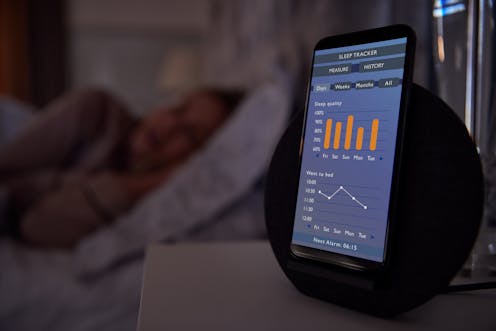
If you have trouble falling asleep or getting a good night’s sleep, it seems intuitive to work harder to solve the problem by using some of the sleep apps, bracelets and other devices that have become increasingly popular.
But could this common practice of self-monitoring your sleep result in a sleep paradox, where instead of fixing the problem we create patterns of stress and arousal that exacerbate it?
Read more: What is brown noise? Can this latest TikTok trend really help you sleep?
What is a normal sleep?
The amount of sleep we need, as well as our preferences for turning in early or staying up late, varies a great deal within individuals. Some differences are related to age, cultural, environmental, or behavioural factors and some are at least in part genetically driven.
In addition to this variation, within each human there is quite a high degree of normal sleep variation – it’s not expected to be exactly the same every night. Most adults require approximately eight hours of sleep per 24 hours, but sleep needs may range from about six to nine hours.
Read more: Has COVID affected your sleep? Here’s how viruses can change our sleeping patterns
But this normal variation in sleep isn’t well understood. Some people who think their sleep is somehow inadequate worry so much about getting a good night’s sleep that it becomes a kind of performance anxiety, rendering sleep as a source of dread.
How do sleep apps work?
Most modern sleep tracker apps use input such as sound, heart rate, and motion indicating bed time or wake time to estimate what happens.
For this, many apps use data from wearable devices such as an Apple Watch to calculate a sleep score and create graphs to show changes over time. Thus sleep tracker apps analyse sounds, movement, and heart rate as you sleep to give a snapshot of the duration and quality of your sleep, sometimes aided by questions on the sleep quality as rated by the sleeper.
These apps claim to determine how much time you spend in light sleep, deep sleep and rapid eye movement (REM) sleep and how many times you are disturbed throughout the night.
But are they accurate?
Often websites determining the best sleep apps limit their tests to the functionalities and features included – but fall short of testing whether these apps actually measure accurately what they claim.
Although sleep trackers are becoming quite accurate at detecting sleep and wake, the classification of sleep stages remains unreliable and inconsistent.
Are there potential dangers in using sleep apps?
It’s important not to put too much emphasis on data which may be imprecise, set unrealistic and uniformed sleep goals (such as viewing wakings as abnormal), or become overly anxious about sleep.
Relatively few and only small studies have focused on how these wearables can be effectively used to drive positive sleep health behaviour change. The most recent study found a slightly positive effect – but in healthy volunteers with no sleeping problem to start with.
There is a risk the increased focus on optimising these biometric data may lead to unexpected problems, such as a preoccupation and an obsession with getting the numbers right. This is becoming so common there is now a name for this condition – orthosomnia.
What is orthosomnia?
Orthosomnia is not a medical disorder – it is more accurately described as an anxiety phenomenon which is affecting people who obsess over the results of their sleep trackers.
The current knowledge of orthosomnia is based only on small case studies of few participants.
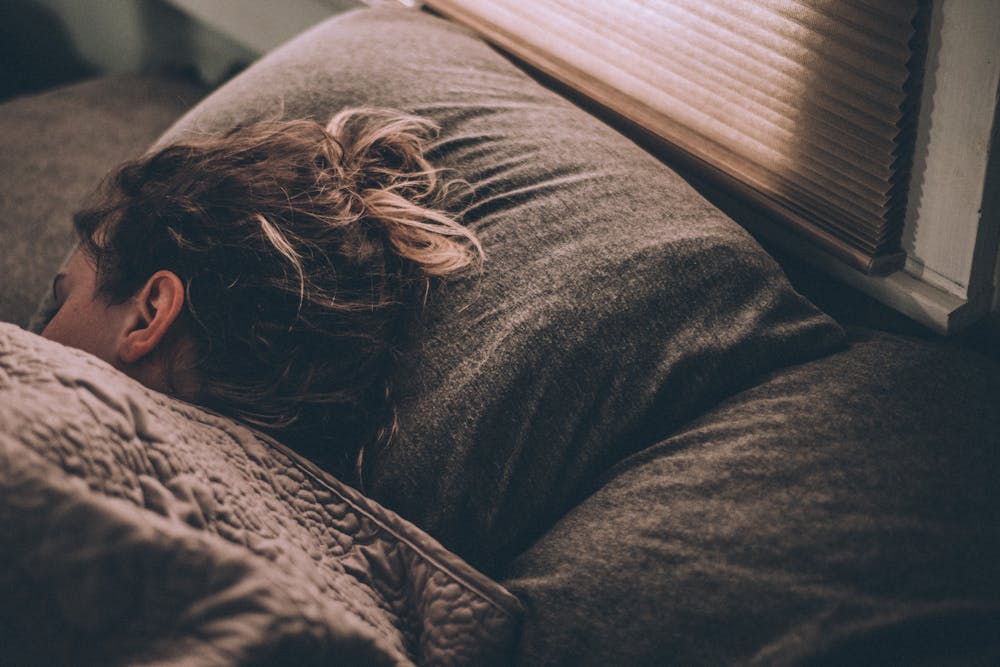 Users should be aware not all sleep data is completely accurate.
Lux Graves/Unsplash, CC BY
Users should be aware not all sleep data is completely accurate.
Lux Graves/Unsplash, CC BY
People with orthosomnia believe tracking devices offer highly accurate information about sleep and trust sleep tracker data over more objective testing like an overnight sleep study in a specialised clinic.
This can develop into unhelpful behaviours such as spending a longer time in bed in order to improve their sleep tracker data, which paradoxically worsens sleep quality and quantity.
Read more: Sleep: here's how much you really need for optimal cognition and wellbeing – new research
So is it time to uninstall the sleep apps?
Sleep tracking devices might have broad appeal and provide no risk to those people in the general population with good sleep who are interested in tracking bio-data.
But if you feel you might be preoccupied with your sleep, and find that you become anxious about your sleep, then you’re probably not a good candidate for a sleep tracker.
There is no commercially available sleep tracker that sends a stronger signal about whether you’re getting enough sleep than your own brain. If you’re alert (without caffeine), able to concentrate, feeling you’re able to have a good quality of life at work and home, then you’re probably getting enough sleep.
Authors: Maximilian de Courten, Professor in Global Public Health and Director of the Mitchell Institute, Victoria University
Read more https://theconversation.com/is-tracking-your-sleep-a-good-idea-190231


 Daily Bulletin


