

Ruapehu's slippery slopes: the uncertain future of snow sports in a climate emergency
- Written by: Holly Thorpe, Professor in Sociology of Sport and Gender, University of Waikato
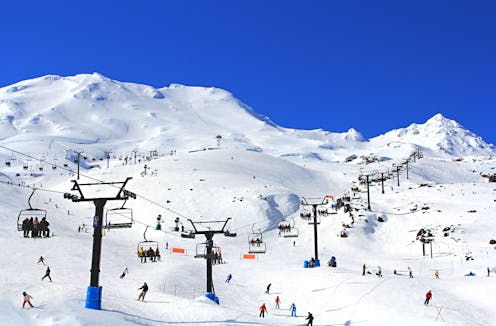
With New Zealand’s two major North Island ski fields in financial trouble, the combined impact of COVID-19 on national and international tourism and this year’s very poor snow season has hit hard. But this may be only a sign of things to come as climate change affects snow sports globally.
Ruapehu Alpine Lifts (RAL), which runs the Turoa and Whakapapa ski fields, has debts of NZ$40 million and has gone into voluntary administration. Despite calls for government support, Minister of Tourism and Economic and Regional Development Stuart Nash has said there will be no more funding beyond the $15 million in loans already provided since 2018.
For now, then, the future of snow sports on the slopes of Mt Ruapehu remains uncertain, directly and indirectly affecting many businesses and livelihoods. But RAL is not the first ski company to struggle under increasingly unpredictable winters.
Shorter or less predictable ski seasons and warmer temperatures are already causing closures elsewhere. Some foreign ski fields are pivoting to cater for summer recreational tourism such as mountain biking and hiking.
Some ski resorts in North America, Europe and Australia are now facing uncertain futures. One US study found revenues could fall 40-60% (on average) by 2080. The research is clearly showing the ways we currently practise and consume snow sports are unsustainable.
No business like snow business
Scientists from the National Institute of Water and Atmospheric Research (NIWA) recently modelled the potential impact of climate change on snow levels in New Zealand. Their report showed an average gradual decrease in snow at nearly all elevations as the century progresses.
While all ski areas will experience this, the effects will vary depending on their location and elevation. Under the warmer climate change predictions, the study showed snow depths between 83% and 45% of current maximums at lower elevation sites by 2040.
By 2090, this will be further reduced (on average) to approximately 48% to 9% of current maximum snow depths. According to NIWA snow and ice scientist Dr Jordy Hendrikz:
From these results we expect to see a gradual change in snow levels but […] we should be able to continue to make snow, even under a more extreme climate scenario, right out to the 2090s.
Read more: Beijing 2022: environmental cost of world's first Winter Olympics without natural snow – expert Q+A
The report was considered good news for New Zealand snow areas, which are reportedly “confident they will adapt to any risks from climate change”. But is a future for ski fields based mostly on making artificial snow really good news?
While some may see innovations in snow-making technologies as future-proofing the ski industry, resorts becoming highly dependent on their capacity to make artificial snow raises serious ethical and environmental concerns. The process uses huge amounts of water and chemical and biological additives, with ramifications for mountain ecosystems and potentially human health.
Greening the snow?
This presents a dilemma. For those privileged enough to visit often expensive ski resorts, the pristine mountain environment is central to the experience. Yet ski resorts are far from environmentally friendly.
With thousands of visitors every day, they have enormous carbon footprints when various factors are accounted for: travel to and from ski fields (planes, 4WD vehicles, buses), the energy demands of lifts and facilities, snow grooming and machinery maintenance.
It’s true that over the past decade there have been attempts to green the snow industry. Ski resorts have invested in sustainability planning and adaption strategies, from recycling food waste to using wind turbines and solar energy. Some clothing and equipment companies are also working to produce more sustainable and eco-friendly products.
Despite signs of change, however, there are questions about whether a form of greenwashing is taking place in the snow sports industry, as it has across the sports sector in general, where many organisations have made superficial claims of environmentalism. Research has shown ski resorts can vary widely in their communication of sustainability efforts versus their actual levels of environmentally responsible action.
From pleasure to politics
Research also suggests that committed lifestyle sports participants like skiers, snowboarders and surfers can develop close relationships with the natural environment that encourage more environmentally sustainable practices.
For example, Protect Our Winters (POW) is an international non-profit organisation (with a New Zealand chapter) where skiers, snowboarders, hikers, climbers and mountain bikers work with scientists, policymakers and politicians to advocate for greater protection of mountains.
As some scholars have observed, however, there is a degree of ecological irony in an industry and its participants claiming to be environmentally conscious while maintaining highly mobile and consumerist lifestyles.
There are other strands of resistance, too. In Aotearoa New Zealand and around the world, mountain ownership and management have long been integral to Indigenous struggles for self-determination. Local communities have recently challenged expansion plans by ski resorts for both cultural and environmental reasons.
First Nations, conservationists and backcountry skiers have been fighting the proposed Jumbo Glacier Resort in British Columbia for decades.Many ski resorts have been built on stolen land. They still represent the privilege and wealth of settler societies. Only a few acknowledge the historical and contemporary politics of ski resort land use.
Any efforts to develop a sustainable ski industry, then, will have to include conserving the environmental integrity and cultural diversity associated with the mountains themselves. But the fact remains that climate change means the future is bleak for the snow sports industry.
While the full effects will be felt by some regions, resorts and communities more than others, the policy questions raised by the troubles at RAL and Ruapehu’s iconic ski fields are urgent: what is the future of snow sports, and what are the ethics of pursuing such activities in a climate emergency?
Authors: Holly Thorpe, Professor in Sociology of Sport and Gender, University of Waikato


 Daily Bulletin


