

Steadying foreign aid budget signals the government takes development seriously
- Written by: Melissa Conley Tyler, Honorary Fellow, Asia Institute, The University of Melbourne
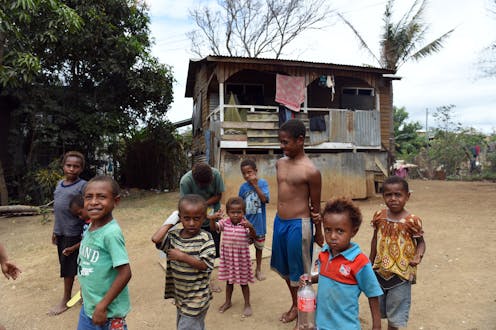
On budget night in 2014, the Abbott government cut nearly $8 billion from Australia’s international development program, the largest-ever aid cuts. Programs in South-East Asia were cut by 30%. For a government obsessed with surplus, it was seen as a sort of political victimless crime. Yes, it would hurt foreigners, but they don’t vote.
Last night’s budget announced an increase in aid of $1.4 billion over four years, including new funding beyond measures promised in the election campaign. This will prevent Australia’s development spend from dropping to its worst-ever level, as it was slated to do.
The previous Morrison government had resisted expanding the development budget beyond $4 billion, responding to the impact of COVID-19 with temporary and targeted measures. As these expired, foreign aid would have slumped to record lows. The new government has crossed this Rubicon by folding these into an increased budget of $4.65 billion.
Read more: Jim Chalmers' 'restraint' budget the first stage of a marathon for the treasurer
What’s notable is not just the funding, it’s also the way it was announced. Foreign Affairs Minister Penny Wong framed the spending as a “major step toward the goal of making Australia stronger and more influential in the world”. She positioned development spending as key to Australia’s relationships in the region.
“Without these investments,” she said, “others will continue to fill the vacuum and Australia will continue to lose ground”. The spending was key to making Australia a “partner of choice for the countries of our region”.
In his budget speech, Treasurer Jim Chalmers described the investment in development as “restoring our role as a diligent and dependable partner and friend to our Pacific neighbours – for a stable, peaceful and more prosperous region”.
This signals a commitment to development as a key tool of statecraft.
Analysts will reasonably say this budget should be seen as steadying rather than improving. The current foreign aid commitment of around 0.2% of national income is well below the international standard of 0.7% and the donor country average of 0.33%. It is also far from the Rudd-era bipartisan position of rising to 0.5%.
Meanwhile, the budget found significant funds for defence, which increased $2.66 billion to $51.5 billion. It’s fair to ask if the dollars match the rhetoric.
But for a new government five months in, putting in the hard yards of budget repair in the face of a teetering global economy, it means a lot that it has committed not to let development funding slip. Many other areas face cuts, and it must have taken tough advocacy to preserve these commitments through the budget process.
The government has committed to year-on-year growth in funding. It puts Australia’s development programs on a more secure and predictable fiscal footing.
The challenge will be to build on this budget in subsequent ones. Many of the questions reasonably being raised around the “what” and “how” can be addressed in the New International Development Policy currently being developed.
Read more: Everything you need to know about Labor's first budget in 6 charts
The federal budget is always about priorities. Among the many things the government and nation would like to do, which are the ones they are prepared to put money behind? As foreign affairs and defence mandarin Sir Arthur Tange noted, “strategy without money is not strategy”. To succeed in this environment, you need to make your case.
There are very strong arguments for development co-operation – which is why developed countries, and even some developing ones, invest money in it. But the supporting arguments come from quite different perspectives. In a speech last month, Minister for International Development and the Pacific Pat Conroy summarised four ways of making the case for foreign aid:
the security case – grinding poverty contributes to social tensions, instability and radicalisation
the economic case – supporting prosperity abroad supports prosperity at home
the international relations case – contributing to developing countries supports prosperity and stability in the region and boosts Australia’s bilateral and multilateral relationships
the moral argument – it is the right thing to do.
When the Abbott government slashed the budget in 2014, it was probably thinking of development mainly in terms of the moral case – and thought that this could be overridden as expedient.
In increasing the budget, the Albanese government is justifying its decision on the basis of the other arguments – linking it to Australia’s national interest and seeing development as a key component in Australia’s foreign policy toolkit. And perhaps the Australian public is heeding this. Since 2019, cuts to the aid budget have become less popular.
The Department of Foreign Affairs and Trade budget paper states:
In an uncertain world, the strength and diversity of Australia’s partnerships is critical. The development program is fundamental to deepening our partnerships with our Indo-Pacific neighbours.
It seems we’re starting to cement the view that an adequate development budget is non-negotiable if Australia wants to have influence in the region. Given the scale of the needs, it would be wonderful if we could aim beyond adequate.
Authors: Melissa Conley Tyler, Honorary Fellow, Asia Institute, The University of Melbourne


 Daily Bulletin


