Read The Times Australia

Daily Bulletin

Budget restraint? When it comes to transport projects, it's hard to find

  • Written by: Marion Terrill, Transport and Cities Program Director, Grattan Institute
Budget restraint? When it comes to transport projects, it's hard to find

“Restraint” – that’s what Treasurer Jim Chalmers claimed as the watchword of Tuesday’s federal budget. Perhaps the claim can be made in general, but when it comes to transport infrastructure, the budget is remarkable not for how different it is to budgets past, but how similar. It has left plenty of opportunities for actual restraint for next time around, in May 2023.

The first similarity to budgets past is how much is being committed to transport infrastructure.

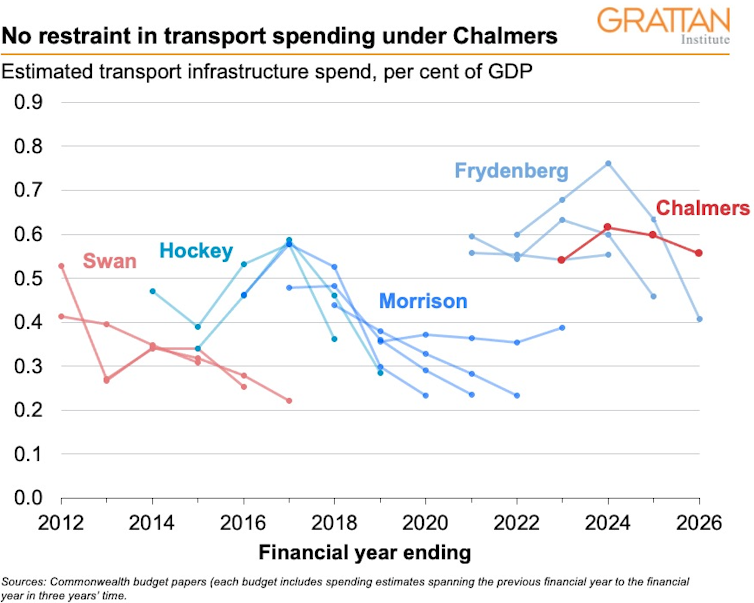
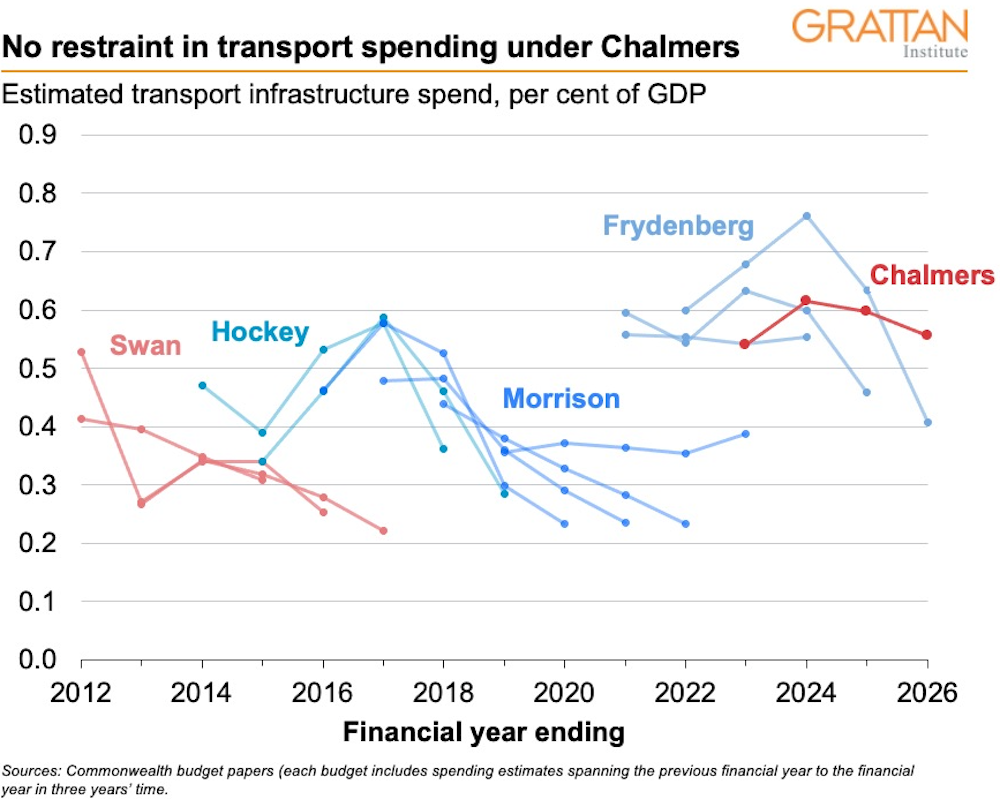
This year the total is about 0.6% of GDP, much like Josh Frydenberg’s budgets of the past three years. That equates to A$13.4 billion this year, rising to about A$15 billion for each of the next three years.

Chart showing level of transport spending in federal budgets, 2012 to 2022
Author provided What Frydenberg and Chalmers have in common is that they have presided over a big shift upwards in the total spend, from around 0.4% of GDP under their predecessors Scott Morrison, Joe Hockey and Wayne Swan. It’s hardly “restraint”. Headline numbers are inflated The second similarity to budgets past is the irresistible temptation to quote far bigger numbers than are actually committed in the budget. It’s all very well to say what you plan to deliver in ten years and beyond, but the budget is all about what you’re committing this year and the following three. It’s just like legislating stage 3 tax cuts in 2019; three years and a pandemic later, it’s hard to backtrack. The problem is exacerbated because the headline number includes projects already committed long ago. The claim in the budget glossy is that the Albanese government “is delivering on its election commitments as part of the more than $120 billion pipeline of investment in transport infrastructure over the next 10 years”. But what’s actually committed in the budget for additional road and rail is $8.1 billion of new money over ten years. Most of the eye-watering $120 billion predates this government. For example, New South Wales residents may applaud the promise to spend $300 million on western Sydney roads and $500 million on early works for high-speed rail, and a total NSW commitment of $1.4 billion over ten years. But it’s hard to square that with the infrastructure minister’s promises of $5.25 billion for the Sydney Metro to Western Sydney Airport, and $1.6 billion for the M12 motorway. Similarly, Victorians may eagerly anticipate the $125 million for the Barwon Heads Road upgrade and $2.2 billion towards the Suburban Rail Loop. There’s a total commitment of $2.6 billion for the state over ten years. But how does that line up with the minister’s promises of $5 billion for Melbourne Airport Rail, along with $448 million for Gippsland Rail? Infrastructure Australia bypassed The third similarity to budgets past is how projects are selected for funding. Prime Minister Anthony Albanese is proud of Infrastructure Australia. It’s the body he set up as infrastructure minister in the Rudd government to help elected representatives who, he said, struggled “with the need to take a long-term non-partisan view” of infrastructure. Yet this budget includes billions of dollars for projects that should have gone through an Infrastructure Australia assessment, but haven’t. The standout is Melbourne’s Suburban Rail Loop. It’s the signature project of the Andrews state government as it heads into a November election. The project was announced three months out from the previous Victorian election, and a business case wasn’t published until three years after the decision to invest. It’s very controversial. The state government claims that building the east and north sections of the rail loop and operating them for 50 years will cost $31 billion to $51 billion. In stark contrast, the Victorian Parliamentary Budget Office calculates it will cost $200 billion. What does Infrastructure Australia think? It considers the project a very long way from investment-ready. Another standout is a $500 million down payment on high-speed rail. Even without a current business case, the government has declared it is “absolutely committed” to the project. If the numbers run in 2013 were correct, this project will cost at least $130 billion, and will compete with the since-begun Western Sydney Airport. What does Infrastructure Australia think? Again, it considers that even corridor preservation for the project is a long way from investment-ready. A third standout is $586 million to upgrade the Bruce Highway through Brisbane’s outer northern suburbs. The Bruce has had a massive program of upgrades over many years. Many sections have been assessed by Infrastructure Australia – but not this one. None of these decisions could be described as restrained, and there are many similar. Still waiting for rigorous assessments Of course, it’s not easy to inherit a swag of major projects from the previous government, many of which are begun or at least anticipated. And it’s to this government’s credit that it has moved $6.5 billion worth of these projects to beyond the budget forward estimates, in recognition that the engineering construction sector is already struggling to keep up with demand. But in this environment, it makes little sense for the government to have thrown its weight behind new commitments, such as east-coast high-speed rail and the Suburban Rail Loop, that will tie its hands for decades to come. Next time around, the treasurer should insist that each individual project up for funding consideration has been properly assessed by the government’s own independent advisory body. If the project is at too early a stage, the government shouldn’t invest public money in it. A more rigorous project-by-project assessment would help the government determine how much of the transport spend is really worth it. Let’s hope. When it comes to transport, restraint is hard to find. Authors: Marion Terrill, Transport and Cities Program Director, Grattan Institute

Read more https://theconversation.com/budget-restraint-when-it-comes-to-transport-projects-its-hard-to-find-192848

Business News

Australian organisations are relying on business continuity plans built for a far more predictable world

Tariff escalations, supply chain fragility, geopolitical events, and the ongoing threat of cyber disruption have reshaped the risk environment facing Australian organisations. The problem is that ma...

Daily Bulletin - avatar Daily Bulletin

How to Rent a Car for Uber in Melbourne: What Every New Driver Needs to Know

Starting out as an Uber driver in Melbourne is not as complicated as it sounds but getting the vehicle right is where most new drivers get stuck. Uber has strict requirements around vehicle age, condi...

Daily Bulletin - avatar Daily Bulletin

When Should You Speak to a Lawyer About a Legal Issue?

Legal issues can begin with a simple question, then become harder to manage once formal steps are involved. Many people wait until a matter feels urgent before seeking guidance, even though earlier ...

Daily Bulletin - avatar Daily Bulletin

The strategic rise of Bali as Australia’s next essential healthcare support hub

As Australian healthcare providers grapple with unprecedented operational bottlenecks, a new nearshore model is quietly transforming patient care delivery. Forward-thinking organisations,  including...

Daily Bulletin - avatar Daily Bulletin

Cost Savings and Benefits of Using Used Pallets in Logistics

In today’s competitive logistics and supply chain industry, businesses are constantly looking for ways to reduce operational costs without compromising efficiency and reliability. One of the most prac...

Daily Bulletin - avatar Daily Bulletin

How Fulfilment Services in Australia Help Businesses Scale Efficiently

The growth of e-commerce and modern retail has transformed customer expectations. Consumers now expect fast shipping, accurate order processing, and seamless delivery experiences regardless of where...

Daily Bulletin - avatar Daily Bulletin

Practical Ways Australian Workplaces Can Reduce Operating Costs

Reducing business costs doesn’t always mean cutting staff, shrinking services or making the workplace feel bare-bones. In many cases, the smarter savings are hiding in everyday operations: the light...

Daily Bulletin - avatar Daily Bulletin

Executive Recruitment Solutions That Help Organisations Secure Exceptional Leaders

Leadership has a direct impact on organisational performance, employee engagement, strategic growth, and long-term success. Businesses operating in increasingly competitive environments require experi...

Daily Bulletin - avatar Daily Bulletin

Why A WooCommerce Website Designer Matters For Online Growth

Running an online store today requires more than simply listing products and waiting for customers to arrive. Businesses need a website that is fast, reliable, easy to navigate, and designed to suppor...

Daily Bulletin - avatar Daily Bulletin

The Daily Magazine

DIY Rodent Control Vs Professional Help: When Is It Time To Call The Experts?

Rodents are one of the most frustrating pest problems for Australian property owners. Rats and mic...

Lighting Shop in Perth: How The Right Lighting Can Transform Your Home And Business

The right lighting can completely change the look, feel, and functionality of any space. Whether it ...

Traffic Light System Solutions For Safer And More Efficient Traffic Management

Modern cities and growing communities rely heavily on effective traffic management to ensure safety...

Gold Migration Lawyers in Liquidation: How the Closure Affects Your ART Appeal

If your appeal was with Gold Migration Lawyers, a recent change to how the Tribunal decides cases ...

The pressure cooker: life in urban Australia in 2026

Australian cities have always been demanding. Long commutes, rising housing costs, busy schedules a...

What Actually Makes a Good Criminal Lawyer in Melbourne

Most people only think about this question once. That is usually too late. Most people charged wi...

Why Working With A Chatswood Tutor Can Improve Academic Performance

Academic expectations continue increasing for students across primary school, high school, and senio...

Is It Worth Getting Solar Panels in Melbourne?

The real question is not whether solar works in Melbourne. It works. The question is what it is co...

How A Diploma Of Project Management Builds Practical Skills For Modern Work Environments

Developing the ability to plan, execute, and deliver outcomes efficiently is a key requirement in to...