

Drone delivery is a thing now. But how feasible is having it everywhere, and would we even want it?
- Written by: Jonathan Roberts, Professor in Robotics, Queensland University of Technology
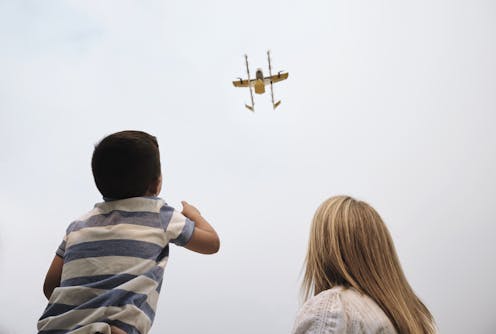
In recent years, cafes, supermarkets and online shops have started to trial drone delivery in a handful of locations around the world. More than a dozen drone delivery companies are now running such trials.
Just this week, Wing (owned by Google’s parent company Alphabet) announced a partnership with Australian supermarket giant Coles to deliver small items via drone to customers close to a Gold Coast supermarket. Wing is already operating in parts of Canberra and Logan, Queensland.
Given the technical success of various trials so far, it is worth exploring whether drone delivery might become mainstream and can actually be scaled up geographically.
As you would expect, the answer is “it depends”. There are many issues when considering drones around people, such as safety and infrastructure. For example, a recent crash of a delivery drone on electricity lines in a suburb of Logan left thousands without power.
There is also potential unwanted noise and visual pollution, and a perceived issue around privacy.
Safety first
Adding potentially dozens of small aircraft to the sky above our homes, workplaces and roads each day is a serious business. As you would hope, currently the operation of commercial drones is a highly regulated undertaking in most countries.
In Australia, the Civil Aviation Safety Authority has strict regulations that aim to make the operation of drones as safe as possible. They also prohibit drone use if the craft can’t be used safely in a given situation.
In fact, Australia was one of the first countries to have drone regulations. For example, you cannot fly a drone close to an airport, or directly over people.
Commercial operators of drones are acutely aware of this and gain a licence to operate – it is not in anyone’s interest to operate unsafely, and it would be bad for business.
A limited geographic market – for now
To satisfy the requirement of operating drones safely, delivery operators focus on flying drones over unpopulated land, generally very low-density areas, and in particular the urban fringe. These are newer suburbs where drone flight paths can be planned to eliminate or minimise safety issues, such as an unexpected crash.
It is no coincidence Wing has been running drone delivery trials in low-density areas of Southeast Queensland, and outer Canberra suburbs. These places are ideal for drone delivery and a great place to continue to develop this business, even if the odd bird attack can disrupt things.
But drone delivery in dense parts of major cities? This is very unlikely in the medium term, due to extreme difficulty in safely operating drones in dense suburbs.
If you live in an apartment building, where would the delivery take place? On the roof? Maybe, if your building was set up for it. This is where scaling up faces the largest difficulties, and the logistics of running potentially hundreds of drones from a distribution centre become truly challenging.
Zipline and Walmart team up for drone delivery.However, if there was a high demand for it, and the right investments were made, it is feasible that drone delivery to dense city areas could be achieved.
But just because it might be technically possible, doesn’t mean it will happen. The long-term business case would need to make sense, of course. But there is a more critical issue in the near term – the social licence to operate.
A social licence
A social licence is not an official thing, a government body does not issue one. It is more about whether the general public accepts and supports the new thing.
At the end of the day, this social acceptance is what often determines the success or failure of widespread uptake of new technology, such as delivery drones.
Take nuclear power, for example. Many countries have nuclear power and the public there seem happy with that. Other countries had a social licence for nuclear power and lost it, such as Japan. In Australia we do not have a social licence for nuclear power, but that does not mean we won’t gain it in the future.
Read more: From divestments to protests, social licence is the key
A social licence is an ever-evolving construct based on the pros and cons of a technology, all of which is influenced by its perceived value. Most people are now seemingly comfortable to be tracked 24 hours a day by their smartphones, as they believe the benefits outweigh the potential negative impacts.
It is likely we already have a solid social licence to use drones to deliver emergency life-saving medicine to people in need. In a potential life-or-death situation like that, it is easy to see that normally the benefits outweigh any risks or inconvenience to others.
But delivering a coffee or a tube of toothpaste by drone? I think the social licence for that is up for grabs. At this point in time, it could go either way.
Authors: Jonathan Roberts, Professor in Robotics, Queensland University of Technology


 Daily Bulletin


