

What’s in the mud? Flood victims' fears eased by early test results
- Written by: Mark Patrick Taylor, Victoria's Chief Environmental Scientist, EPA Victoria; Honorary Professor, School of Natural Sciences, Macquarie University
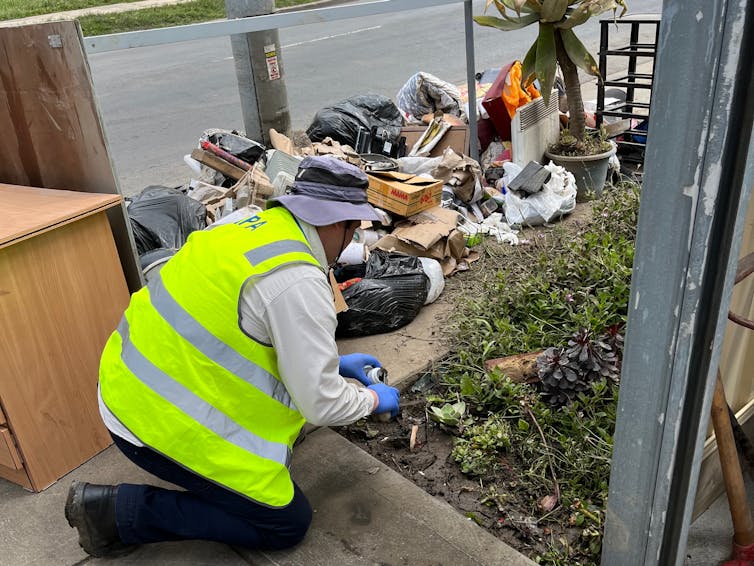
Flooding stirs up river sediments, which can spread contaminants in our waterways and floodplains. Flood water can carry sediments bearing contaminants from a range of sources, both historical and new, such as sewage, petrol stations, industrial yards and farming areas. This is worrying many people whose homes and gardens have been hit by repeated floods across eastern Australia.
One of the sites of the latest flooding is the suburb of Maribyrnong in Melbourne’s inner west. The Maribyrnong River’s industrial past means swimming was already not recommended. The community has longstanding concerns about water and sediment quality. The flood washed those concerns right into the homes of hundreds of residents.
In response, EPA Victoria’s Science division mobilised last week, at the request of Maribyrnong Council, to provide some answers for residents. We took samples from the river at three locations. We also collected and analysed flood sediments in public areas and residents’ gardens.
The results so far from across the impacted area are consistent – the chemicals and compounds analysed were mostly below levels of concern for human health. The exception was concentrations of pathogens like E. coli, which is linked to sewage. Exposure to sunlight is expected to reduce these pathogen levels.
The best thing you can do to protect yourself at these times is to stay clear of the river and wear gloves, boots and masks while cleaning up. Leave your dirty shoes outside and wash your hands regularly. While flood conditions and clean-ups continue, stay abreast of the most recent advice on managing the hazards.
Read more: Don't go wading in flood water if you can help it. It's a health risk for humans – and dogs too
Why was Maribyrnong at high risk?
The river flooding raised significant concerns in the community because it drains from an industrial catchment with known contamination. The catchment is also home to Tullamarine Airport, a known source of per- and poly-fluoroalkyl substances (PFAS). These industrial chemicals are persistent – they’re known as “forever chemicals” – and spread easily through the environment.
Maribyrnong sits on a river floodplain, which accommodates excess water and sediment during high flow. The redistribution of contaminated sediment across such areas during floods is well established. Research also has found examples of toxicity in farm animals from such events.
In addition to daily water sampling along the Maribyrnong, we have to date sampled sediment from 109 gardens and 13 public areas. To reflect the potential sources of contamination, flood water and sediment are being analysed for a suite of:
potentially toxic trace metals – arsenic, cadmium, chromium, copper, manganese, nickel, lead and zinc
chemicals present in oil, coal and petroleum known as polycyclic aromatic hydrocarbons
PFAS
pathogen indicator bacteria including E. coli and Enterococci.
Read more: Victoria's wild storms show how easily disasters can threaten our water supply
So why are contamination levels not higher?
Sediment cores from floodplains and riverbanks allow scientists to evaluate what it contains. Bands of coarse particles – sands and silts – from high-flow events are interspersed with finer clay deposited as the water recedes. Finer deposits often contain more contaminants than the coarser material.
This is because the surface-area-to-volume ratio of a particle increases with decreasing particle size. This means there is more surface area for metal ions and organic contaminants to bind to finer sediments.
Floods are known to deposit potentially toxic trace metals on floodplains. However, other large flood events, such as the one caused by Hurricane Katrina in New Orleans in 2005, have produced outcomes like we see in Maribyrnong, where clean sediments have been draped over more contaminated urban soils.
For example, results so far show flood sediments contained average concentrations of lead, a well-known contaminant, about one-third of the national guideline for residential gardens. Lead was an element of concern because of the former munitions factory in Maribyrnong.
Read more: Backyard hens' eggs contain 40 times more lead on average than shop eggs, research finds
Levels of PFAS chemicals were also very low. On average, concentrations were roughly a tenth of the values regarded as being of concern for human health.
Small amounts of perfluorooctane sulfonic acid (PFOS) and perfluorohexane sulfonic acid (PFHxS) were detected. This is unsurprising given the upstream sources at Tullamarine Airport.
What’s the next step?
EPA Science has engaged the State Emergency Service to set up similar sampling in regional locations. This will help to provide the same evidence-based guidance to communities affected by floods in those areas. This work should begin next week, with the organisations working together on sampling and fast-tracked laboratory analysis.
The current focus of this new rapid response from EPA Victoria is for flood-impacted communities. The work will shortly shift to all Victorian residents who want to know what’s in their soil. Through EPA’s GardenSafe program, they can have their garden soil tested, free of charge, for trace element contaminants and soil quality indicators.
Building homes on a floodplain, which by definition is a plain that floods and where homes will always be at risk, arguably increases the impacts of climate change. That said, it’s not a new venture for humans who have been taking advantage of accessible and organically rich floodplains for centuries.
Given how much flood-prone land is now developed, the crux of long-term management is to ensure we are better prepared. Future decisions should aim to create adequate space for rivers to do their natural work.
Rapid sampling and advice do not fix the root cause of the problem. However, this work can ease residents’ fears, allowing them to focus on cleaning up and rebuilding their lives after the flood.
Read more: Beyond a state of sandbagging: what can we learn from all the floods, here and overseas?
The authors undertook the work discussed in this article as employees of the EPA Victoria.
Authors: Mark Patrick Taylor, Victoria's Chief Environmental Scientist, EPA Victoria; Honorary Professor, School of Natural Sciences, Macquarie University
Read more https://theconversation.com/whats-in-the-mud-flood-victims-fears-eased-by-early-test-results-193111


 Daily Bulletin


