

From farming to fermentation: how New Zealand could 'brew up' new foods to reduce agricultural emissions
- Written by: Ian Mason, Research Fellow in Renewable Energy Systems Engineering, University of Canterbury
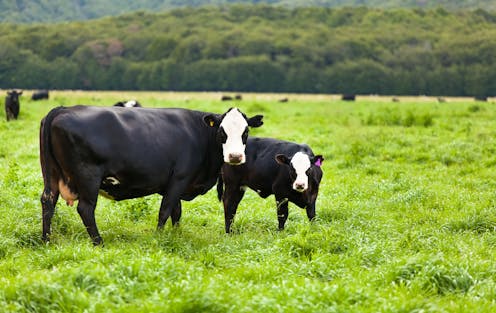
New Zealand agriculture contributed 50% of the country’s greenhouse gas emissions in 2020, an unusually high proportion by world standards. Dairy farming was responsible for about half of the 39.1 megatonnes of carbon dioxide equivalent (CO₂-eq) emitted, or 25% of all emissions.
Addressing the problem of New Zealand’s agricultural emissions has mainly focused on technical fixes aimed at reducing methane and nitrous oxide produced by livestock and fertiliser and relying on voluntary agreements with the industry.
But these measures may not result in substantial emissions reductions any time soon. Reductions of less than 1% are predicted according to one analysis of a government/industry accord, which forms the basis of a recently announced pricing scheme for agricultural emissions.
Exploring alternatives to conventional farming is therefore timely and urgent. One such alternative with the potential to drastically reduce agricultural emissions – while at the same time helping restore ecological quality – is to use fermentation technology.
This would allow some yet-to-be-determined proportion of dairy and meat farming to be replaced by “precision fermentation” of high-protein products, a process akin to brewing.
It might seem like a radical step for a traditional agricultural nation, but given the urgency of the problem, New Zealand needs to consider it at least.
Using bacteria to make protein
In his recent book Regenesis, British journalist and activist George Monbiot discusses the prospects for precision fermentation, or single-cell protein (SCP) production. In particular, he highlights a process developed by Finnish startup Solar Foods.
This process employs hydrogen-oxidising bacteria as an alternative means of food production with a much lower climate impact. The end product is a nutritious high-protein powder suitable for use as a food ingredient and as a component of new foods.
Key to this process are the production of hydrogen by electrolysis of tap water and the direct capture of carbon in the form of carbon dioxide from the air. Hydrogen produced in this way can also be used to make ammonia for use as a nitrogen source for the bacteria.
In a comprehensive life-cycle analysis, Finnish researchers determined that each kilogram of product made using hydroelectricity created about one kilogram of CO₂-eq emissions, requiring 18 kilowatt-hours of electricity.
The product itself is comprised of 65-75% protein, 4-10% fat, 18-20% carbohydrates, 4-10% minerals and 5% moisture. This means it has a high protein content, complemented by smaller amounts of fats (mostly polyunsaturated), carbohydrates and nutrients.
Where could the electricity come from?
New Zealand has a world-class wind resource, both onshore and offshore. Major developers have recently revealed plans for more than six gigawatts (GW) of offshore wind farms off the Taranaki and Waikato coastlines. The first is due to be operational by the end of this decade.
Using a 1GW offshore wind farm as an example, this could supply enough electricity to produce about 240,000 tonnes of SCP product a year, containing about 160,000 tonnes of protein. The carbon footprint, based on the Finnish life-cycle analysis, would be around 0.25 megatonnes of CO₂-eq emissions.
The same amount of milk protein produced at a dairy farm would have a carbon footprint of about 3.6 megatonnes of CO₂-eq emissions (based on the average emissions intensity from a recently updated life-cycle analysis).
If replaced by the SCP product, this would result in an 18.9% reduction in dairy-sector emissions and milk production based on 2019-2020 levels. Net emissions to the global atmosphere would also be reduced.
Milk contains a large proportion of fat – about 125% of the protein content compared to about 10% for the SCP product. Lactose and other nutrients, plus meat and by-products from culled cows and bobby calves, would also be removed from production under this process.
The extent to which these might be substituted with plant-based or precision-fermentation alternatives requires further investigation. Using vegetable oils to supply the difference in fat would add about 0.7 megatonnes of CO₂-eq emissions to the SCP footprint.
If the equivalent land area was retired from intensive dairy farming this would allow a range of alternative land uses, including rewilding of sensitive areas.
Given New Zealand’s serious degradation of water quality due to nutrient runoff associated with intensive farming, this would have obvious environmental and ecological benefits.
It would also provide a permanent carbon sink of native bush, adding further to the net emissions reduction.
Transition to a new system
Animal agriculture is deeply embedded in New Zealand’s culture, society and economy. Discussing alternative means of food production will therefore require a thoughtful, detailed and respectful conversation focused on a just partial transition to new systems.
New development funding would be well spent on comprehensive consultation, pilot trials of the SCP technology under local conditions and on training.
Read more: Farmers need certainty over emissions pricing – removing government from the equation might help
What is signalled is a very real prospect for capping and then reducing the scale of our industrial animal farming. It’s an opportunity to fit within the greenhouse gas budget we need to live within to avoid the 2.7℃ warmer world we now appear to be heading for.
It is also an opportunity to write a new chapter in New Zealand’s environmental history. Adding to the menu the “rich, mellow and filling” SCP pancake George Monbiot enjoyed in Finland sounds like a good option, too.
Authors: Ian Mason, Research Fellow in Renewable Energy Systems Engineering, University of Canterbury


 Daily Bulletin


