

Gliding treefrogs, mini-males and burrowing frogs in trees: why Melanesia is the world's tropical island frog hotspot
- Written by: Paul Oliver, Senior Lecturer, Griffith University
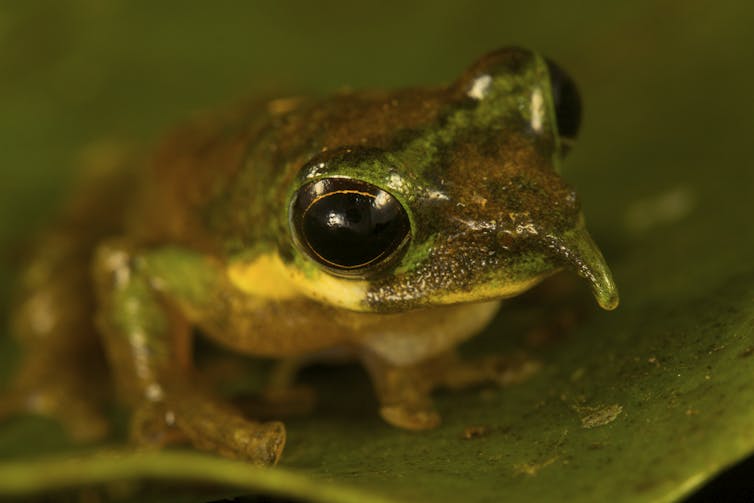
A chocolate treefrog that looks like a Freddo. Burrowing frogs which live in trees. Long-nosed frogs named after Pinocchio. Frogs which go straight from egg to froglet without stopping at tadpole. And large treefrogs which can glide from tree to tree.
All these and many more are found only in Melanesia. This tiny region in the South Pacific is a global hotspot of cultural and biological diversity. And we still don’t know the full extent of its extreme biological riches.
Centred on the world’s largest tropical island, New Guinea, Melanesia is home to 534 types of frog. As our new research shows, that’s 7% of all the world’s frog species living on just 0.7% of the world’s land. And there are more to come. Almost 40% of these frogs have only been scientifically described in the last two decades.
Hundreds more species will likely be added to the tally, as we know of at least 190 species not yet formally described. The final tally will be over 700, with frogs colonising every possible niche. But their sheer evolutionary inventiveness also puts them at risk, with many species restricted to tiny ranges.
Winged fingers, erectile noses and tiny males
Melanesia’s wealth of frog species easily surpasses other tropical island regions, including famed hotspots such as Madagascar (around 370 species), Borneo and the Caribbean (both around 200).
On these islands live more than double Australia’s tally of around 248 species.
Species diversity goes hand-in-hand with weird and wonderful evolutionary twists.
Take the narrow-mouthed frogs, which skip the tadpole stage and hatch directly from egg to frog. In this family, Microhylidae, is the likely ancestor of most of the region’s frog species after migrating from Asia around 20 million years ago. These frogs were spectacularly successful, calving off an estimated 400 species.
Their tally include some of the world’s smallest creatures with a backbone, as well as many burrowing frogs which abandoned the ground to live in trees, and others with complex parental care, such as the father frog guarding his eggs and tadpoles, or carrying babies on his back.
The treefrogs are numerous too, with an estimated 200 species. Large green treefrog species have evolved finger webbing so they can glide to a lower branch. Other treefrogs have odd nose spikes. And of course, the recently described chocolate treefrog has drawn worldwide attention (and amusement) for its resemblance to a certain confectionery.
Other islands have their own unique frogs. On the Papua New Guinean (PNG) island of New Britain lives Boulenger’s wrinkled ground frog (Cornufer boulengeri), a species whose males are 40 times lighter than females. For many years, scientists didn’t realise the males and females were the same species.
Read more: Australian frogs are dying en masse again, and we need your help to find out why
Why so many frogs?
Melanesia’s many islands have fertile soil and often have extraordinarily varied landscapes. New Guinea, for instance, goes from sea level to highlands and mountains almost five kilometres high, with a few peaks still holding their last ice.
This is a key reason for frog diversity. Why? Because populations can easily become isolated, which speeds up the development of new species. New Guinea, for instance, is one of the world’s megadiverse hotspots, containing an estimated 7% of the world’s species on a fraction of the land area.
We also suspect the arrival of the direct-developing frog family have further supercharged species diversity in Melanesian frogs.
These frogs don’t have free-living tadpoles able to be dispersed by floods or along streams. This stay-at-home disposition may increase their chances of becoming isolated and evolving into distinct species.
Our research found direct-developing frogs in Melanesia have narrower ranges than their more conventional relatives.
In fact, the easternmost tip of New Guinea and nearby islands have the most extreme concentration of vertebrates with small ranges anywhere in the world, with more than 160 species jammed into an area less than a quarter of the size of Tasmania.
Melanesia is a good place to be a frog – but threats are arriving
The world’s frogs are in trouble. Hundreds of species have gone extinct in recent decades.
But Melanesia, for now, is a good news story. We know of no frog extinction events and only 6% of species are threatened, compared to a global average of over 30%).
This could change if a lethal fungus takes hold. So far, Melanesia has stayed clear of it. Biosecurity measures are essential to conserve this bounty of frogs.
Because so many of Melanesia’s frogs have tiny ranges, they are particularly vulnerable to changes, such as the loss of a small area of forest. Climate change will pose an existential threat, particularly to frogs dependent on cold climates in the mountains.
PNG’s eastern biodiversity hotspot around Milne Bay is most at risk. Six species are threatened here by forest loss, while plans for oil palm plantations threaten many frog species.
We hope documenting Melanesia’s wealth of frogs and other species will help conservation efforts. This region is special. Let’s keep it that way.
Read more: A deadly fungus threatens to wipe out 100 frog species – here's how it can be stopped
Authors: Paul Oliver, Senior Lecturer, Griffith University


 Daily Bulletin


