

You are now one of 8 billion humans alive today. Let's talk overpopulation – and why low income countries aren't the issue
- Written by: Matthew Selinske, Senior research fellow, RMIT University
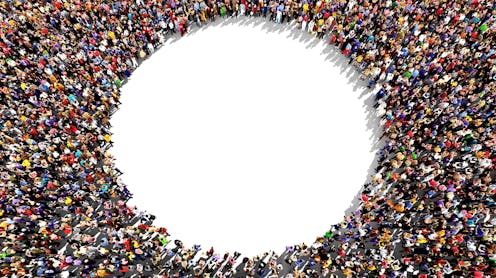
Today is the Day of Eight Billion, according to the United Nations.
That’s an incredible number of humans, considering our population was around 2.5 billion in 1950. Watching our numbers tick over milestones can provoke anxiety. Do we have enough food? What does this mean for nature? Are more humans a catastrophe for climate change?
The answers are counterintuitive. Because rich countries use vastly more resources and energy, greening and reducing consumption in these countries is more effective and equitable than calling for population control in low income nations. Fertility rates in most of the world have fallen sharply. As countries get richer, they tend to have fewer children.
We can choose to adequately and equitably feed a population of 10 billion by 2050 – even as we reduce or eliminate global greenhouse gas emissions and staunch biodiversity loss.
Why is the world’s population still growing?
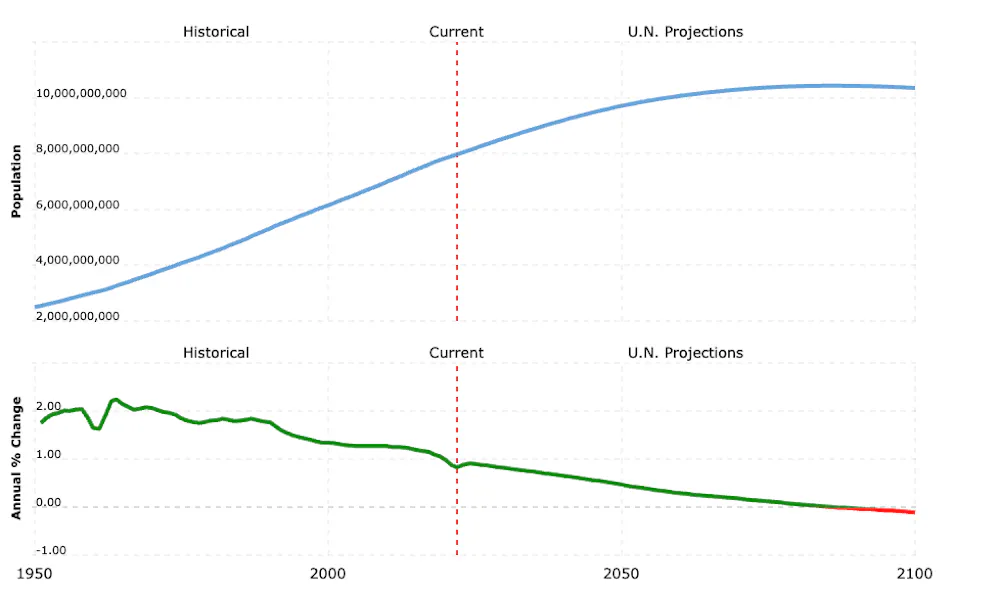
We hit 7 billion people just 11 years ago, in October 2011, and 6 billion in October 1999. And we’re still growing – the UN predicts 9.7 billion humans by 2050 before potentially topping out at 10.3 billion at the end of the century. But modelling by the Institute for Health Metrics and Evaluation predicts the population peak much earlier, in 2064, and falling below 9 billion by century’s end.
Why is it still growing? Momentum. The number of women entering child-bearing age is growing, even as the average number of children each woman is having falls. Plus, we are generally living longer.
In 1950, the world’s population was growing at almost 2% a year. That growth rate is now less than 1%, and predicted to keep falling. There’s little we can do to change population trends. Researchers have found even if we introduced harsh one-child policies worldwide, our population trajectories would not change markedly.
In many ways, the story of population growth is evidence of improvement. Better farming techniques and better medicine made the population boom possible. And slowing population growth has come from falling rates of poverty, as well as better health and education systems, especially for women.
Increased gender equality and women’s empowerment have also helped. Put simply, if women can choose their own paths, they still have children – just fewer of them. That’s why climate solutions group Project Drawdown ranks female education and family planning as one of the top ways to tackle climate change.
Should we worry about overpopulation at all?
You are now one of 8,000,000,000 humans alive today. How should we feel about this?
The modern fear of overpopulation has old roots. In 1798, Reverend Thomas Malthus warned population grows exponentially while food supply does not. Close to two centuries later, Paul and Anne Erlich’s 1968 book The Population Bomb triggered a new wave of concern. As our numbers skyrocketed, they argued, we would inevitably hit a Malthusian cliff and run out of food. Famine and war would follow. It didn’t happen.
What resulted was inhumane population control policies. The book – replete with racially charged passages about a crowded Delhi “slum” – directly influenced India’s 1970s forced sterilisation policies. China’s notorious one-child policy emerged from similar concerns.
Read more: 'Overpopulation' and the environment: three ideas on how to discuss it in a sensitive way
Low- or middle-income countries are most often called on to tackle overpopulation. And the people calling for action tend to be from high-income, high-consumption countries. Even David Attenborough is concerned.
Recent calls by Western conservation researchers to tackle environmental degradation by slowing population growth repeat the same issue, focusing on the parts of the world where populations are still growing strongly – sub-Saharan Africa, Latin America and some Asian countries.
People from lower income countries reject these calls. Pakistani academic Adil Najam has observed these countries are “weary of international population policy in the name of the environment.”
Overall, the world’s wealthiest 1% account for 15% of the world’s carbon emissions. That’s more than double the emissions of the poorest 50% of the planet – who are the most vulnerable to climate change.
Prince William, for instance, has linked African population growth to wildlife loss – even though he has three children and comes from a family with a carbon footprint almost 1,600 times higher than the average Nigerian family.
What about saving wildlife? Again, a mirror may be useful here. It turns out demand from rich countries is the single largest driver of biodiversity loss globally. How? Your beef burger may have been made possible by burning the Amazon for pasture for cows, as well as many other global supply chain issues. Rich countries like Australia are also notoriously bad at protecting their own wildlife from agriculture and land clearing.
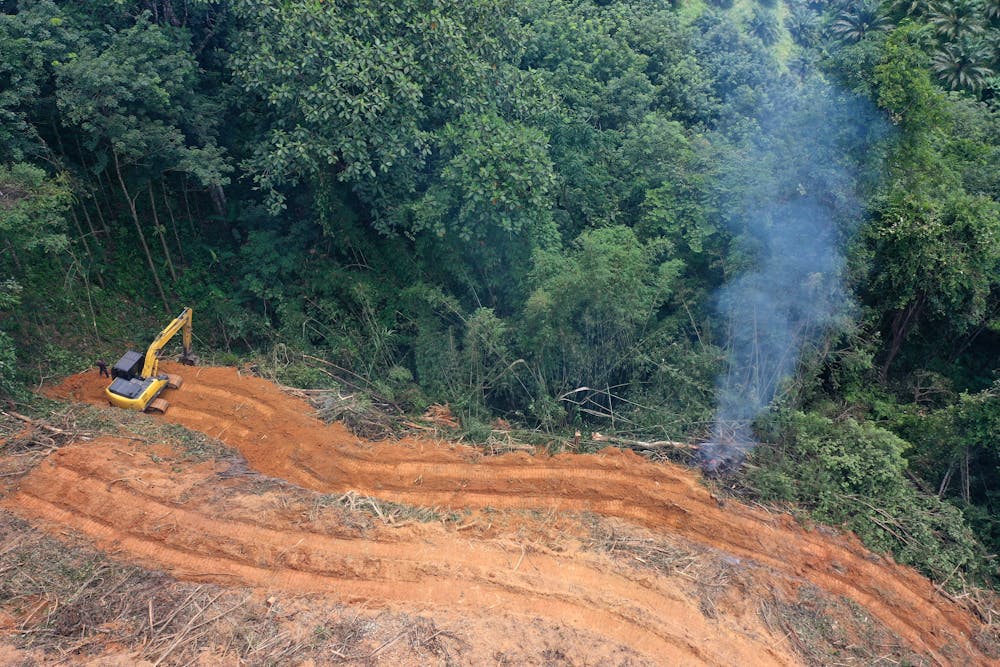 Destroying rainforest is bad - but what if it’s being destroyed to make beef or palm oil for richer countries, as in this photo of clearing for oil palms in South-East Asia.
Shutterstock
Destroying rainforest is bad - but what if it’s being destroyed to make beef or palm oil for richer countries, as in this photo of clearing for oil palms in South-East Asia.
Shutterstock
This is not to say population growth in lower income countries isn’t worth discussing. While many countries have seen their populations taper off naturally as they get wealthier, countries like Nigeria are showing signs of strain from very fast population growth. Many young Nigerians move to cities seeking opportunities, but infrastructure and job creation has not kept pace.
For Western environmentalists and policymakers, however, it would be better to shift away from a blame mentality and tackle drivers of inequality between and within nations. These include support for family planning, removing barriers to girls’ education, better regulation of global financial markets, reduced transaction costs for global remittances, and safe migration for people seeking work or refuge in higher income countries.
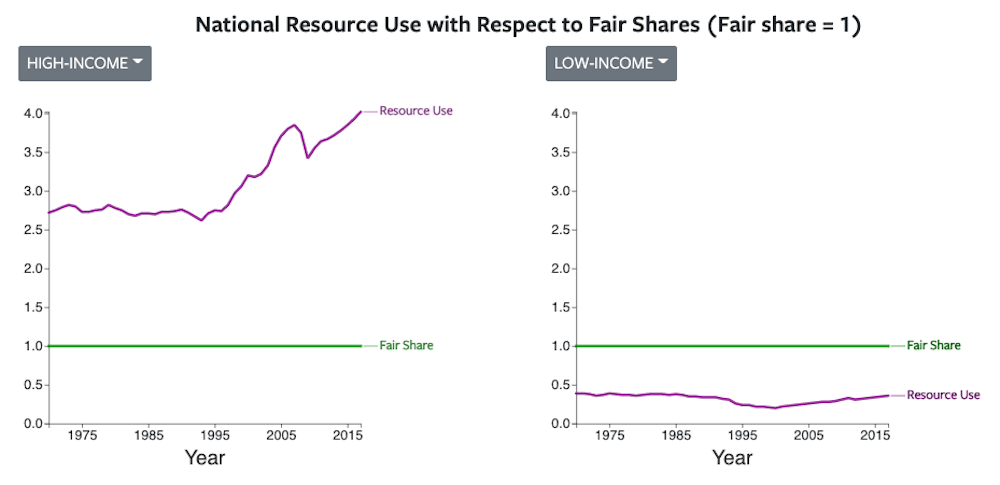 This graph shows what fair use of the world’s resources would look like (green line) and what proportion is actually used by high and low income countries.
Goodlife.leeds.ac.uk, CC BY
This graph shows what fair use of the world’s resources would look like (green line) and what proportion is actually used by high and low income countries.
Goodlife.leeds.ac.uk, CC BY
As we pass the eight billion mark, let’s reconsider our reaction. Blaming low-consumption, high-population growth countries for environmental issues ignores our role. Worse, it takes our attention away from the real work ahead of transforming society and reducing our collective impact on the planet.
Read more: Why we should be wary of blaming 'overpopulation' for the climate crisis
Authors: Matthew Selinske, Senior research fellow, RMIT University


 Daily Bulletin


