

Queensland's high-tech plan to make the 2032 Brisbane Olympic Games smarter and greener
- Written by: Davina Jackson, Visiting Scholar, Department of Architecture, University of Cambridge
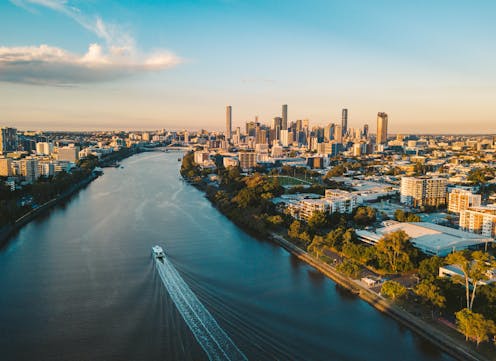
With Brisbane to host the 2032 Olympic Games, Queensland is accelerating “smart” and “green” infrastructure projects right across the coast from Coolangatta to Coolum.
So what practical steps is the state government taking to bring Brisbane closer to being a smart city while managing rapid growth? And what differences can city residents realistically expect to see for themselves?
Exploiting a quarter century of technological progress
Vastly more ambitious than the South Bank building boom, which preceded Brisbane’s World Expo 88 in the pre-internet era, Queensland’s current infrastructure programs are exploiting the last quarter-century of technological progress.
Think sensor-triggered street lights, automated air conditioning and watering of parks and green facades. Envision robots for cleaning and construction, satmaps, swipe cards and QR codes. Data technology will be embedded in 32 existing and planned Olympic venues, the future athletes’ village at Northshore Hamilton (near Breakfast Creek) and the international media centres.
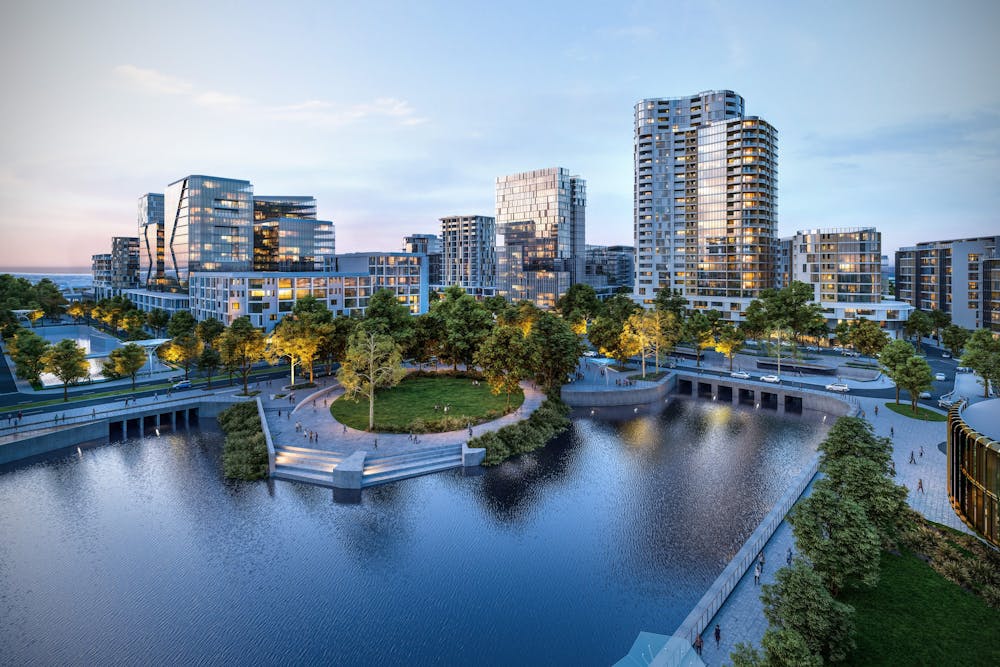
Technology will also underpin a substantial city centre at Maroochydore. Here, a mid-rise precinct will be powered via a solar farm at nearby Valdora, and will include fibre-optic telecommunications cables. In what may be a first for Australia, a new system will sluice garbage from chutes through underground vacuum pipes.
A ‘New Norm’ Olympics
All Games facilities must align with a set of 118 reforms the International Olympic Committee (IOC) calls its “New Norm” guidelines.
These were introduced in 2018 to improve energy efficiency, cost-effectiveness and long-term value from the huge development expenditure required of host governments. There had been concerns about integrity and wastefulness in the IOC’s old-school supervision of Games bidding and delivery processes.
Brisbane’s Games win is accelerating and expanding some major public mobility programs offering “turn up and go” transport routes for the 4.4 million people expected to live in South-East Queensland by 2031.
Aerial taxis without pilots
The most provocative proposal – still speculative – is to introduce aerial taxis to fly passengers without pilots, but remotely supervised, between future “vertiports”.
 A prototype of the Wisk aerial taxi proposed to be flying passengers around South-East Queensland before the Brisbane Olympics.
Wisk Aero
A prototype of the Wisk aerial taxi proposed to be flying passengers around South-East Queensland before the Brisbane Olympics.
Wisk Aero
A prototype eVTOL (electric vertical take-off and landing) aircraft is in Brisbane while its American manufacturer, Wisk Aero, seeks approval from the Civil Aviation Safety Authority to operate commercially before the 2032 Games.
Wisk (backed by Boeing) has completed more than 1,600 test flights with six generations of aircraft. The Brisbane model has 12 lift fans on two 15-metre wings and is powered by a battery in the tail.
Delegates at a recent Smart Cities Council transport workshop I attended noted the potential of autonomous aerial vehicles to change patterns of housing development beyond road and rail links. Even so, Queensland is rapidly expanding its terrestrial network.
Land transport projects
Brisbane’s Cross River Rail line is being extended northwards through a new twin tunnel under Brisbane River and four new underground stations at Boggo Road, Woolloongabba, Albert Street and Roma Street.
This project uses smart tunnel-boring machines to carve through the tuff (a type of volcanic rock, pronounced toof) that formed Brisbane’s geology more than 200 million years ago.
As well as supporting the new health, science and education precinct near Boggo Road, this rail extension will connect the city’s southern suburbs with the existing line north from Bowen Hills.
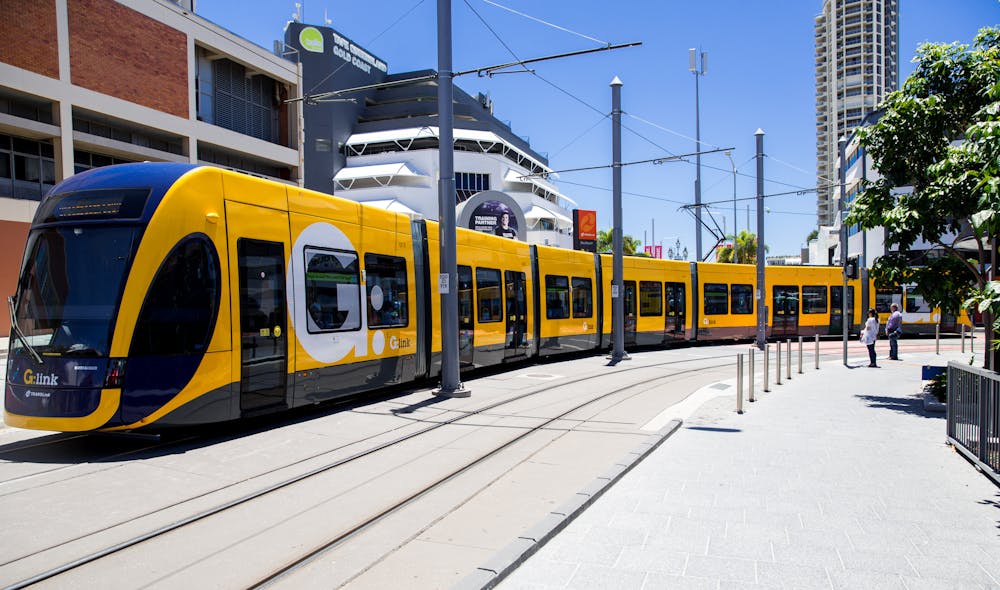 One of the new articulated carriages on the G:Link light rail line at Southport on the Gold Coast.
G:Link
One of the new articulated carriages on the G:Link light rail line at Southport on the Gold Coast.
G:Link
And work continues on extending the Brisbane-to-Gold Coast light railway (also known as the G:Link).
This extension will provide eight new stations along a 6.7km track from Broadbeach to Burleigh Heads. The G:Link service uses German Bombardier Flexity carriages that are bi-directional and air-conditioned, with low-level floors matching station platforms and storage for wheelchairs, bikes, prams and surfboards. These are electric-powered via 750V overhead cables.
Superfast bus charging
More innovative is the Brisbane Metro project, which is being tested to potentially supply 60 electric buses (or “trackless trams”) to supplement the city’s existing fleet. These would be battery-powered by a combination of 600kW, six-minute, superfast “flash chargers” at end-of-line stations and 50kW, overnight, slow chargers at depots.
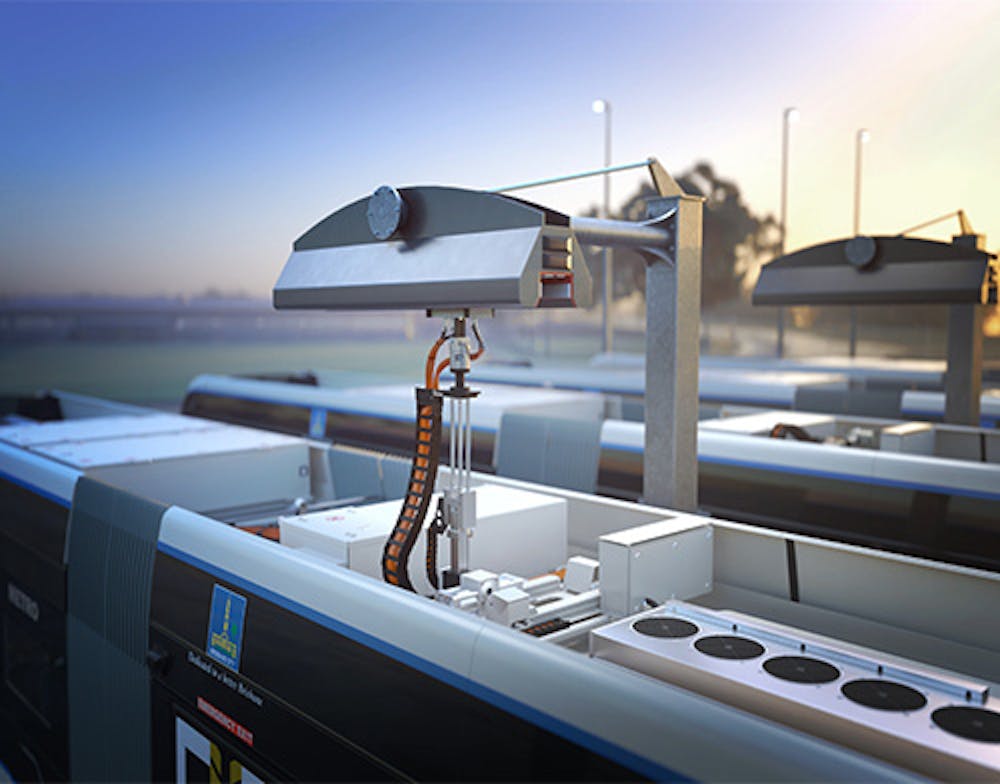 Flash (super-fast) charging of a Metro bus via rooftop equipment docking with an overhead charging arm.
Brisbane Metro.
Flash (super-fast) charging of a Metro bus via rooftop equipment docking with an overhead charging arm.
Brisbane Metro.
Each bus can be recharged up to 85 times faster than an electric car at home – but the flash system degrades batteries more than slow charging overnight.
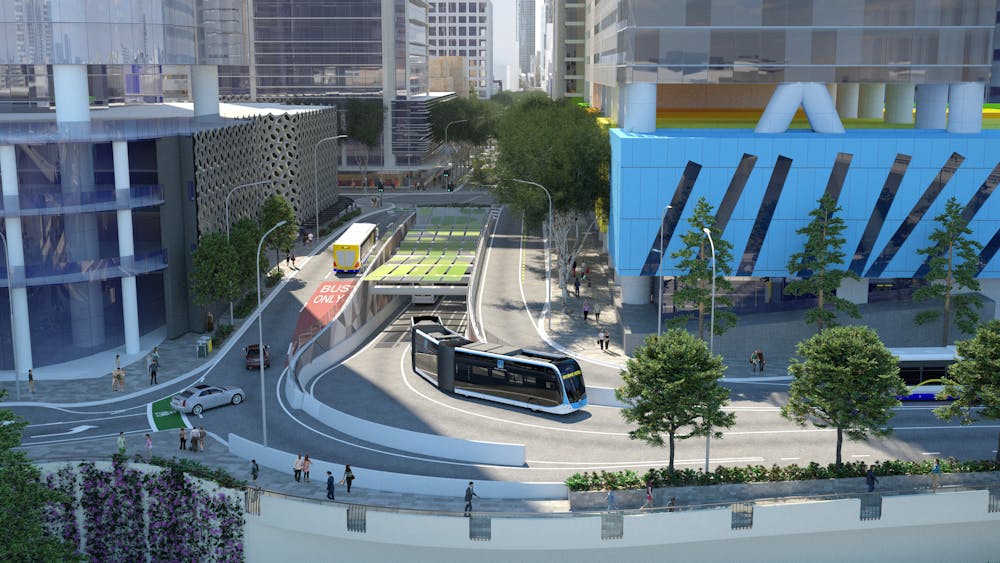 Artist impression of a Brisbane Metro electric bus emerging from a city tunnel, with an older bus on the ramp.
Brisbane City Council.
Artist impression of a Brisbane Metro electric bus emerging from a city tunnel, with an older bus on the ramp.
Brisbane City Council.
Healthy footbridges
Although two of Brisbane’s four proposed “green bridges” for pedestrians and cyclists were paused to prioritise flood recovery, new crossings from the city to Kangaroo Point and Newstead to Albion are expected to open in 2024.
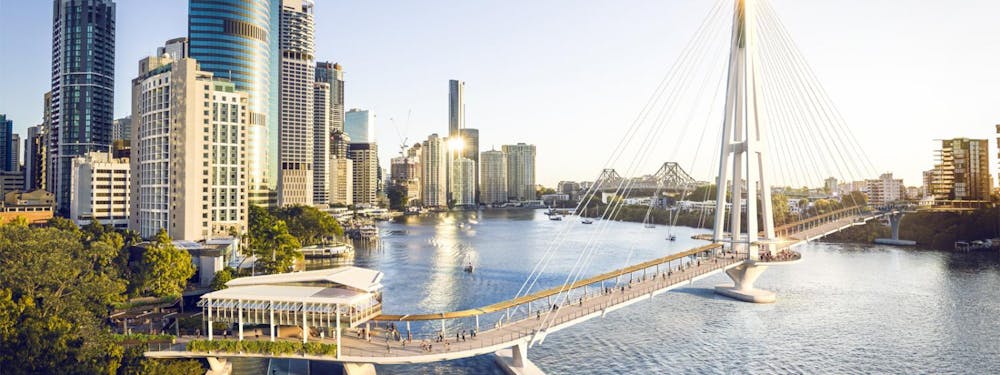 Artist impression of the green bridge between Kangaroo Point and Ann Street now under construction in Brisbane.
Queensland government.
Artist impression of the green bridge between Kangaroo Point and Ann Street now under construction in Brisbane.
Queensland government.
The Kangaroo Point green bridge will include a restaurant overlooking the botanic gardens. Newstead bridge will join the 1.2km-long Lores Bonney Riverwalk.
These are examples of a new phenomenon in public transport planning – to not merely move people between destinations but also boost their health and enjoyment outdoors.
As Corey Gray, global CEO of the Smart Cities Council, told me at the Smart Cities Council conference:
Smart cities are not ultimately about data and technology, but improving human systems.
Authors: Davina Jackson, Visiting Scholar, Department of Architecture, University of Cambridge


 Daily Bulletin


