

Why are shallow earthquakes more destructive? The disaster in Java is a devastating example
- Written by: Phil R. Cummins, Professor, Australian National University
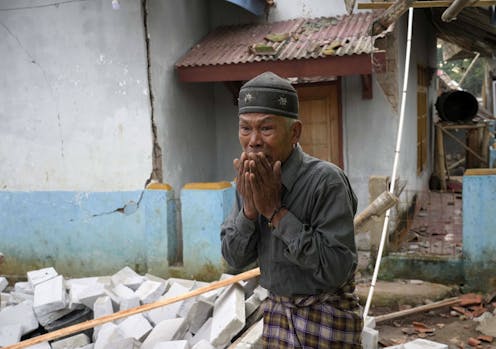
On November 21 2022 an earthquake near the Indonesian city of Cianjur in West Java caused at least 268 deaths and damaged 22,000 buildings.
At magnitude 5.6, this earthquake was much smaller than many other earthquakes that have caused death and destruction in Indonesia over the past few decades.
Why is this one so different? One of the main reasons the Cianjur earthquake was so destructive was its shallow depth of 10km.
This event should serve as a wake-up call to improve building practices in Indonesia, because we know from the past that much larger shallow events can occur in Java; it’s not a question of if but when.
The role of earthquake depth
Two of the most important factors that determine the intensity of ground shaking caused by an earthquake are its magnitude and distance.
Large earthquakes of greater than 50km depth can and do cause widespread damage, but the intensity of shaking is reduced because the seismic waves travel at least 50km before they reach people.
Such earthquakes rarely cause massive fatalities – the magnitude 6.5 Tasikmalaya, Java earthquake in 2017 occurred at 90km depth and killed only four people and damaged 4,826 homes.
The recent Cianjur earthquake was much smaller – at magnitude 5.6, its energy was 21 times smaller than the Tasikmalaya earthquake, but it did much greater damage.
The Cianjur earthquake had a greater impact because it ruptured within a few kilometres of the city of Cianjur, where the shaking was classified as “severe” (Modified Mercalli Intensity 8).
A similar comparison could be made with giant subduction zone earthquakes that occur offshore. While these can be far greater in size than this week’s Java earthquake, they are generally 100km or more distant from population centres, so they kill fewer people through building collapse.
Infrequent danger
There is another reason inland shallow earthquakes can be so devastating, particularly in Java: they occur infrequently, so most people are oblivious to the danger.
The population of Java increased by a factor of four through the 20th century, and during this time there was only one shallow earthquake in 1924 that caused nearly 800 deaths, and another four that caused between 10 and 100 deaths.
It wasn’t until 2006 that a really major event occurred: the 2006 Yogyakarta earthquake, magnitude 6.3, which killed killed 5,749 people.
Elsewhere in Java there is no lived experience of a major earthquake, often stretching back several generations.
As a consequence, little attention is paid to the earthquake resilience of residential construction, so when an earthquake does occur many of the weak buildings will collapse.
A starkly different colonial past
Java’s earthquake history during the colonial era paints a starkly different picture. Our recent study shows many damaging earthquakes have occurred in Java since the 17th century. At least nine earthquakes since 1865 have caused shaking so severe they were almost certainly shallow events.
These include two earthquakes near Wonosobo in central Java in 1924 that caused catastrophic mudslides that killed nearly 900 people.

In our recent study we also documented extremely violent shaking caused by the October 25 1875 earthquake near Kunningan in West Java. An eyewitness described being thrown off a chair and saw a herd of cows being knocked off their feet.
Cirebon also experienced a damaging earthquake on November 16 1847 which is thought to have caused a river channel offset of 5 metres, suggesting a magnitude of 7 or greater.
Cianjur, the site of this week’s earthquake, has experienced at least one damaging earthquake, on March 28 1879, which caused the collapse of several buildings in Cianjur with some loss of life.
A fact of life
Geologists understand well that earthquakes are a fact of life in Java. In work over the past two decades they have identified many faults – cracks or joints in Earth’s crust – in Java that are likely to be active, but only a handful of these have been studied in detail.
Read more: Why do people in Indonesia still live in disaster-prone areas?
The Lembang Fault on the outskirts of Bandung, Indonesia’s fourth-largest city (population 8.8 million, as opposed to Cianjur’s 170,000), is one of the few for which geologic evidence of prehistoric earthquake activity has been established. This fault is thought to be capable of producing a magnitude 6.5–7.0 earthquake every 170–670 years.
Other active faults are known to threaten the cities of Jakarta, Surabaya and Semarang, in addition to Yogyakarta. And these are just the ones we know about.
Preparing for the next quake
Shallow earthquakes could occur that are much larger than the Cianjur earthquake, next to cities that are much larger than Cianjur. What can Indonesia do to avoid massive fatalities in such an event?
The typical answer is to improve – and enforce – building codes, forcing any new construction to be more earthquake-resilient.
Indonesia does have a building code based on a modern seismic hazard map, but it is only applied to buildings of eight floors or higher. Given the high poverty level in Indonesia, universal enforcement of the building code is regarded as impractical.
Read more: We may never be able to predict earthquakes – but we can already know enough to be prepared
An alternative may be the adoption of simple, minimum standards for concrete strength, quality of reinforcement and other aspects of building practice that may not conform to the building code, but at least afford a higher level of protection than current practice.
Any change in building practice requires a change in culture: people have to expect more of builders, and be willing to pay for it.
Correction: This article has been updated to correct two points – the recent Cianjur earthquake was 21 times smaller than the Tasikmalaya earthquake, not eight times smaller. Additionally, it was clarified that the 1847 earthquake caused a river channel offset.
Authors: Phil R. Cummins, Professor, Australian National University


 Daily Bulletin


