

What COVID has taught us about sharing our emotions – and why now's a good time to share again
- Written by: Lisa A Williams, Associate professor, School of Psychology, UNSW Sydney
Although they were only two-and-a-half years ago, the first months of the COVID pandemic and ensuing lockdowns seem like a distant past.
We have – perhaps intentionally – let fade our memories of 5 kilometre-radius travel restrictions, long lines at testing locations, work from home mandates, remote schooling, and border closures. We seem to just not talk about it anymore.
Yet, a fresh wave of cases is here, new variants keep emerging, and we find ourselves navigating a constantly shifting “new normal”.
What have we learnt from our emotional responses during the first waves of the pandemic and the way we shared them? And should this shape how we face the future?
Read more: Friday essay: COVID in ten photos
It has been real
The pandemic has been poignantly emotional.
We longed for our usual social interaction patterns. Many of us were unwell and/or supporting others who were unwell. These stressors were both acute and ongoing.
It’s no surprise most Australians reported lowered mental wellbeing since the onset of the pandemic.
Evidence of the emotional impact of the pandemic is evident in data from online social networks. Australia saw a 28% increase in Twitter posts expressing anxiety and a 15% increase in posts expressing sadness during the first five weeks of the 2020 outbreak relative to pre-COVID periods.
These broad shifts in emotional tenor were accompanied by “bursts” of emotional activity. For instance, the day of national mourning for COVID victims in China saw a spike in social media language reflecting sadness.
We were also fairly resilient. Tightened restrictions, and the acute effects of the pandemic that drove them, were met with initial stress. But most people showed hedonic adaptation – or a return to baseline emotion levels – over time.

Read more: The 'city' is becoming increasingly digital, forcing us to rethink its role in life and work
Sharing all the feels
As people so often do in emotional situations, we talked about our experiences as COVID became a part of our daily lives – even if we couldn’t do it in person.
Once lockdowns and social distancing restrictions happened, we had to get creative. We phoned friends and loved ones and also attended Zoom parties and online game nights. We posted to social media and digital devices became integral to maintaining contact.
Talking about our experiences and feelings – something researchers call the social sharing of emotion – likely had great benefit.
Belgian researcher Bernard Rimé, whose focus is the social psychology of emotion, argues we mostly feel compelled to discuss our emotional experiences. Friends, spouses, and partners are the main targets of sharing among adults. More intense emotions are shared more often and more quickly. We also tend to share pivotal experiences again and again – in the days, weeks, and months after an event.
So even now, years into the pandemic, there’s value in sharing our feelings.
In general, sharing our emotional experiences carries a range of benefits. When we share positive experiences, we relive the event, capitalising on its benefits again into the future. Sharing inherently involves naming our feelings – a process called affect labelling, which itself kicks off processes that, in particular, bring our negative emotional states back to baseline.
But it’s the communal nature of social sharing that’s really important – and how someone responds is key.
For instance, relationships improve when conversation partners react enthusiastically to positive emotion sharing. Further, we feel better, closer to the target, and less lonely, when others respond empathically and help us reframe negative events.
One caveat is worth noting: there are fewer benefits if sharing extensively focuses on negative feelings and problems. Co-rumination, as it’s termed, does bring people together, but fails to bring about emotional recovery.
A ‘wash of emotions’
It’s clear we can gain a lot out of sharing our personal emotional experiences. But some emotional events impact an entire group, community, or indeed the entire world. The COVID pandemic is a prime example.
Collective emotions are converging responses to an event among members of a group. Discussing collective events and engaging with media coverage serve to create a social narrative and collective memory of what happened, ultimately affording a sense of social belonging and shared beliefs in the group.
This process is accelerated in both pace and reach in online social networks.
Analysis over time of Twitter data shows people who posted frequently online about the pandemic came to express less negativity later on, reinforcing the idea that engaging in the collective emotional response facilitated personal emotional recovery.
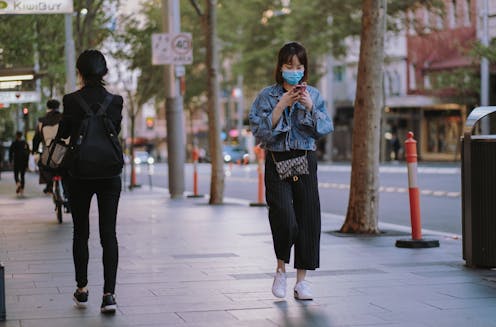
 While mandates have eased, some people are still staying home to protect their health.
Unsplash, CC BY
While mandates have eased, some people are still staying home to protect their health.
Unsplash, CC BY
Read more: 'The stories a nation tells itself matter': how will the COVID generation remember 2020?
Facing the future
What can we learn from all this about facing an ongoing pandemic and other large-scale stressors? Share how you felt and how you feel, both the good and the bad – particularly with close others. Chances are you and those you share with will benefit.
Not on social media? Not a problem. Social sharing of emotions, and the emergence of collective emotions, certainly happens in face-to-face interaction. Worried about lack of face-to-face opportunities? Also not a problem. Computer-mediated and face-to-face communication are remarkably similar in terms of how much emotion is shared. Find the medium that works for you.
If others are sharing with you – especially negative experiences – go further than providing comfort, validation and understanding. Aim to help them cognitively process the event by thinking differently about it. And of course, avoid co-rumination.
Sharing our feelings and processing our collective emotions can be helpful, especially as we step into an uncertain future.
Authors: Lisa A Williams, Associate professor, School of Psychology, UNSW Sydney


 Daily Bulletin


