

Read The Times Australia

Daily Bulletin

How FTX Australia was able to get away with claiming it was 'ASIC-licenced'

  • Written by: Pamela Hanrahan, Professor of Commercial Law and Regulation, UNSW Business School, UNSW Sydney
How FTX Australia was able to get away with claiming it was 'ASIC-licenced'

When cryptocurrency exchange FTX Group collapsed in the Bahamas last month, its local subsidiaries FTX Australia Pty Ltd and FTX Express Pty Ltd fell over too.

The Australian companies were placed into administration on November 11 and within days the Australian Securities and Investments Commission (ASIC) had suspended the Australian financial service licence FTX Australia had held since March 2022.

The fact that FTX Australia had an Australian financial service came as a surprise to some people, who had wrongly assumed everything crypto-related was beyond the reach of Australia’s regulators.

It also raised questions – including for Assistant Treasurer Stephen Jones – about how FTX Australia managed to acquire its Australian financial services licence, and how ASIC seemed to have missed the chance to intervene sooner.

And it draws wider attention to the 20-year-old licensing system and what an Australian financial service actually means for the firms that have them.

Licensed to do what, precisely?
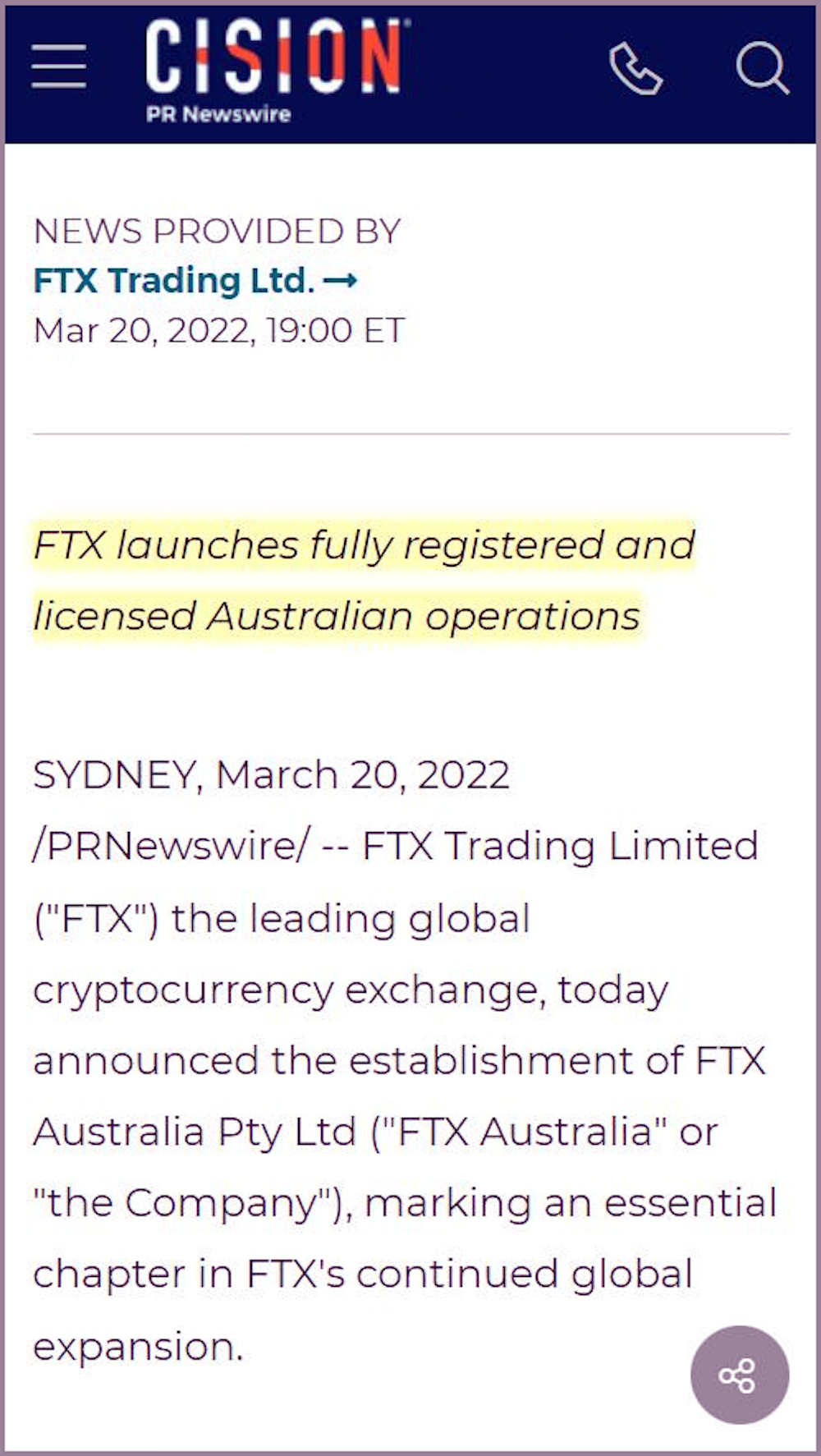
FTX Trading Limited When FTX commenced operations in Australia this year, its media release was headed: “FTX launches fully registered and licensed Australian operations”. But what exactly was it licensed to do? The Australian financial service (AFS) licensing regime in place since the late 1990s authorises each firm to do specified things, in relation to specified financial products, for specified clients. Each firm’s licence is different, and what is required by ASIC is different depending on what the firm is authorised to do. FTX Australia’s licence authorised it to deal in, make a market for, and provide general advice relating to derivatives and foreign exchange contracts to retail and wholesale clients. That’s it. Note that crypto-assets are not specified, nor is running a crypto-asset exchange. The jury is still out globally on whether crypto-assets (as distinct from investments derived from crypto-assets) are financial products at all. It is possible to think of them as like gold bullion or fine art – or pet rocks – where the asset itself is not a financial product, but a financial product might be constructed from it. If a cryptocurrency is not a financial product, then licensing laws can’t apply, which might explain why one of the two firms set up in Australia – FTX Express, which operated the crypto-exchange – was not AFS licensed. Read more: 'I thought crypto exchanges were safe': the lesson in FTX's collapse The lesson is that knowing a firm has an AFS licence only takes you so far, and often not very far at all. Unless you check the specific authorisations, there’s no way of knowing how little the firm you are dealing with is licensed to do. And ASIC-regulation doesn’t involve prudential regulation, which is directed at the stability of the company itself, ensuring among other things that it should be able to meet its financial commitments under reasonable circumstances. Prudential regulation is the job of the Australian Prudential Regulation Authority, which regulated neither FTX Australia nor FTX Express. Licences for sale FTX Australia’s ASIC licence was originally granted to someone else entirely back in 2008. A series of takeovers meant it passed through a number of hands until it ended up with FTX in March this year. While an original applicant has to satisfy rigorous checks, this hasn’t always been the case for subsequent purchasers. ASIC has known for years that its ASF licences were ending up in new hands when companies were bought and sold. In 2017, it asked the government’s ASIC Enforcement Review Taskforce to recommend changes to the law that would allow it to revisit an AFS licence when its owners changed. The change that was eventually legislated in 2020 only required licensees to notify ASIC when a licence changed hands, within 30 days. It did not require ASIC to approve the change in control. Limited ASIC powers ASIC is able to inquire further to determine whether there is reason to believe a new licensee was likely to contravene its statutory obligations or is “fit and proper” – but it is not required to do so. If it finds either that the licensee is likely to contravene its obligations or that it is not fit and proper, it is able to suspend or cancel the licence after giving the new owners a fair hearing. Read more: How 'bad credit' lender Cigno has dodged ASIC's grasp But such inquiries have not become routine. Most of the (hundreds of) licensee purchases notified each year seem to go through to the keeper, as did FTX’s. Even if ASIC had reviewed FTX’s purchase of the licence in March 2022, it might well have found no grounds to revoke it, given the very limited range of activities it authorised. The FTX collapse may result in ASIC changing its attitude to change-of-control transactions involving AFS licensees, for which it might need more resources. But even if that happens, clients would still be well advised to take care to understand exactly what “AFS licensed” really means. Authors: Pamela Hanrahan, Professor of Commercial Law and Regulation, UNSW Business School, UNSW Sydney

Read more https://theconversation.com/how-ftx-australia-was-able-to-get-away-with-claiming-it-was-asic-licenced-196361

Business News

Designing Eco-Friendly Custom Water Bottles for Your Next Event

The Evolution of Sustainable Event Merchandise Event planning has undergone a massive transformation over the last decade. Gone are the days when organizers could hand out cheap, single use plastic...

Daily Bulletin - avatar Daily Bulletin

Why Choosing a Professional Florist Melbourne Makes Flower Delivery Impactful

Flowers have a great power to speak when humans cannot express their feelings with right words. Flowers are the best gifts when you are celebrating a birthday or welcoming a newborn child into your fa...

Daily Bulletin - avatar Daily Bulletin

The Business Case for Choosing Australian Fabricators Over Imported Alternatives

For a long time, you might have defaulted to overseas suppliers when sourcing fabricated metal components for a project. The unit price was lower on paper, and the maths seemed straightforward. That...

Daily Bulletin - avatar Daily Bulletin

Australian organisations are relying on business continuity plans built for a far more predictable world

Tariff escalations, supply chain fragility, geopolitical events, and the ongoing threat of cyber disruption have reshaped the risk environment facing Australian organisations. The problem is that ma...

Daily Bulletin - avatar Daily Bulletin

How to Rent a Car for Uber in Melbourne: What Every New Driver Needs to Know

Starting out as an Uber driver in Melbourne is not as complicated as it sounds but getting the vehicle right is where most new drivers get stuck. Uber has strict requirements around vehicle age, condi...

Daily Bulletin - avatar Daily Bulletin

When Should You Speak to a Lawyer About a Legal Issue?

Legal issues can begin with a simple question, then become harder to manage once formal steps are involved. Many people wait until a matter feels urgent before seeking guidance, even though earlier ...

Daily Bulletin - avatar Daily Bulletin

The strategic rise of Bali as Australia’s next essential healthcare support hub

As Australian healthcare providers grapple with unprecedented operational bottlenecks, a new nearshore model is quietly transforming patient care delivery. Forward-thinking organisations,  including...

Daily Bulletin - avatar Daily Bulletin

Cost Savings and Benefits of Using Used Pallets in Logistics

In today’s competitive logistics and supply chain industry, businesses are constantly looking for ways to reduce operational costs without compromising efficiency and reliability. One of the most prac...

Daily Bulletin - avatar Daily Bulletin

How Fulfilment Services in Australia Help Businesses Scale Efficiently

The growth of e-commerce and modern retail has transformed customer expectations. Consumers now expect fast shipping, accurate order processing, and seamless delivery experiences regardless of where...

Daily Bulletin - avatar Daily Bulletin

The Daily Magazine

Top 4 Wheelchair Ramp Providers in the Boulder Area

Finding the right wheelchair ramp in Boulder will feel like a turning point. Whether you are plann...

Thermoplastic vs. Paint: The True Long-Term Cost Comparison

Line marking looks like a simple line item on a school maintenance budget, until the true cost of ...

Why Vetting Beats Volume: The Real Story Behind Australia's Growing Applicant Pools

On paper, hiring should be getting easier. Job ads across the country are pulling in more applicat...

Moving Out of a Rental in Melbourne? A Practical Moving Checklist

Moving out of a rental in Melbourne is one of those things that always feels further away than it ...

Why a Cordless Rebar Tying Machine Is a Smart Investment for Australian Construction Projects

Tying reinforcing steel by hand means spending hours bent over while making the same twisting moti...

How to Get a Document Notarised in Sydney: What to Bring, What It Costs and How Long It Takes

If an overseas bank, embassy, university, employer or land registry has asked you for a notarised ...

The 2026 Used-Car Market

For a few strange years, the used-car market rewrote its own rules. Supply shortages sent second-h...

Why CCTV Alone Is Not Enough for Modern Business Security

Cameras are usually the initial step that companies take to strengthen their physical security. If...

Why Every Workplace Should Take Emergency Preparedness Seriously

Emergency planning is one of those things many workplaces know they should think about, but it oft...