

Rethinking the big spring clean chuck-out frenzy: how keeping old things away from the landfill can 'spark joy' in its own way
- Written by: Ashley Jameson Eriksmoen, Senior Lecturer, School of Art & Design, Australian National University
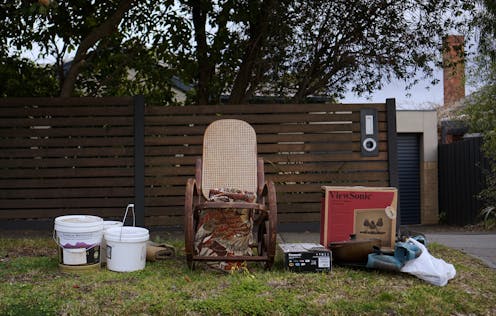
Driving home recently, I encountered a familiar sight: four dining chairs on the kerb waiting for some sucker to rescue them. Loading them into the car (sucker!) I wondered: how long were these chairs in shed limbo-land before finally getting kicked to the kerb?
When a wooden chair goes a bit wonky, it feels counter-intuitive to throw it away when it’s mostly OK. It’s often demoted to the shed, with the optimistic thought: “The wood is still good. Maybe it could be fixed.”
But will you really fix it? Sell it? Give it? Keep it? Nah. Chuck it.
Chucking has become easy – and socially acceptable. The pressure to de-clutter, galvanised by the Marie Kondo tidying-up craze, can feel moralistic. “Just chuck it already!” we say to ourselves, or our partners.
Kondo’s books (more than 13 million sold) implore us to discard ruthlessly any item that doesn’t immediately “spark joy”, with Kondo urging us to:
not be distracted by thoughts of being wasteful […] to get rid of what you no longer need is neither wasteful nor shameful […] so, arm yourself with plenty of garbage bags and prepare to have fun!
Kondo promotes throwing things “away” or “out” without addressing where exactly that nebulous place is.
Read more: When a tree dies, don't waste your breath. Rescue the wood to honour its memory
Where do chucked-out things go?
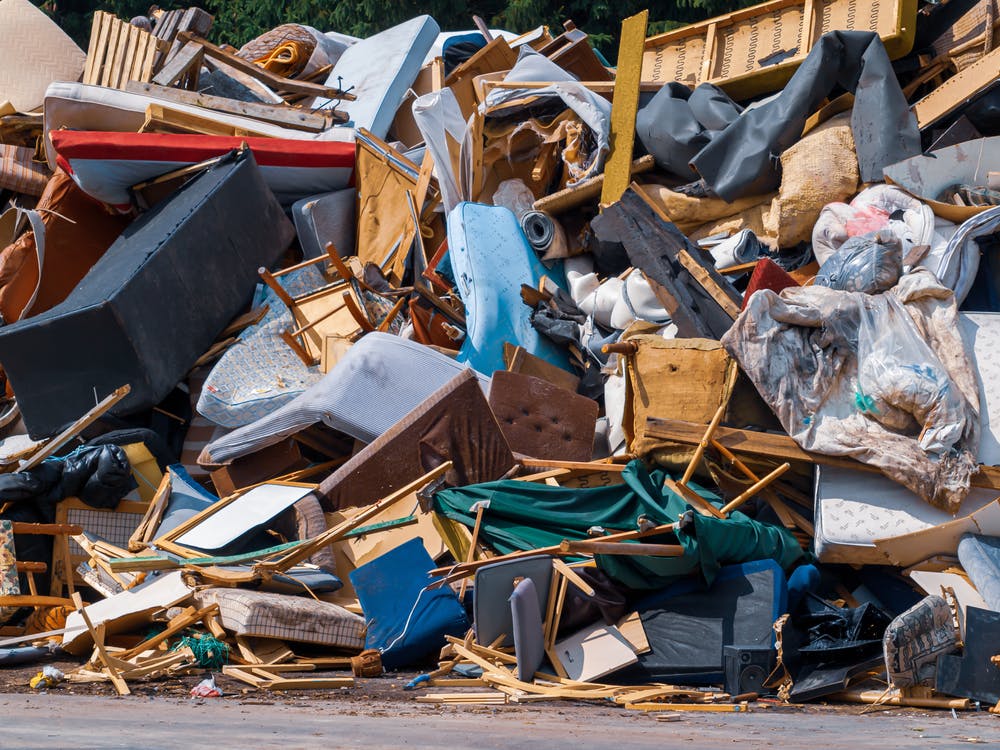
These items do not disappear when flung into the ether. They land quite concretely in expanding landfills that degrade landscapes and ecosystems, taint water supplies, and pump out methane as carbon is released during decomposition.
In a world of unbridled consumerism, we are experiencing a waste crisis. We dispose of tremendous amounts of furniture while consuming masses of new furniture, all in the midst of global timber supply shortages.
Even buying well-crafted, locally made “green” furnishings from sustainably harvested timber doesn’t stop our chucked-out things from rotting in landfill.
In my research, I have spoken to craftspeople, academics, community organisers, and environmental activists about furniture waste. The message is consistent: try to keep what already exists circulating in the world.
Waste as a cultural construct
Waste is often described as “matter out of place”. What we define as rubbish is a matter of perspective. It’s a cultural construct.
A wonky chair may be only negligibly different to its original state. But even if still functioning, or easily repaired, it becomes worthless once worn or wobbly.
This loss of value is reflected in waste collection policies and op-shops. It’s simple to book a council pickup collection or donate to an op-shop. It’s just so easy to get rid of things.
But either that chair is in good serviceable condition and is diverted from the waste stream for reuse, or it’s deemed rubbish and sent to the pit. There is no middle ground for easily repairable items.
If a chair is an antique, finely crafted, or of sentimental value, people tend to make the effort and spend money on expert restoration work.
But it can be hard to justify that for an ordinary chair.
Sandie Parkes, founder and owner of the Canberra Green Sheds, is awash in chairs to the point where they intermittently need to cull them, saying:
Every day we are offered about ten times more chairs than we can possibly sell.
 Few people know where to begin with fixing a wooden chair.
Ashley Eriksmoen, Author provided
Few people know where to begin with fixing a wooden chair.
Ashley Eriksmoen, Author provided
Learning to repair
Few people know where to begin with fixing a wooden chair. But many community groups teach such skills. Two Sheds Workshops in Canberra and Bega has woodworking and upholstery classes for women and children to learn basic skills and boost confidence.
Jess Semler, Two Sheds Workshop’s Canberra manager, told me, told me repair “doesn’t have to be a convoluted or long process. There is no one right way to fix something.” Once the process is demystified, students can work out how to fix other things, bringing creativity and playfulness to the process.
Greg Peters, key conservator of Patinations Conservation Service in Canberra, reiterated that for everyday, mass-produced furniture with no inherent historical or financial value, most repairs are actually relatively simple if you just “give it a go”, learn from the internet and remember there’s usually nothing to lose in trying.
Don’t have the tools? Ask around. Dr Niklavs Rubenis, a senior lecturer in object design at the University of Tasmania, suggests tapping into the collective knowledge of communities by asking neighbours for advice, or to borrow and share tools.
One positive global trend is the proliferation of repair cafes, where volunteers and clients can drop-in to pop-up repair events.
Griffith University’s Professor Leanne Wiseman researches the international Right to Repair movement, and is part of the Australian Repair Network. Wiseman counts about 100 repair cafes in Australia, most of which are listed here, operated mostly by volunteers bringing their own equipment.
And there are at least 11 tool libraries across Australia.
Finding a good home for broken furniture
Time poor or not keen to repair? Try posting on Facebook Marketplace or your local Facebook Buy Nothing group. You might connect your old chair to someone keen to fix it or harvest its usable timber for creative reuse.
My practice as an artist involves re-purposing abandoned chairs into works of critical design, which provokes viewers to rethink everyday objects.
My work The Dream, or The view from here is both bleak and resplendent is made from discarded chairs and has 47 legs touching the floor and a tangled canopy cresting over the seat. It raises questions about consumption and reuse.
 My work: The Dream, or The view from here is both bleak and resplendent.
David Paterson of Dorian Photographics, Author provided
My work: The Dream, or The view from here is both bleak and resplendent.
David Paterson of Dorian Photographics, Author provided
The chairs I rescued recently were made from dark stained wood. The look was dated, and the white seats were stained, but structurally, the chairs were in good nick. I will be deconstructing them and shaping parts into leafy stems to make new sculptural works that return the wood to plant and tree-like forms, like I did in my recent work for Sculpture by the Sea in Bondi. Another chair set saved from the pit.
I get it. Holidays and new year’s resolutions often mean big clean-ups. But before you chuck out good or almost-good things for the sake of decluttering, ask yourself if there’s a less wasteful option. (And if you really must get new chairs, consider finding quality second-hand chairs that will last).
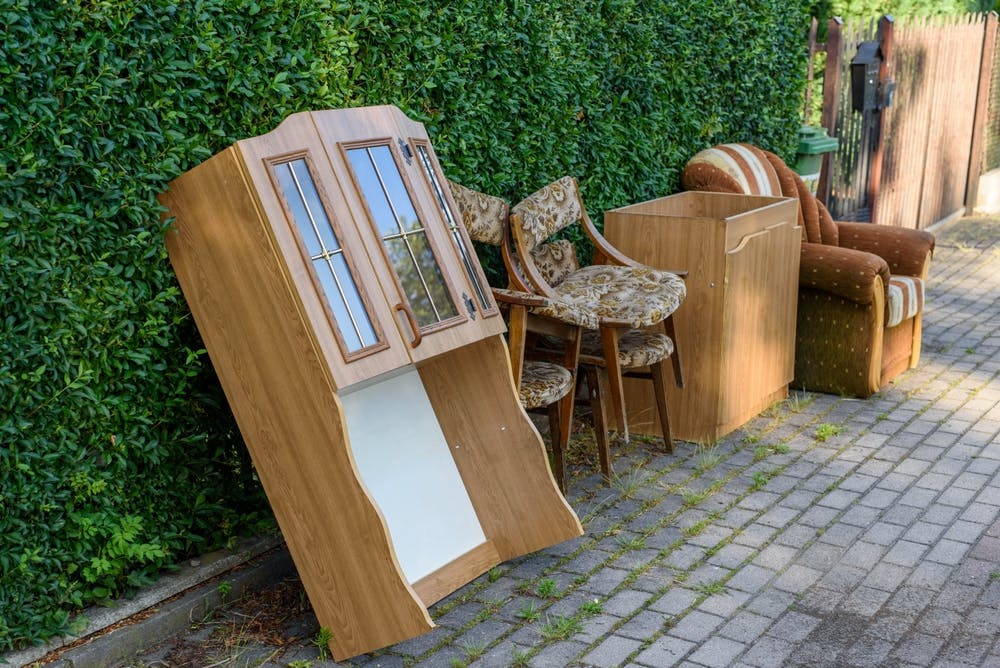 Think before you chuck.
Shutterstock
Think before you chuck.
Shutterstock
Nobody is saying you should become a hoarder. But not everything needs to be Marie Kondo-ed just because it doesn’t “spark joy”. Make peace with old items, even if they’re a bit dated. They can often be spruced up with a bit of glue, paint or fresh upholstery. Think carefully before you throw out something good or fixable as part of a furious spring clean.
When I bring furniture into my house, I think of it like a pet – something that should be cared for and not discarded on a whim. Furniture can last for generations if we just let it.
Read more: Design and repair must work together to undo our legacy of waste
Authors: Ashley Jameson Eriksmoen, Senior Lecturer, School of Art & Design, Australian National University


 Daily Bulletin


