

'I had it first!' 4 steps to help children solve their own arguments
- Written by: Amelia Church, Senior Lecturer, Melbourne Graduate School of Education, The University of Melbourne
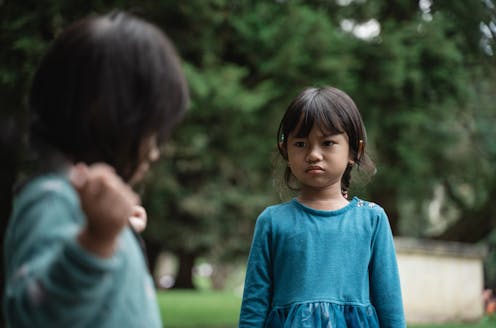
All children argue. And while this can be tedious for parents and carers, it’s not necessarily a problem.
Conflict can help develop social skills, including learning to negotiate, and accommodate the needs of others.
But if the conflict is physical, if there is any distress, or if children are stuck in a loop of unproductive complaints (“no, it’s mine!”), adults can step in to help restore the peace.
Usually, adults intervene by trying to establish the cause of the problem and then providing a solution. But this type of intervention is not as effective as involving children in the process.
A chapter in our new book on how to talk with preschool-aged children suggests four steps to help them solve arguments.
1. Remove the conflict object
Preschool-aged children mostly argue about objects. That is, who can touch, move or play with the object, who was playing with it first, and how the object is supposed to be used.
Intervention won’t work if children are locked in tug of war over who had the blocks or marbles first. By asking for the object and removing it from any child’s “ownership” (perhaps just temporarily), adults can redirect children’s attention to finding a solution. Trying saying something like: “Let’s put the marbles all together in the middle, and talk about it.”
2. Forget about blame
Children will be eager and able to explain what happened, who did what to whom, and how they have been offended.
It can be useful to establish what happened to establish moral accountability (if, for example, one child has ignored another’s reasonable request) or to know more about how each child feels their rights have been infringed. We should acknowledge, rather than ignore the position of each child. Children hold opposing views and alternate accounts – this is the reason for the conflict in the first place. But we don’t need to evaluate these accounts.
To move from conflict to cooperation, the focus needs to shift to talking about a solution. For example: “What can we do to make this fair?”
Young children have a strong sense of fairness, and are quick to identify when things are “not fair”. Encouraging children to consider what’s fair invites solutions that take into account other children’s perspectives.
Read more: Why do kids bully? And what can parents do about it?
3. Ask children for their ideas
Solutions imposed by adults don’t work well when children are then left to their own devices again.
Take this example from an Australian study of playground interactions in the first year of school: two five-year-olds complain to a teacher about other children interrupting their play.
The teacher suggests they explain they were using the area, and to invite the others to join their play rather than take over. This seems sensible advice. But as they walk away, one of the children says to her friend, “yeah, that’s not gonna work”.
It’s important to remember that children are expert members of their own peer culture – they create and navigate relationships and rules with other children. Ask them what might work. Inviting ideas from children supports them to arrive at solutions independently.
4. Seek consensus and then supervise
Moving to the next step, you could ask children, “What have we decided to do?”
Having asked each child to contribute their ideas means they have buy-in, even if their suggestion does not prevail. Contributing their own ideas means children have invested in the resolution. After brainstorming ideas, ask the children which solution they will choose or they could even “vote”.
Rather than walking away once children have agreed on a compromise, it’s then a good idea to stay nearby to encourage children to stick to their agreement.
Meanwhile, children are learning
Modelling solutions, and enacting how to reach a compromise is part of children’s learning about how to be in the world.
If we just tell kids what to do all the time, it means they don’t learn how to compromise or negotiate with others. In fact, some research has shown educators can disrupt the peacemaking process that children might otherwise navigate by themselves.
Parents are knowledgeable about their own children’s lives, but in many ways, children understand their peers better than adults do. Understanding how children’s interactions actually work, helps us provide more useful advice. So the adult’s role in an argument is not to attribute blame or hand the marbles back to the kid who cries the loudest. Rather it is to help children to recognise the needs of others in finding a fair solution.
Authors: Amelia Church, Senior Lecturer, Melbourne Graduate School of Education, The University of Melbourne
Read more https://theconversation.com/i-had-it-first-4-steps-to-help-children-solve-their-own-arguments-167979


 Daily Bulletin


