

Read The Times Australia

Daily Bulletin

Astronomers reveal the most detailed radio image yet of the Milky Way's galactic plane

  • Written by: Andrew Hopkins, Professor of Astronomy, Macquarie University
Astronomers reveal the most detailed radio image yet of the Milky Way's galactic plane

Two major astronomy research programs, called EMU and PEGASUS, have joined forces to resolve one of the mysteries of our Milky Way: where are all the supernova remnants?

A supernova remnant is an expanding cloud of gas and dust marking the last phase in the life of a star, after it has exploded as a supernova. But the number of supernova remnants we have detected so far with radio telescopes is too low. Models predict five times as many, so where are the missing ones?

We have combined observations from two of Australia’s world-leading radio telescopes, the ASKAP radio telescope and the Parkes radio telescope, Murriyang, to answer this question.

The gas between the stars

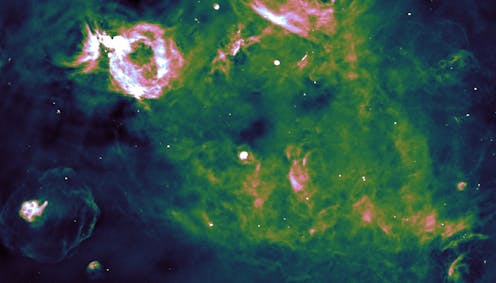
Comparison between the ASKAP/EMU image and the combined ASKAP/EMU plus Parkes/PEGASUS image. Images: R. Kothes (NRC) and E. Carretti (INAF).

The new image reveals thin tendrils and clumpy clouds associated with hydrogen gas filling the space between the stars. We can see sites where new stars are forming, as well as supernova remnants.

In just this small patch, only about 1% of the whole Milky Way, we have discovered more than 20 new possible supernova remnants where only seven were previously known.

These discoveries were led by PhD student Brianna Ball from Canada’s University of Alberta, working with her supervisor, Roland Kothes of the National Research Council of Canada, who prepared the image. These new discoveries suggest we are close to accounting for the missing remnants.

So why can we see them now when we couldn’t before?

The ASKAP radio telescope, showing radio dishes pointed at a blue sky with the sun in the background.
The ASKAP radio telescope at Inyarrimanha Ilgari Bundara, the CSIRO Murchison Radio-astronomy Observatory in Western Australia. CSIRO

The power of joining forces

I lead the Evolutionary Map of the Universe or EMU program, an ambitious project with ASKAP to make the best radio atlas of the Southern Hemisphere.

EMU will measure about 40 million new distant galaxies and supermassive black holes, to help us understand how galaxies have changed over the history of the universe.

Early EMU data have already led to the discovery of odd radio circles (or “ORCs”), and revealed rare oddities like the “Dancing Ghosts”.

For any telescope, the resolution of its images depends on the size of its aperture. Interferometers like ASKAP simulate the aperture of a much larger telescope. With 36 relatively small dishes (each 12m in diameter) but a 6km distance connecting the farthest of these, ASKAP mimics a single telescope with a 6km wide dish.

That gives ASKAP a good resolution, but comes at the expense of missing radio emission on the largest scales. In the comparison above, the ASKAP image alone appears too skeletal.

The Parkes radio telescope, Murriyang, showing the 64 telescope dish.
The Parkes radio telescope, Murriyang. CSIRO

To recover that missing information, we turned to a companion project called PEGASUS, led by Ettore Carretti of Italy’s National Institute of Astrophysics.

PEGASUS uses the 64m diameter Parkes/Murriyang telescope – one of the largest single-dish radio telescopes in the world – to map the sky.

Even with such a large dish, Parkes has rather limited resolution. By combining the information from both Parkes and ASKAP, each fills in the gaps of the other to give us the best fidelity image of this region of our Milky Way galaxy. This combination reveals the radio emission on all scales to help uncover the missing supernova remnants.

Linking the datasets from EMU and PEGASUS will allow us to reveal more hidden gems. In the next few years we will have an unprecedented view of almost the entire Milky Way, about a hundred times larger than this initial image, but with the same level of detail and sensitivity.

We estimate there may be up to 1,500 or more new supernova remnants yet to discover. Solving the puzzle of these missing remnants will open new windows into the history of our Milky Way.

ASKAP and Parkes are owned and operated by CSIRO, Australia’s national science agency, as part of the Australia Telescope National Facility. CSIRO acknowledge the Wajarri Yamaji people as the Traditional Owners and native title holders of Inyarrimanha Ilgari Bundara, the CSIRO Murchison Radio-astronomy Observatory, where ASKAP is located, and the Wiradjuri people as the traditional owners of the Parkes Observatory.

Authors: Andrew Hopkins, Professor of Astronomy, Macquarie University

Read more https://theconversation.com/astronomers-reveal-the-most-detailed-radio-image-yet-of-the-milky-ways-galactic-plane-197905

Business News

Designing Eco-Friendly Custom Water Bottles for Your Next Event

The Evolution of Sustainable Event Merchandise Event planning has undergone a massive transformation over the last decade. Gone are the days when organizers could hand out cheap, single use plastic...

Daily Bulletin - avatar Daily Bulletin

Why Choosing a Professional Florist Melbourne Makes Flower Delivery Impactful

Flowers have a great power to speak when humans cannot express their feelings with right words. Flowers are the best gifts when you are celebrating a birthday or welcoming a newborn child into your fa...

Daily Bulletin - avatar Daily Bulletin

The Business Case for Choosing Australian Fabricators Over Imported Alternatives

For a long time, you might have defaulted to overseas suppliers when sourcing fabricated metal components for a project. The unit price was lower on paper, and the maths seemed straightforward. That...

Daily Bulletin - avatar Daily Bulletin

Australian organisations are relying on business continuity plans built for a far more predictable world

Tariff escalations, supply chain fragility, geopolitical events, and the ongoing threat of cyber disruption have reshaped the risk environment facing Australian organisations. The problem is that ma...

Daily Bulletin - avatar Daily Bulletin

How to Rent a Car for Uber in Melbourne: What Every New Driver Needs to Know

Starting out as an Uber driver in Melbourne is not as complicated as it sounds but getting the vehicle right is where most new drivers get stuck. Uber has strict requirements around vehicle age, condi...

Daily Bulletin - avatar Daily Bulletin

When Should You Speak to a Lawyer About a Legal Issue?

Legal issues can begin with a simple question, then become harder to manage once formal steps are involved. Many people wait until a matter feels urgent before seeking guidance, even though earlier ...

Daily Bulletin - avatar Daily Bulletin

The strategic rise of Bali as Australia’s next essential healthcare support hub

As Australian healthcare providers grapple with unprecedented operational bottlenecks, a new nearshore model is quietly transforming patient care delivery. Forward-thinking organisations,  including...

Daily Bulletin - avatar Daily Bulletin

Cost Savings and Benefits of Using Used Pallets in Logistics

In today’s competitive logistics and supply chain industry, businesses are constantly looking for ways to reduce operational costs without compromising efficiency and reliability. One of the most prac...

Daily Bulletin - avatar Daily Bulletin

How Fulfilment Services in Australia Help Businesses Scale Efficiently

The growth of e-commerce and modern retail has transformed customer expectations. Consumers now expect fast shipping, accurate order processing, and seamless delivery experiences regardless of where...

Daily Bulletin - avatar Daily Bulletin

The Daily Magazine

Moving Out of a Rental in Melbourne? A Practical Moving Checklist

Moving out of a rental in Melbourne is one of those things that always feels further away than it ...

Why a Cordless Rebar Tying Machine Is a Smart Investment for Australian Construction Projects

Tying reinforcing steel by hand means spending hours bent over while making the same twisting moti...

How to Get a Document Notarised in Sydney: What to Bring, What It Costs and How Long It Takes

If an overseas bank, embassy, university, employer or land registry has asked you for a notarised ...

The 2026 Used-Car Market

For a few strange years, the used-car market rewrote its own rules. Supply shortages sent second-h...

Why CCTV Alone Is Not Enough for Modern Business Security

Cameras are usually the initial step that companies take to strengthen their physical security. If...

Why Every Workplace Should Take Emergency Preparedness Seriously

Emergency planning is one of those things many workplaces know they should think about, but it oft...

Why Clearer Communication Still Matters in a Digital-First Business

It’s never been easier for businesses to communicate, but that doesn’t mean they’re always communica...

What Happens After You Lodge a BYDA Enquiry? The Step Most Excavation Projects Miss

Every excavation project in Australia — from a backyard deck footing to a multi-storey commercial bu...

How to Choose the Right Dentist on the Gold Coast

Finding a dentist you trust is one of those decisions that quietly affects your health for years, ye...