

Want your child to eat more veggies? Talk to them about ‘eating the rainbow'
- Written by: Emma Beckett, Senior Lecturer (Food Science and Human Nutrition), School of Environmental and Life Sciences, University of Newcastle
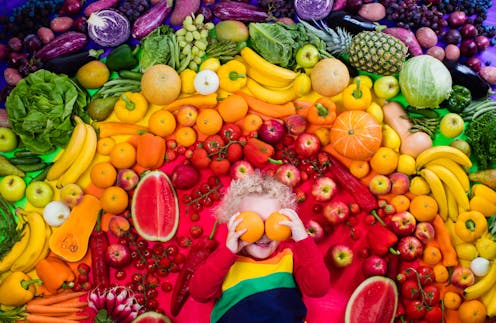
Parents of young children today were raised during some of the most damaging periods of diet culture. From diet and “lite” foods and drinks, to expensive “superfoods”, one constant across these changing trends has been the moralisation of food as “good” or “bad”.
These diet movements have led to many of us having difficult relationships with food, eating and dieting. If this sounds familiar, you might be wondering how to use the fun features of healthy foods to encourage kids to eat more of them.
“Eating the rainbow” means regularly eating a variety of different coloured fruits and vegetables. Encouraging your child to eat a rainbow is backed by the evidence and can start more well-rounded and positive conversations with them about foods.
Read more: We're told to 'eat a rainbow' of fruit and vegetables. Here's what each colour does in our body
Encouraging variety
All fruits and vegetables are good for us. Depending on the age and sex of your child, Australia’s dietary guidelines recommend they eat 2–5.5 serves of vegetables and a 0.5–2 serves of fruit each day.
Each fruit and vegetable has it’s own unique profile of nutrients, so the wider variety of fruit and vegetables you eat in those serves, the better.
Eating a variety of fruits and vegetables each day has more benefits than just eating the one type on repeat, so striving for the rainbow can help encourage variety.
Serving variety and colourful meals can also encourage us to eat more. So if you or your kids are struggling to eat enough fruit and vegetables, you can use the rainbow to help get all those serves in.
Sparking adventurousness
Chasing the rainbow can also help kids break out of their comfort zones and can be an early way to encourage adventurousness for new foods.
While kids can benefit from routine, there are links between how adventurous we are with trying new foods and other healthy traits and habits. Those who love trying new things tend to have a higher quality diet than those who hate trying new things.
Starting early conversations about the complexities of food
Most parents of today’s kids were raised during the “reductionist” era of nutrition. The focus wasn’t on whole, complex foods, but on the key macro and micronutrients they contain. So, bread becomes all about the carbs and citrus becomes all about the vitamin C.
When we think along these lines it’s easy to think bread is “bad” and citrus fruits are only a good source of vitamin C.
But foods are much more complex than this. Nutrients are rarely found in just one food, and each food is seldom made of just one nutrient. And even more importantly, food isn’t just nutrients – it also contains “bioactive compounds”.
Read more: Let's untangle the murky politics around kids and food (and ditch the guilt)
These bioactives, which you might also see called phytonutrients or phytochemicals (phyto means from plants), occur naturally in plant foods. They’re not essential for our survival like nutrients are, but they can have healthy benefits.
Often these bioactives are linked to colours, so foods of different colours not only have different nutritional profiles, but they have different bioactive profiles too.
In fact, the pigments that give fruits and vegetables their colours are often bioactives. For example, reds can be lycopenes, linked to heart and blood vessel health and purples can be anothcyanins, linked to improved inflammation.
Kids don’t need to know which bioactive goes with which colour, or what they all do. But you can start conversations about the complexity of our biology and the food that nourishes it.
Where does fresh food come from?
Survey data regularly shows many kids don’t know where their food comes from, or don’t know which fruits and vegetables are which.
Fruits and vegetables often change colours when they ripen, and different parts of the plants they come from are different colours. So talking about the rainbow can open up conversations about:
- where food comes from
- how it grows
- which parts of each plant are safe to eat
- which parts of the plants are tasty.
Rainbows go with everything
As children get older, you can start talking about what happens to the colours of foods when when you cook or mix them. Some foods that aren’t very tasty alone might be more palatable when you mix them with some other colours. For example, bitter green leafy vegetables can be tastier if we combine them with sour from citrus or sweetness from berries.
Cooking might make foods brighter or duller, and can release or change nutrients and bioactives.
Read more: Curious Kids: how do tongues taste food?
Colours can be used in kitchen science experiments – like cabbage or blueberries acting as natural indicators of acidity.
Kids don’t need to know all the details to benefit from eating the rainbow, but talking about colours can spark curiosity. The rainbow is diverse, so it reduces the focus on individual foods, making healthy eating easier and more fun.
Authors: Emma Beckett, Senior Lecturer (Food Science and Human Nutrition), School of Environmental and Life Sciences, University of Newcastle


 Daily Bulletin


