

Read The Times Australia

Daily Bulletin

How to save $4 billion a year: reform a fuel tax credit scheme with no real rationale

  • Written by: Marion Terrill, Transport and Cities Program Director, Grattan Institute
How to save $4 billion a year: reform a fuel tax credit scheme with no real rationale

Revising the generous fuel tax credits given to businesses should be a priority for the Albanese government, because keeping them would conflict with two other pressing priorities: reducing carbon emissions and repairing the budget.

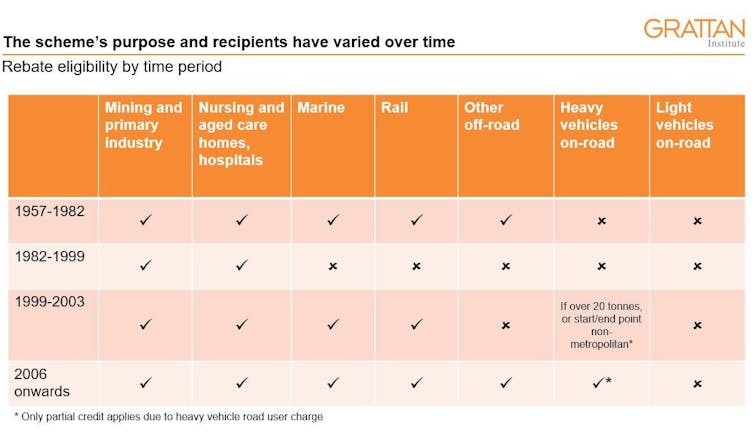
Fuel tax exemptions have existed for as long as the federal government has taxed fuel, starting in 1957. With the rationale for the tax being to pay for building and maintaining roads, initially all off-road users were exempt.

But the earmarking of all fuel tax revenue for spending on roads ended in 1959 – more than 60 years ago. With the tax becoming a general revenue-raiser, the rationale for exemptions or tax credits has shifted with the disposition of the government of the day.

The settings inherited by the Albanese government now cost the budget almost $8 billion a year.

CC BY As long ago as 1991, the Australian National Audit Office recommended the credit scheme “clarify its purpose and objectives”. Yet those objectives remain unclear today. Who benefits most? Previous governments have argued exemptions and tax credits support regional industries, and people living in regional areas. In 1999, when the credit was extended to marine, rail, and some trucks and buses, the then-deputy prime minister (and National Party leader) John Anderson said the goal was to reduce transport costs, particularly for “those people living in regional, rural and remote areas”. In 2006, when expanding the credit to include all off-road users and on-road vehicles weighing over 4.5 tonnes, the then-assistant treasurer Peter Dutton said: “This is good news for business, and regional Australia in particular.” But if the aim of the policy is to support regional areas, fuel tax credits are a poorly targeted way to do so. Read more: We pay billions to subsidise Australia’s fossil fuel industry. This makes absolutely no economic sense In the five industries that receive almost 90% of the value of credits, more than 60% of businesses, and 67% of employees, are in major cities. There is no evidence fuel tax credits particularly benefit regional areas, or that they are more effective than other policies in doing so. It is hard to avoid the conclusion that fuel tax credits are mostly a gift to the mining and agricultural industries – the only non-care industries that have always received an exemption from paying taxes on fuel, and the major recipients of fuel tax credits today. Business in the mining, transport and agriculture industries are biggest recipients of fuel tax credits. CC BY-SA Budgetary needs have prompted changes Changes to fuel tax credits have also aligned with the budgetary needs of the government of the day. In 1982, when government debt as a share of GDP was rising steadily, the Fraser government narrowed the scheme to just mining, primary industries and care industries. Many businesses previously exempt – including in rail, marine, construction and manufacturing – were forced to pay fuel taxes. In 2006, the Howard government broadened the scheme during the mining boom when budget surpluses meant no net debt for the first time in 30 years. Despite the straightened fiscal position the government now faces, the credit scheme remains unchanged. Out of step with net zero and budget repair The Albanese government has several growing spending obligations, particularly in health, aged care, disability care and interest expenses on its debt. After stripping out the effects of temporary factors such as high commodity prices, there remains a stubborn gap between government receipts and spending of about $40 billion a year. In a new report published by Grattan Institute, Fuelling budget repair: How to reform fuel taxes for business, we argue fuel tax credits should be removed for on-road users, and roughly halved for off-road users. This would save about $4 billion a year. It would also reflect the environmental and health costs of diesel use. Read more: Australia's government gives more support to fossil fuel research than is apparent Giving businesses tax credits on for consuming fuel without having to pay for or reduce their carbon emissions is sharply at odds with the government’s goal of net zero emissions by 2050. Diesel combustion currently accounts for 17% of Australia’s emissions. In 2020, the top five industry recipients of fuel tax credits directly produced more than half of Australia’s emissions. That share is expected to reach 64% by 2030. As well as helping repair the budget, reducing fuel tax credits would signal to businesses that they need to consider emissions in their investment decisions, minimising the costs to future consumers, taxpayers and shareholders. Authors: Marion Terrill, Transport and Cities Program Director, Grattan Institute

Read more https://theconversation.com/how-to-save-4-billion-a-year-reform-a-fuel-tax-credit-scheme-with-no-real-rationale-198999

Business News

Designing Eco-Friendly Custom Water Bottles for Your Next Event

The Evolution of Sustainable Event Merchandise Event planning has undergone a massive transformation over the last decade. Gone are the days when organizers could hand out cheap, single use plastic...

Daily Bulletin - avatar Daily Bulletin

Why Choosing a Professional Florist Melbourne Makes Flower Delivery Impactful

Flowers have a great power to speak when humans cannot express their feelings with right words. Flowers are the best gifts when you are celebrating a birthday or welcoming a newborn child into your fa...

Daily Bulletin - avatar Daily Bulletin

The Business Case for Choosing Australian Fabricators Over Imported Alternatives

For a long time, you might have defaulted to overseas suppliers when sourcing fabricated metal components for a project. The unit price was lower on paper, and the maths seemed straightforward. That...

Daily Bulletin - avatar Daily Bulletin

Australian organisations are relying on business continuity plans built for a far more predictable world

Tariff escalations, supply chain fragility, geopolitical events, and the ongoing threat of cyber disruption have reshaped the risk environment facing Australian organisations. The problem is that ma...

Daily Bulletin - avatar Daily Bulletin

How to Rent a Car for Uber in Melbourne: What Every New Driver Needs to Know

Starting out as an Uber driver in Melbourne is not as complicated as it sounds but getting the vehicle right is where most new drivers get stuck. Uber has strict requirements around vehicle age, condi...

Daily Bulletin - avatar Daily Bulletin

When Should You Speak to a Lawyer About a Legal Issue?

Legal issues can begin with a simple question, then become harder to manage once formal steps are involved. Many people wait until a matter feels urgent before seeking guidance, even though earlier ...

Daily Bulletin - avatar Daily Bulletin

The strategic rise of Bali as Australia’s next essential healthcare support hub

As Australian healthcare providers grapple with unprecedented operational bottlenecks, a new nearshore model is quietly transforming patient care delivery. Forward-thinking organisations,  including...

Daily Bulletin - avatar Daily Bulletin

Cost Savings and Benefits of Using Used Pallets in Logistics

In today’s competitive logistics and supply chain industry, businesses are constantly looking for ways to reduce operational costs without compromising efficiency and reliability. One of the most prac...

Daily Bulletin - avatar Daily Bulletin

How Fulfilment Services in Australia Help Businesses Scale Efficiently

The growth of e-commerce and modern retail has transformed customer expectations. Consumers now expect fast shipping, accurate order processing, and seamless delivery experiences regardless of where...

Daily Bulletin - avatar Daily Bulletin

The Daily Magazine

Moving Out of a Rental in Melbourne? A Practical Moving Checklist

Moving out of a rental in Melbourne is one of those things that always feels further away than it ...

Why a Cordless Rebar Tying Machine Is a Smart Investment for Australian Construction Projects

Tying reinforcing steel by hand means spending hours bent over while making the same twisting moti...

How to Get a Document Notarised in Sydney: What to Bring, What It Costs and How Long It Takes

If an overseas bank, embassy, university, employer or land registry has asked you for a notarised ...

The 2026 Used-Car Market

For a few strange years, the used-car market rewrote its own rules. Supply shortages sent second-h...

Why CCTV Alone Is Not Enough for Modern Business Security

Cameras are usually the initial step that companies take to strengthen their physical security. If...

Why Every Workplace Should Take Emergency Preparedness Seriously

Emergency planning is one of those things many workplaces know they should think about, but it oft...

Why Clearer Communication Still Matters in a Digital-First Business

It’s never been easier for businesses to communicate, but that doesn’t mean they’re always communica...

What Happens After You Lodge a BYDA Enquiry? The Step Most Excavation Projects Miss

Every excavation project in Australia — from a backyard deck footing to a multi-storey commercial bu...

How to Choose the Right Dentist on the Gold Coast

Finding a dentist you trust is one of those decisions that quietly affects your health for years, ye...