

In a new study, we've observed clues that distinguish the very deepest part of Earth's core
- Written by: Thanh-Son Pham, Postdoctoral Fellow in Geophysics, Australian National University
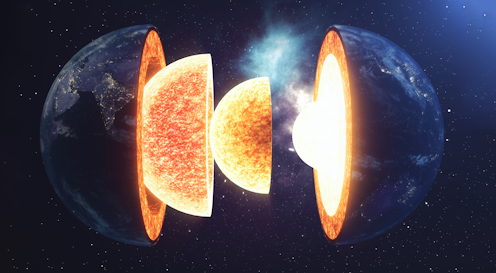
Not so long ago, Earth’s interior was thought to be made up of four layers: the crust, mantle, (liquid) outer core and (solid) inner core.
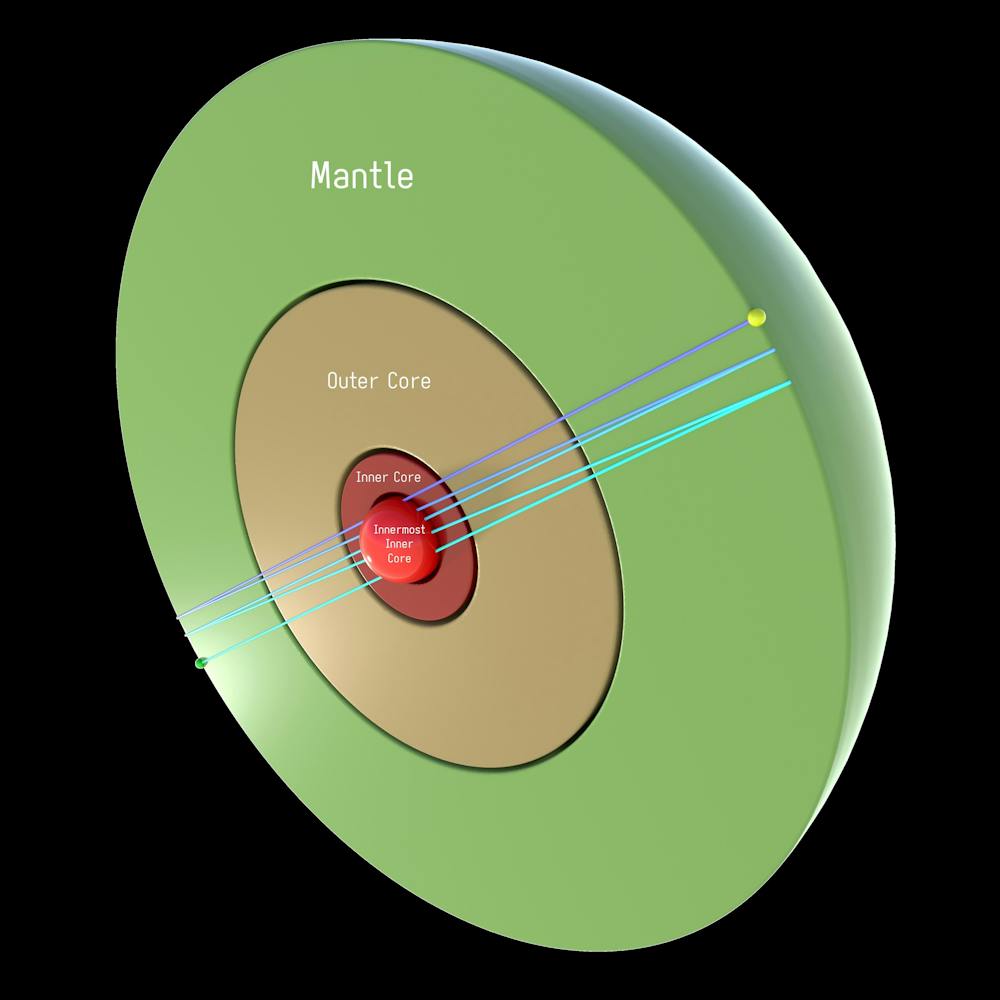
In a new study published today in Nature Communications, we provide further evidence for the existence of an “innermost inner core” – a distinct internal metallic ball embedded in the inner core like the most petite Russian nesting doll.
Studying Earth’s centre is not just a topic of academic curiosity, but something that sheds light on the very evolution of life on our planet’s surface.
This is because the inner core grows outwards by solidifying materials from the liquid outer core. As these materials solidify, heat is released and causes upward movement in the liquid layer – what’s known as a convection current. In turn, this convection generates our planet’s geomagnetic field.
The magnetic field protects life on Earth from harmful cosmic radiation. Without the shield it provides, life on Earth would not be possible in the form we know today.
So, understanding the evolutionary history of our planet’s inner core and its connection with the geomagnetic field is relevant to understanding the timeline of life’s evolution on Earth’s surface.
Read more: What makes one Earth-like planet more habitable than another?
Studying the insides of the planet
Like radiologists imaging a patient’s internal organs, seismologists use seismic waves from large earthquakes to study the deep interior of Earth. Earthquakes are our sources, and seismometers recording ground motions or vibrations that move through Earth are our receivers.
However, unlike medical imaging, we do not have the luxury of having sources and receivers equally distributed around the body. Large earthquakes useful for our probes are confined near tectonic margins, such as the Ring of Fire surrounding the Pacific. Meanwhile, seismometers mainly exist on land.
Furthermore, the inner core, which is one-fifth of Earth’s radius, accounts for less than 1% of Earth’s volume. To target this relatively small volume in the planet’s centre, seismometers often need to be positioned on the opposite side of the globe, the so-called antipode of an earthquake.
But that’s unlikely in practice because the antipodes of active earthquake zones are often in the ocean, where seismometers are expensive to install.
With the limited data we do have from such antipode measurements, an internal metallic ball within the inner core – the innermost inner core – was hypothesised about 20 years ago, with an estimated radius of about 300km.
Several lines of evidence have confirmed its existence, including recent studies from our research group.
Bouncing seismic waves
Now, for the first time, we report observations of seismic waves originating from powerful earthquakes travelling back and forth from one side of the globe to the other up to five times like a ricochet. These new observations are exciting because they provide new probes from different angles of the centremost part of our planet.
A critical advantage of our study was getting data from dense continental-scale networks (consisting of several hundred seismometers) installed around some of the largest quakes.
It differs from previous studies because it uses seismic waves that bounce multiple times within Earth, along its diameter and through its centre. By capturing them, we obtain an unparalleled sampling of the innermost inner core.
A ball in the centre
The potential difference between the innermost metallic ball and the outer shell of the inner core is not in its chemical composition, like with some other Earth layers. Both are likely made of an iron-nickel alloy with small amounts of lighter chemical elements.
Additionally, the transition from the innermost (solid) ball to the outer shell of the inner core (also solid) seems gradual rather than sharp. That is why we can’t observe it via direct reflections of seismic waves from it. This differs from previous studies documenting sharp boundaries between the other layers inside Earth – from crust to mantle, for example.
So, what precisely did we observe that gives us clues about this innermost inner core?
The observed difference is in anisotropy – a material’s property to let (or propagate) seismic waves faster or slower through it depending on the direction in which they travel.
Different speeds could be caused by different arrangements of iron atoms at high temperatures and pressures, or by the arrangements of atoms when crystals grow.
There is strong evidence that the outer shell of the inner core is anisotropic. The slowest direction of seismic waves is in the equatorial plane (and the fastest is parallel to Earth’s spin axis).
By contrast, in the innermost part of the inner core – as our study of the ricochet waves shows – the slowest direction of propagation forms an oblique angle with the equatorial plane. This is critical, and this is why we can say we’ve detected “distinct” anisotropy in the innermost inner core.
Excitingly, while shallow structures within Earth’s crust and upper mantle are being mapped in incredible detail, we are still at the discovery stage regarding its deepest structures.
However, the image of Earth’s deep interior is getting sharper with the expansion of the dense continental networks, advanced data analysing techniques, and computational capacities.
Read more: Just add (mantle) water: new research cracks the mystery of how the first continents formed
Authors: Thanh-Son Pham, Postdoctoral Fellow in Geophysics, Australian National University


 Daily Bulletin


