

Why do small rural communities often shun newcomers, even when they need them?
- Written by: Saleena Ham, Adjunct Research Fellow, Rural Sociology, University of Southern Queensland
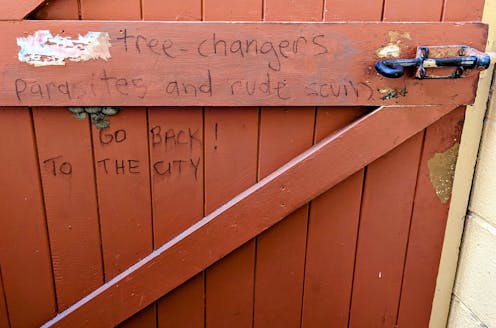
Do you remember the time you and your friends started a secret club and didn’t let anyone else join? Well, it’s kind of like that in some small rural communities. Even though these communities really need to attract and keep newcomers, some longstanding residents belong to a special “locals” club. Many newcomers who moved from the cities in recent years would know this all too well.
My research to understand the experience of newcomers in small towns found a few common themes in what happened to them. It found social identity was a factor that can often inhibit progress, resilience and acceptance of change in rural social groups.
Locals are regarded as the legitimate residents and often have greater local power and privileged status. They can be used to calling the shots for the community. They may hold back change by undermining or failing to accept or support new people, their ideas or businesses.
Newcomers can be intrinsically disruptive to the old and comfortable social norms of small towns. While newcomers want to show their value as residents by offering their new ideas or experience, these are not welcomed by locals because they disrupt the status quo and make them uncomfortable.
I interviewed 89 residents and recent residents in two rural Queensland communities with populations under 2,000. The locals often say newcomers or outsiders don’t have a right to have a say about the town and certainly not to make changes. They question their social legitimacy and tell stories of their inferiority as residents.
Even when newcomers manage to make a difference, the locals can ignore, criticise or undermine their achievements.
Read more: 'Let's just do it': how do e-changers feel about having left the city now lockdowns are over?
How are newcomers undermined?
In one town, a newcomer became the leader of a business group. He had experience, was energetic, accessed grants and consulted to develop a plan. But then problem after problem was found with it. It was suggested the whole process begin again. He could not move the business community forward to adopt the plan.
They wore him down. He was burned out by their active and passive resistance. After a couple of years, he ended his community involvement, exactly as the locals expected, because he “was not local”.
In another community, a new catering business opened. The locals thought it was too much like the city, certainly too flash for this little place. They made bookings without turning up, complained to the local council that bylaws were broken, suggested one partner was having an affair, and shared rumours of poor hygiene practice.
The business made social connections with other new businesses and created local events, attracting outsiders. The owners experimented, marketed, found clientele beyond the town and survived, but it was very tough when it did not need to be.
The locals undermine, censure and attack, in overt or subtle ways, newcomers who are seeking to belong and contribute until they become disillusioned or just withdraw. Businesses fail and people leave. The small community stays the same, familiar and declining, and the locals are happy because they were proved right about the newcomers.
Read more: Why young women say no to rural Australia
Why do residents behave like this?
One reason this happens is because people who live in small communities feel so attached to their community. It is as if it’s an extension of themselves.
So, when someone new comes in and wants to change things, it feels personal. The people who have lived there for a long time read it as a personal attack that threatens their values, stories, history, status and privileges. They feel like they have to defend their story of their special community from the outsiders and anything they might want to introduce. They resist and repel in order to unconsciously protect and defend their place in the secret insiders’ club.
Change can make people feel socially uncertain. Uncertainty about identity can make people feel like they have to act to protect what they know and love: it’s who they are.
It can seem like they’re being senselessly mean and self-sabotaging, but they see it as necessary and justified to protect the familiar qualities and social order of their community or social group.
Read more: It seemed like a good idea in lockdown, but is moving to the country right for you?
Why should communities welcome newcomers?
Newcomers also want to belong. They want friendship, to be themselves, acknowledged and accepted. They want to build community, contribute ideas, initiatives and effort. These things are vital for small communities to survive and stay vibrant.
Fear of social censure for breaking the local social norms flows into many other small town subjects: rejection of new agricultural practices, exclusion of the socially different, opposition to new business, rejection of developing precincts or modernising services.
Rural locals describe themselves as traditionalists, old school, practical. They expect to embrace hardship, inconvenience and loss as their unique identity. They see their group as morally superior to others.
This also makes it hard for people inside the secret club to get help when they struggle with mental health, financial failure, domestic abuse or grief. If they break the identity norms, will they be shamed or mocked?
Stoicism and resilience is integral to the secret club’s membership. Who are you if you can’t hack hardship? Can you still belong?
So, next time you hear about an unfriendly small rural community that undermines change, remember that it might be a social identity issue. They may be acting to protect their special insiders’ status and familiar way of life.
And small community members could remember that welcoming and reaching out to a newcomer or outsider may make all the difference to both that individual’s social success and the future of the community.
Read more: Has COVID really caused an exodus from our cities? In fact, moving to the regions is nothing new
Authors: Saleena Ham, Adjunct Research Fellow, Rural Sociology, University of Southern Queensland


 Daily Bulletin


