

Cyclone Gabrielle hit NZ's main fruit-growing region hard -- now orchardists face critical climate choices
- Written by: Anita Wreford, Professor Applied Economics, Lincoln University, New Zealand
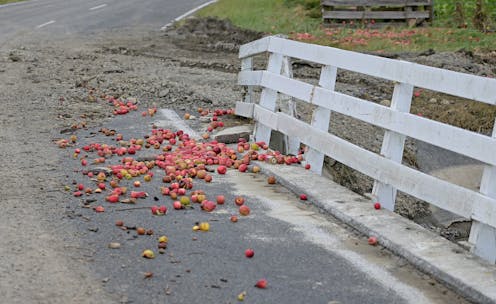
Hawke’s Bay, one of New Zealand’s most productive regions and the hub of the fruit-growing sector, is among the areas worst hit by Cyclone Gabrielle and ongoing rain.
Horticulture underpins the local economy, with apple earnings alone contributing around NZ$700m annually. The immediate destruction of crops from the heavy wind and rain is obvious. But the full extent of the long-term damage to trees and vines themselves is yet to fully assessed.
With metres of silt covering the land, smothering crops and potentially suffocating the root systems of fruit trees, it’s clear the impacts will be severe.
Horticulture will take longer to recover than pasture, which can be grown back on the affected land. Fruit trees have deep roots and require a functioning soil structure, which may have been destroyed by the silt. Recent media coverage suggests the industry could take 50 to 100 years to fully recover, but during that time, we know there will be more extreme weather events.
The region has already been dealing with variable weather, including a severe frost in October that caused considerable damage to kiwifruit crops.
In the immediate weeks after the cyclone, growers will be busy removing silt from the base of trees to avoid the roots suffocating from a lack of oxygen. Prospects of harvesting for those hit hard are likely to be low – even without the destruction of crops, getting machinery into the orchards will be difficult.
Beyond the immediate clean-up, some fruit growers may need to consider whether this is a “window” for changing the type of crop or system.
Adaptation to a changing climate
Recovery will range from clearing the damage and possibly salvaging trees and vines to complete loss of orchards. The cost of replanting is eye-watering, and likely to be prohibitive for many. One Hawke’s Bay farmer estimated it will take three years to replant an 11-hectare apple orchard, at a cost of $180,000 to $250,000 per hectare.
Given the significant investment and the long life of fruit trees, there is a more strategic question to be asked about replanting the same crops in the same areas.
Hawke’s Bay has long been treasured for its highly valuable and diverse soils, resulting in the abundance of fruit grown in the region. But a changing climate may mean some of these areas will become less suitable over the coming decades.
Researchers are developing a growing understanding of the changing suitability for a range of crops during the remainder of the century. Assessments of suitability are based on projections of climate variables such as temperature, precipitation and frost days. All these represent gradual changes in growing conditions.
We are already observing fewer frost days, which is making the region less suitable for certain kiwifruit varieties. This is likely to be even more pronounced in the future. For apples, decreased chill is likely to be the biggest driver of change.
More intense weather will be part of the future
These projections do not, however, include extreme weather events such as Cyclone Gabrielle. In a changing climate, we know extremes will occur more often and may be more intense.
Although climate change doesn’t generate more cyclones, it can make them more intense. Even without these extreme events, rainfall is likely be become more variable and periods of heavy rainfall may increase.
Growers looking to get back on their feet after this highly disruptive event would benefit from understanding what the future is likely to hold for their region.
Industry bodies have a role here to support their growers’ knowledge and awareness of options and processes for adaptation. The horticulture sector has developed an action plan that recognises the need to develop new techniques and consider new growing regions, underpinned by scientific evidence.
Read more: Extreme heat and rain: thousands of weather stations show there's now more of both, for longer
Opportunity to do things differently
We’ll need to tackle adaption to climate change at all levels to ensure horticulture can continue to thrive in Hawke’s Bay. Growers may reconsider the types of crops planted, where they are grown or the way they are grown.
Some growers are already developing covered systems to provide protection from some elements (but which may not withstand events such as Gabrielle).
We must also consider the role of stop banks. They allow the development of land in potentially flood-prone areas, which may lead to a false sense of security and greater damage if they are inadequate for projected water volumes.
Read more: Grape growers are adapting to climate shifts early – and their knowledge can help other farmers
There is increasing interest in returning riparian areas to their natural state to buffer against flooding, while also generating ecological benefits. But when the land protected by stop banks is as valuable as it is in Hawke’s Bay, this will be a challenging conversation.
With the increasingly disruptive weather Aotearoa New Zealand is already facing, and the changes expected over the next decades, it is crucial the decisions we make today do not make us more vulnerable in the future.
Authors: Anita Wreford, Professor Applied Economics, Lincoln University, New Zealand


 Daily Bulletin


