

PFAS might be everywhere – including toilet paper – but let's keep the health risks in context
- Written by: Mark Patrick Taylor, Victoria's Chief Environmental Scientist, EPA Victoria; Honorary Professor, School of Natural Sciences, Macquarie University
The United States Environmental Protection Agency has announced new limits on the toxic “forever chemicals” – perfluoroalkyl and polyfluoroalkyl substances (PFAS) – in drinking water.
The announcement comes amid rising concern about PFAS, which persist in the environment, are ubiquitous and do not break down over time.
The carbon and fluorine PFAS compounds have been used in myriad domestic and industrial products from non-stick cookware to cosmetics to firefighting foams and fabric treatments. This week, a group of researchers said toilet paper should be considered a potential source (but more on that later).
Every household is more likely than not to have dusts containing PFAS chemicals at low concentrations; forming a route of exposure for the people living there. But how worried should we be about the risks to our personal health linked to these forever chemicals?
Read more: Regulating 'forever chemicals': 3 essential reads on PFAS
Harmful impacts
Three specific PFAS chemicals of concern: perfluorooctane sulfonate (PFOS), perfluorooctanoic acid (PFOA), and perfluorohexane sulfonate (PFHxS) are listed on the Stockholm Convention on Persistent Organic Pollutants. The convention is a global treaty to protect human health and the environment from chemicals that remain intact in the environment for long periods, become widely distributed geographically, accumulate in the fatty tissue of humans and wildlife, and have harmful impacts on human health or on the environment.
To address PFAS risks and set acceptable limits, Australia has environmental and health guidelines for food, drinking water and recreational water exposures – like those just announced in the US.
The effects of PFAS exposure remain a matter of debate, specifically around the causal links between exposure and poorer human health. Nonetheless, there are clear associations to health outcomes including low fetal weight, impaired immune response, thyroid function abnormalities, obesity, increased lipid levels and liver function and impaired vaccine response.
These associations to disease have been disputed, but it nevertheless remains prudent to minimise exposure to all potentially harmful chemicals.

Read more: New evidence shows blood or plasma donations can reduce the PFAS 'forever chemicals' in our bodies
What about toilet paper though?
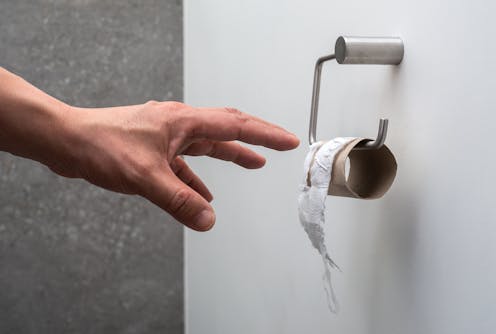
The issue in regard to the PFAS in toilet paper study is that consumers do not know the products they are buying contain PFAS. Toilet roll PFAS may have entered the paper as an additive as part of the pulping and manufacturing process. Toilet paper with PFAS adds to the total burden found in wastewater and biosolids. But should we really give a crap?
Yes and no. Yes because it’s not unreasonable for consumers to demand to know if the products they are buying (and rubbing on their nether regions) contain potentially toxic compounds. Some chemicals such as BPA (Bisphenol-A, an an industrial chemical used in plastics manufacturing) have been voluntarily phased out and products that are BPA-free are labelled accordingly.
One concern when swapping out chemicals is that subsitutions are actually more acceptable and are not replaced by something equally concerning. And we should do everything we can to minimise adding persistent, bioaccumalative and toxic chemicals to our environment that are hard to remediate.
On the other hand, we should not worry overly because dermal exposure to PFAS is negligible even from wiping your bum. Most assessments show food and water are the primary sources of PFAS exposure for humans.
And harm from exposure is determined by the dose. Although for some chemicals there is no safe acceptable threshold, ultra low concentrations are typically present in the wider environment away from PFAS sources such as fire stations and training grounds and airports.
 BPA-free plastic is now widely available.
Shutterstock
BPA-free plastic is now widely available.
Shutterstock
Read more: House dust from 35 countries reveals our global toxic contaminant exposure and health risk
Levels are falling
Australian population exposure levels to regulated PFAS chemicals – PFOA, PFOS and PFHxS – have been falling over the last 20 years despite the fact these chemicals are still present in cosmetics, food packing, cookware, clothes and carpets.
In addition, the Australian Total Diet Study showed only PFOS was detected in five of 112 food types and in less than 2% of all samples. The daily intake of PFOS in the population was identified as being well below public health and safety concerns. Australian food PFAS values were consistently lower than those reported from Europe, the US, United Kingdom and China.
Population exposure concentrations – outside of known contamination hotspots – are low and the risks have been reducing over time. Our prime focus should be improving modifiable social determinants of health such as income, education, employment security, relationships with friends and family. These will result in tangible beneficial health outcomes.
Authors: Mark Patrick Taylor, Victoria's Chief Environmental Scientist, EPA Victoria; Honorary Professor, School of Natural Sciences, Macquarie University


 Daily Bulletin


