

Satellites and space junk may make dark night skies brighter, hindering astronomy and hiding stars from our view
- Written by: Jessica Heim, PhD researcher, University of Southern Queensland
Since time immemorial, humans around the world have gazed up in wonder at the night sky. The starry night sky has not only inspired countless works of music, art and poetry, but has also played an important role in timekeeping, navigation and agricultural practices in many traditions.
For many cultures, the night sky, with its stars, planets and the Milky Way, is considered just as important a part of the natural environment as the forests, lakes and mountains below. Countless people around the world gaze at the night sky: not only amateur and professional astronomers, but also casual observers who enjoy looking up at the stars to contemplate our place in the cosmos.
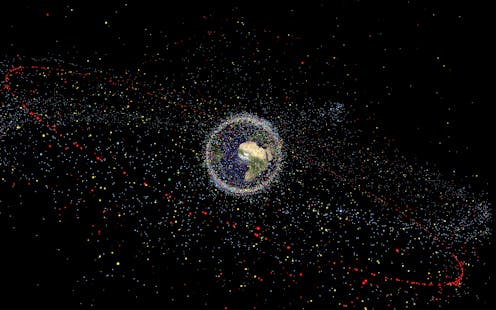
However, the night sky is changing. Not only is ground-based light pollution increasing rapidly, but growing numbers of satellites and space debris in orbit around Earth are also impacting the night sky.
Earlier research showed that satellites and space debris may increase the overall brightness of the night sky. In a new paper in Nature Astronomy, my colleagues and I applied this knowledge to predicting the performance of a major astronomical sky survey. We found this phenomenon may make the survey 7.5% less efficient and US$21.8 million more expensive.
A brighter sky
As a cultural astronomer, I am interested in the role of the night sky in cultural traditions around the world. In particular, I am interested in how light pollution and increasing satellite numbers affect different communities.
The number of satellites in orbit is growing rapidly. Since 2019, the number of functional satellites in orbit has more than doubled to around 7,600. The increase is mostly due to SpaceX and other companies launching large groups of satellites to provide high-speed internet communications around the world.

By the end of this decade, we estimate, there may be 100,000 satellites in orbit around the Earth. Collisions that generate space debris are more likely as space fills with new satellites. Other sources of debris include the intentional destruction of satellites in space warfare tests.
Increasing numbers of satellites and space debris reflect ever more sunlight towards the night side of Earth. This will almost certainly change the appearance of the night sky and make it harder for astronomers to do research.
One way satellites impact astronomy is by appearing as moving points of light, which show up as streaks across astronomers’ images. Another is by increasing diffuse night sky brightness. This means all the satellites that are too dim or small to be seen individually, as well as all the small bits of space debris, still reflect sunlight, and their collective effect is to make the night sky appear less dark.
Hard times for astronomers
In our research, we present the first published calculations of the aggregate effects of satellites and space debris in low-Earth orbit on major ground-based astronomy research facilities.
We looked at the effect on the planned large-scale survey of the night sky to be carried out at the Vera Rubin Observatory starting in 2024. We found that, by 2030, reflected light from objects in low-Earth orbit will likely increase the diffuse background brightness for this survey by at least 7.5% compared to an unpolluted sky.
This would diminish the efficiency of this survey by 7.5% as well. Over the ten-year lifetime of the survey, we estimate this would add some US$21.8 million to the total project cost.
Brighter night skies mean longer exposures through telescopes are needed to see distant objects in the cosmos. This will mean that for projects with a fixed amount of observing time, less science will be accomplished, and there will be increased competition for telescope access.
In addition, brighter night skies will also reduce the detection limits of sky surveys, and dimmer objects may not be detected, resulting in missed research opportunities.
Some astrophysical events are rare and if researchers are unable to view them when they occur, there might not be an opportunity to easily see a given event again during a survey’s operational period. One example of faint objects is near-Earth objects – comets and asteroids in orbits close to Earth. Brighter night skies make it more likely such potentially hazardous objects may remain undetected.
A dramatic and unprecedented tranformation
Increases in diffuse night sky brightness will also change how we see the night sky with the unaided eye. As the human eye cannot resolve individual small objects as well as a telescope can, an increase in satellites and space debris will create an even greater increase in the apparent brightness of the night sky. (When using a telescope or binoculars, one would be able to make out more of the dimmer satellites individually.)
The projected increase in night sky brightness will make it increasingly difficult to see fainter stars and the Milky Way, both of which are important in various cultural traditions. Unlike “ground-based” light pollution (which tends to be the worst near large cities and heavily populated areas), the changes to the sky will be visible from essentially everywhere on Earth’s surface.
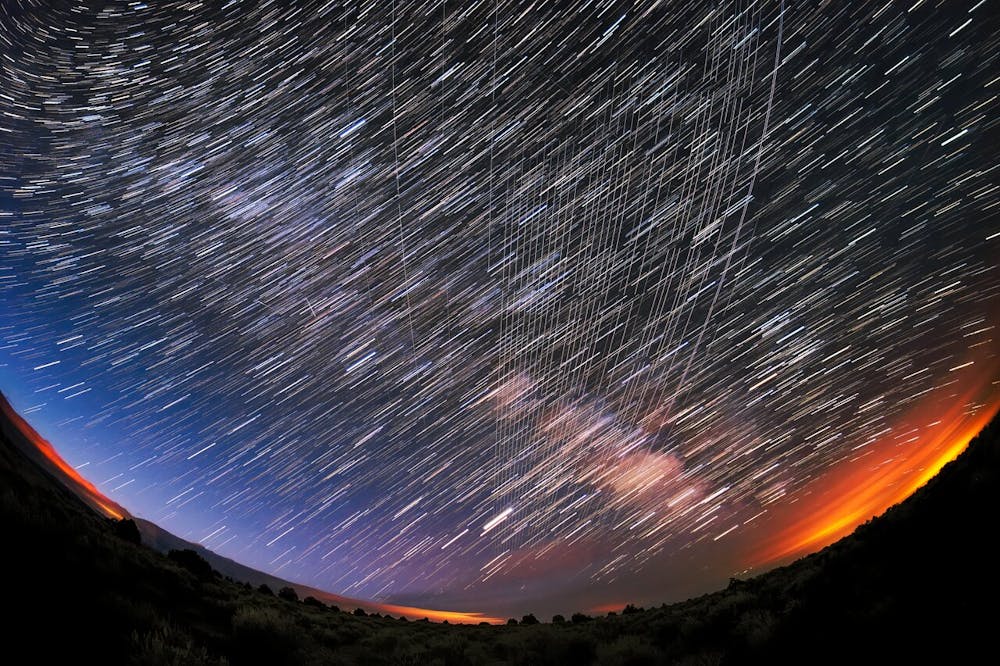 There may be 100,000 satellites in orbit around Earth by 2030.
M Lewinsky / NOIRLab, CC BY
There may be 100,000 satellites in orbit around Earth by 2030.
M Lewinsky / NOIRLab, CC BY
Our models give us a conservative lower limit for a likely increase in night sky brightness. If numbers of satellites and space debris continue to grow at the expected rate, the impacts will be even more pronounced.
As we note in our paper, “we are witnessing a dramatic, fundamental, and perhaps semi-permanent transformation of the night sky without historical precedent and with limited oversight”. Such a transformation will have profound consequences for professional astronomy as well as for anyone who wishes to view an unpolluted night sky.
Authors: Jessica Heim, PhD researcher, University of Southern Queensland


 Daily Bulletin


