

Read The Times Australia

Daily Bulletin

How can Australia pay $368 billion for new submarines? Some of the money will be created from thin air

  • Written by: Peter Martin, Visiting Fellow, Crawford School of Public Policy, Australian National University
How can Australia pay $368 billion for new submarines? Some of the money will be created from thin air

Australia’s decision to buy three nuclear-powered submarines and build another eight is so expensive that, for the A$268 billion to $368 billion price tag, we could give a million dollars to every resident of Geelong, or Hobart, or Wollongong.

Those are the sort of examples used by former NSW treasury secretary Percy Allan on the Pearls and Irritations blog, “in case you can’t get your head around a billion dollars”.

Such multi-billion megaprojects almost always go over budget.

For instance, when Prime Minister Malcolm Turnbull announced the Snowy Hydro 2.0 pumped hydroelectricity project in 2017, it was supposed to take four years and cost $2 billion. The latest guess is it’ll actually take 10 years and cost $10 billion.

So to pay for those two megaprojects alone, there’s an awful lot of money we will need to find from somewhere. Or will we?

‘No simple budget constraint’

In the first year of the pandemic, Australians were given a glimpse of a truth so unnerving that economists and politicians normally keep to themselves.

It’s that, for a country like Australia, there is “no simple budget constraint” – meaning no hard limit on what we can spend.

“No simple budget constraint” is the phrase used by Financial Times’ chief economics commentator Martin Wolf, but he doesn’t want it said loudly.

The problem is, he says, “it will prove impossible to manage an economy sensibly once politicians believe there is no budget constraint”.

A quick look at history shows he is correct about there being no simple budget constraint, despite all the talk about the need to pay for spending.

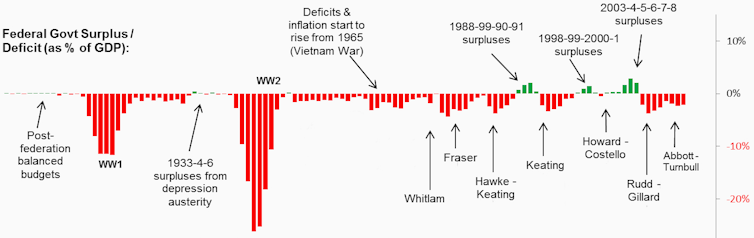
As you can see below, Australia’s Commonwealth government has been in deficit (spent more than it earned) in all but 17 of the past 50 years. The US government has been in deficit for all but four of the past 50.

Commonwealth government surpluses and deficits since 1901
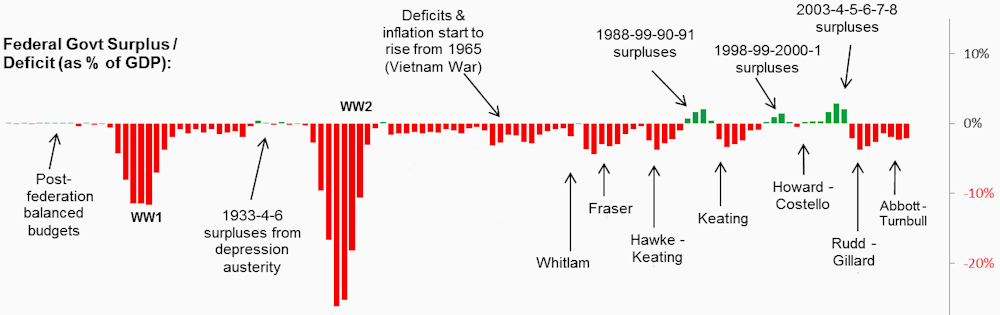
Ashley Owen, Stanford Brown There is no hard limit on how the Commonwealth can spend over and above what it earns, just as there’s no hard limit on how much you and I can spend. But whereas you or I have to eventually pay back what we have borrowed, governments face no such constraint. Because the Commonwealth lives forever, it can keep borrowing forever, even borrowing to pay interest on borrowing. And unlike private corporations, it can borrow from itself – borrowing money it has itself created. Governments create money That’s what the Morrison government did in 2020 and 2021, in the early days of COVID. To raise the money it needed for programs such as JobKeeper, the government sold bonds (which are promises to repay and pay interest) to traders, which its wholly-owned Reserve Bank then bought, using money it had created. The government could have just as easily cut out the traders and borrowed directly from its wholly-owned Reserve Bank, using money the bank had created – effectively borrowing from itself. But the Reserve Bank preferred the appearance of arms-length transactions. And there’s no doubt the Reserve Bank created the money it spent, out of thin air. Asked in 2021 whether it was right to say he was printing money, Governor Philip Lowe said it was, although the money was “created”, rather than printed. People think of it as printing money, because once upon a time if the central bank bought an asset, it might pay for that asset by giving you notes, you know, bank notes. I’d have to run my printing presses to do it. We don’t operate that way anymore. These days the Reserve Bank creates money electronically. It credits the accounts of the banks that bank with it. One way to think about it (the way so-called modern monetary theorists think about it) is that none of the money the government spends comes from tax. The government creates money every time it gets the Reserve Bank to credit the account of a private bank (perhaps in order to pay a pension), and destroys money every time someone pays tax and the Reserve Bank debits the account. If it creates more money than it destroys, it’s called a budget deficit. If it destroys more than it creates, it’s called a budget surplus. Too much spending creates problems Can the government create more money than it destroys without limit? No, but where it should stop is a matter for judgement. If it spends too much money on things for which there is plenty of demand and a limited supply, it’ll push up prices, creating inflation. Where to stop will depend on how much others are spending. If there’s little demand (say for builders, as there was during the global financial crisis) the government can safely spend without much pushing up prices (as it did on builders during the global financial crisis). If it wants to spend really big (say on building submarines), it might have to restrain the spending of others, which it can do by raising taxes. What matters is what others are spending But it’s not a mechanical relationship. The main function of tax is not to pay for government spending, but to keep other spenders out of the way. If the economy is weak in the decades when the subs are being built, the burst of government spending will be welcome, and needed to create jobs. There will be no economic need to offset it by raising tax. Read more: Explainer: what is modern monetary theory? But if the economy is strong, so strong the government would have to bid up prices to get the subs built, it might have to push up tax to wind other spending back. This truth means there’s no simple answer to the question “how they are going to pay for subs?” – just as there was no simple answer to questions about how to pay for a much-needed increase in the JobSeeker, or anything else. The deeply unsatisfying answer is that, from an economic perspective, it depends on who else is spending what at the time. Authors: Peter Martin, Visiting Fellow, Crawford School of Public Policy, Australian National University

Read more https://theconversation.com/how-can-australia-pay-368-billion-for-new-submarines-some-of-the-money-will-be-created-from-thin-air-202150

Business News

The strategic rise of Bali as Australia’s next essential healthcare support hub

As Australian healthcare providers grapple with unprecedented operational bottlenecks, a new nearshore model is quietly transforming patient care delivery. Forward-thinking organisations,  including...

Daily Bulletin - avatar Daily Bulletin

Cost Savings and Benefits of Using Used Pallets in Logistics

In today’s competitive logistics and supply chain industry, businesses are constantly looking for ways to reduce operational costs without compromising efficiency and reliability. One of the most prac...

Daily Bulletin - avatar Daily Bulletin

How Fulfilment Services in Australia Help Businesses Scale Efficiently

The growth of e-commerce and modern retail has transformed customer expectations. Consumers now expect fast shipping, accurate order processing, and seamless delivery experiences regardless of where...

Daily Bulletin - avatar Daily Bulletin

Practical Ways Australian Workplaces Can Reduce Operating Costs

Reducing business costs doesn’t always mean cutting staff, shrinking services or making the workplace feel bare-bones. In many cases, the smarter savings are hiding in everyday operations: the light...

Daily Bulletin - avatar Daily Bulletin

Executive Recruitment Solutions That Help Organisations Secure Exceptional Leaders

Leadership has a direct impact on organisational performance, employee engagement, strategic growth, and long-term success. Businesses operating in increasingly competitive environments require experi...

Daily Bulletin - avatar Daily Bulletin

Why A WooCommerce Website Designer Matters For Online Growth

Running an online store today requires more than simply listing products and waiting for customers to arrive. Businesses need a website that is fast, reliable, easy to navigate, and designed to suppor...

Daily Bulletin - avatar Daily Bulletin

Turning Your Empty Tables into Revenue

The rise of AI demand tools in hospitality, the EatClub–CommBank partnership, and seven trends reshaping Australian dining  A growing number of Australian venues are turning to AI-powered demand ma...

Daily Bulletin - avatar Daily Bulletin

High-Impact Dental Marketing Strategies That Are Driving Real Practice Growth Today

The landscape of dental practice growth in Australia has shifted dramatically over recent years. Standard, broad-spectrum advertising campaigns no longer yield the return on investment they once did. ...

Daily Bulletin - avatar Daily Bulletin

How Telematics Helps Australian Companies Improve Productivity

Operating a commercial fleet in Australia is a uniquely demanding endeavour. Between the sprawling urban sprawl of cities like Sydney and Melbourne and the immense, unforgiving stretches of the Outb...

Daily Bulletin - avatar Daily Bulletin

The Daily Magazine

Lighting Shop in Perth: How The Right Lighting Can Transform Your Home And Business

The right lighting can completely change the look, feel, and functionality of any space. Whether it ...

Traffic Light System Solutions For Safer And More Efficient Traffic Management

Modern cities and growing communities rely heavily on effective traffic management to ensure safety...

Gold Migration Lawyers in Liquidation: How the Closure Affects Your ART Appeal

If your appeal was with Gold Migration Lawyers, a recent change to how the Tribunal decides cases ...

The pressure cooker: life in urban Australia in 2026

Australian cities have always been demanding. Long commutes, rising housing costs, busy schedules a...

What Actually Makes a Good Criminal Lawyer in Melbourne

Most people only think about this question once. That is usually too late. Most people charged wi...

Why Working With A Chatswood Tutor Can Improve Academic Performance

Academic expectations continue increasing for students across primary school, high school, and senio...

Is It Worth Getting Solar Panels in Melbourne?

The real question is not whether solar works in Melbourne. It works. The question is what it is co...

How A Diploma Of Project Management Builds Practical Skills For Modern Work Environments

Developing the ability to plan, execute, and deliver outcomes efficiently is a key requirement in to...

How to Choose the Right Football for Every Level

Choosing a football may seem straightforward, but the right option depends on who will be using it a...