

Read The Times Australia

Daily Bulletin

Credit Suisse is an anomaly: why Australia and New Zealand are safe from 'bank run' contagion

  • Written by: John Hawkins, Senior Lecturer, Canberra School of Politics, Economics and Society, University of Canberra
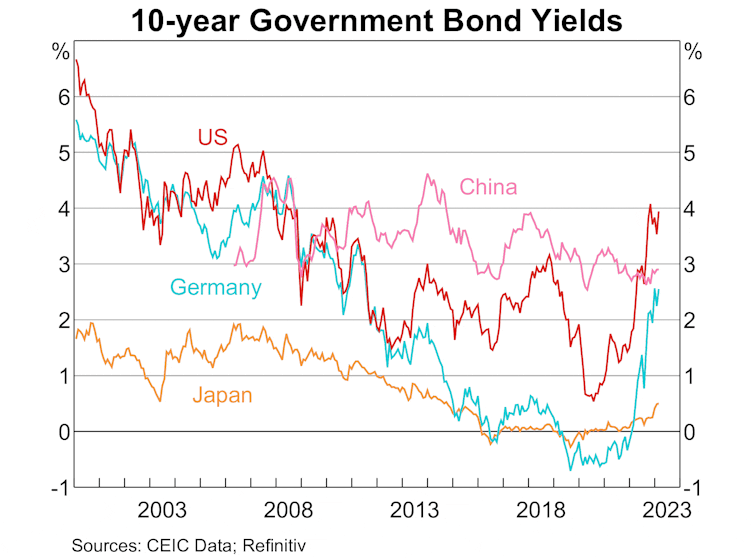
10-year government bond yields

There has been a lot of talk about the risk of financial contagion following the collapse of California’s Silicon Valley Bank. Perhaps too much talk.

While the frequency of bank runs in the past shows the power of emotions to move markets, there’s little reason to panic.

We’re not looking at anything like the circumstances that precipitated the global financial crisis of 2008. If you’ve got your savings in any bank or credit union in Australia or New Zealand, the greatest fear is fear itself.

Just two other US banks, the New York-based Signature Bank and First Republic in San Francisco, have been caught up in the trouble. Internationally, the only casualty is Credit Suisse in Switzerland, whose customers have been saved by loans offered from Switzerland’s central bank and takeover by Switzerland’s largest bank, UBS.

It is likely that until a few weeks ago you’d never heard of Silicon Valley Bank (or Signature or First Republic). But Credit Suisse, founded in 1856, is known around the world. It was regarded as one of 30 systemically important global banks.

What does its troubles have to do with Silicon Valley Bank? Not much, except that fear is contagious, and the bank already had problems that made it extra susceptible to panic.

Interest rates and bond debts

Apart from fear, the one common factor in these bank failures is the impact of higher interest rates on government bonds.

Bonds are a form of debt. Governments issue them to raise money in excess of their tax revenue. Bond buyers are paid regular fixed interest (known as a “coupon”) until the bond matures, when the issuer repays what the original buyer paid for the bond.

Banks like bonds, particularly in uncertain times. Even though they pay less interest than on other forms of debt, there’s an extremely low risk of default. Governments rarely go broke. They can always raise funds through taxation, or issuing more bonds, to meet their obligations.

Read more: We've just sold $15 billion 31-year bonds. What's a bond?

In the early months of COVID, as central banks slashed interest rates as much as possible to sustain economic activity, the already low rate of interest that governments paid on bonds dropped further. In some cases this meant bond yields were even negative. But they were still attractive to banks because of the low default risk compared to, say, lending money to companies facing tough times.

10-year government bond yields
Reserve Bank of Australia But then came 2022 and unexpected inflation, as economies recovered and Russia’s war on Ukraine pushed up global energy prices. In response, central banks began quickly pushing up interest rates. Bond interest rates rose too. The interest rate on a ten-year US treasury bond, for example, was about 1.5% in November 2021. A year later it was more than 4%. These higher yields on new bonds have lowered the value of existing bonds that pay less interest. Any bank wanting to sell those bonds (on a secondary market) must do so for less than what it paid. What happened with Silicon Valley Bank This is what happened with Silicon Valley Bank. The early stages of the pandemic were great for it. Deposits by customers, concentrated in northern California’s high-tech industry, tripled. The bank then invested heavily in US government bonds, intending to hold them until they matured. Then came inflation and the tech industry downturn, with many companies announcing layoffs. Customers started drawing down their deposits to pay their bills. To cover those withdrawals, the bank had to sell bonds at a loss. This reduced market confidence in the bank, leading to further withdrawals by depositors worried it might collapse. Fear of a collapse became a self-fulfilling prophecy. Customers queue outside a Silicon Valley Bank branch Wellesley, Massachusetts, March 13, 2023.
Customers queue outside a Silicon Valley Bank branch Wellesley, Massachusetts, March 13 2023. Steven Senne/AP

But the outcome of a classic “bank run” – with fear spreading through an interconnected financial system – was prevented by the US Federal Reserve stepping in to guarantee deposits.

What happened with Credit Suisse

So what has this to do with Credit Suisse? Like Silicon Valley Bank, which had poor risk controls, it too had specific problems indicative of poor management.

It has been implicated in providing banking services to corrupt and criminal clients. In June 2022 it was convicted in Switzerland’s Federal Criminal Court for failing to prevent money-laundering by cocaine trafficker.

In short, Credit Suisse was a disaster waiting for a catalyst. The collapse of Silicon Valley Bank, and the talk of a global banking crisis, was enough to send already jittery customers to the exit. Credit Suisse’s largest shareholder, Saudi National Bank, then bluntly and publicly refused to contribute more capital.

Read more: The European Central Bank seems to have got away with raising interest rates in the middle of a banking crisis – here's why

Stronger in Australia and New Zealand

In my view, the chances of any bank in Australia and New Zealand following this trajectory is effectively zero.

There’s a lot of crossover between the two countries’ financial sectors and the principal banking regulators, the Australian Prudential Regulation Authority and the Reserve Bank of New Zealand. To prevent bank runs developing, the RBNZ and APRA set minimum levels of liquid assets that can be quickly converted to cash to cover withdrawals.

It is almost a century since any depositor in an Australian bank lost even a portion of their money.

This not to say there haven’t been crises. For example, in 1979 the Bank of Adelaide faced collapse. The RBA organised massive loans from other banks. It was then taken over by ANZ Bank. Depositors kept their savings.

In 1990 the troubled State Bank of Victoria was taken over by the Commonwealth Bank of Australia (then still owned by the Commonwealth government). Again, depositors didn’t lose.

Read more: Worst bank turmoil since 2008 means Federal Reserve is damned if it does and damned if it doesn't in decision over interest rates

In the very unlikely event a bank did fail, Australian depositors are also protected by a federal government deposit insurance scheme called the Financial Claims Scheme. This was set up during the global financial crisis to protect customers of banks, credit unions, building societies and general insurers. It guarantees that every depositor with up to $250,000 will get their money.

The NZ government has a similar scheme in the works, with legislation expected to become law later in 2023.

Authors: John Hawkins, Senior Lecturer, Canberra School of Politics, Economics and Society, University of Canberra

Read more https://theconversation.com/credit-suisse-is-an-anomaly-why-australia-and-new-zealand-are-safe-from-bank-run-contagion-202126

Business News

Cost Savings and Benefits of Using Used Pallets in Logistics

In today’s competitive logistics and supply chain industry, businesses are constantly looking for ways to reduce operational costs without compromising efficiency and reliability. One of the most prac...

Daily Bulletin - avatar Daily Bulletin

How Fulfilment Services in Australia Help Businesses Scale Efficiently

The growth of e-commerce and modern retail has transformed customer expectations. Consumers now expect fast shipping, accurate order processing, and seamless delivery experiences regardless of where...

Daily Bulletin - avatar Daily Bulletin

Practical Ways Australian Workplaces Can Reduce Operating Costs

Reducing business costs doesn’t always mean cutting staff, shrinking services or making the workplace feel bare-bones. In many cases, the smarter savings are hiding in everyday operations: the light...

Daily Bulletin - avatar Daily Bulletin

Executive Recruitment Solutions That Help Organisations Secure Exceptional Leaders

Leadership has a direct impact on organisational performance, employee engagement, strategic growth, and long-term success. Businesses operating in increasingly competitive environments require experi...

Daily Bulletin - avatar Daily Bulletin

Why A WooCommerce Website Designer Matters For Online Growth

Running an online store today requires more than simply listing products and waiting for customers to arrive. Businesses need a website that is fast, reliable, easy to navigate, and designed to suppor...

Daily Bulletin - avatar Daily Bulletin

Turning Your Empty Tables into Revenue

The rise of AI demand tools in hospitality, the EatClub–CommBank partnership, and seven trends reshaping Australian dining  A growing number of Australian venues are turning to AI-powered demand ma...

Daily Bulletin - avatar Daily Bulletin

High-Impact Dental Marketing Strategies That Are Driving Real Practice Growth Today

The landscape of dental practice growth in Australia has shifted dramatically over recent years. Standard, broad-spectrum advertising campaigns no longer yield the return on investment they once did. ...

Daily Bulletin - avatar Daily Bulletin

How Telematics Helps Australian Companies Improve Productivity

Operating a commercial fleet in Australia is a uniquely demanding endeavour. Between the sprawling urban sprawl of cities like Sydney and Melbourne and the immense, unforgiving stretches of the Outb...

Daily Bulletin - avatar Daily Bulletin

Inside the Icon: The BridgeMuseum Officially Opens at the Sydney Harbour Bridge

A bold new way to experience one of Australia’s most recognisable landmarks has arrived, with BridgeClimb Sydney officially opening the all-new BridgeMuseum.  Located inside the Sydney Harbour Bridge...

Daily Bulletin - avatar Daily Bulletin

The Daily Magazine

Lighting Shop in Perth: How The Right Lighting Can Transform Your Home And Business

The right lighting can completely change the look, feel, and functionality of any space. Whether it ...

Traffic Light System Solutions For Safer And More Efficient Traffic Management

Modern cities and growing communities rely heavily on effective traffic management to ensure safety...

Gold Migration Lawyers in Liquidation: How the Closure Affects Your ART Appeal

If your appeal was with Gold Migration Lawyers, a recent change to how the Tribunal decides cases ...

The pressure cooker: life in urban Australia in 2026

Australian cities have always been demanding. Long commutes, rising housing costs, busy schedules a...

What Actually Makes a Good Criminal Lawyer in Melbourne

Most people only think about this question once. That is usually too late. Most people charged wi...

Why Working With A Chatswood Tutor Can Improve Academic Performance

Academic expectations continue increasing for students across primary school, high school, and senio...

Is It Worth Getting Solar Panels in Melbourne?

The real question is not whether solar works in Melbourne. It works. The question is what it is co...

How A Diploma Of Project Management Builds Practical Skills For Modern Work Environments

Developing the ability to plan, execute, and deliver outcomes efficiently is a key requirement in to...

How to Choose the Right Football for Every Level

Choosing a football may seem straightforward, but the right option depends on who will be using it a...