

Binding Ties explores celebrated artist Catherine Opie's world of transitions
- Written by: Cherine Fahd, Associate Professor, Visual Communication, University of Technology Sydney
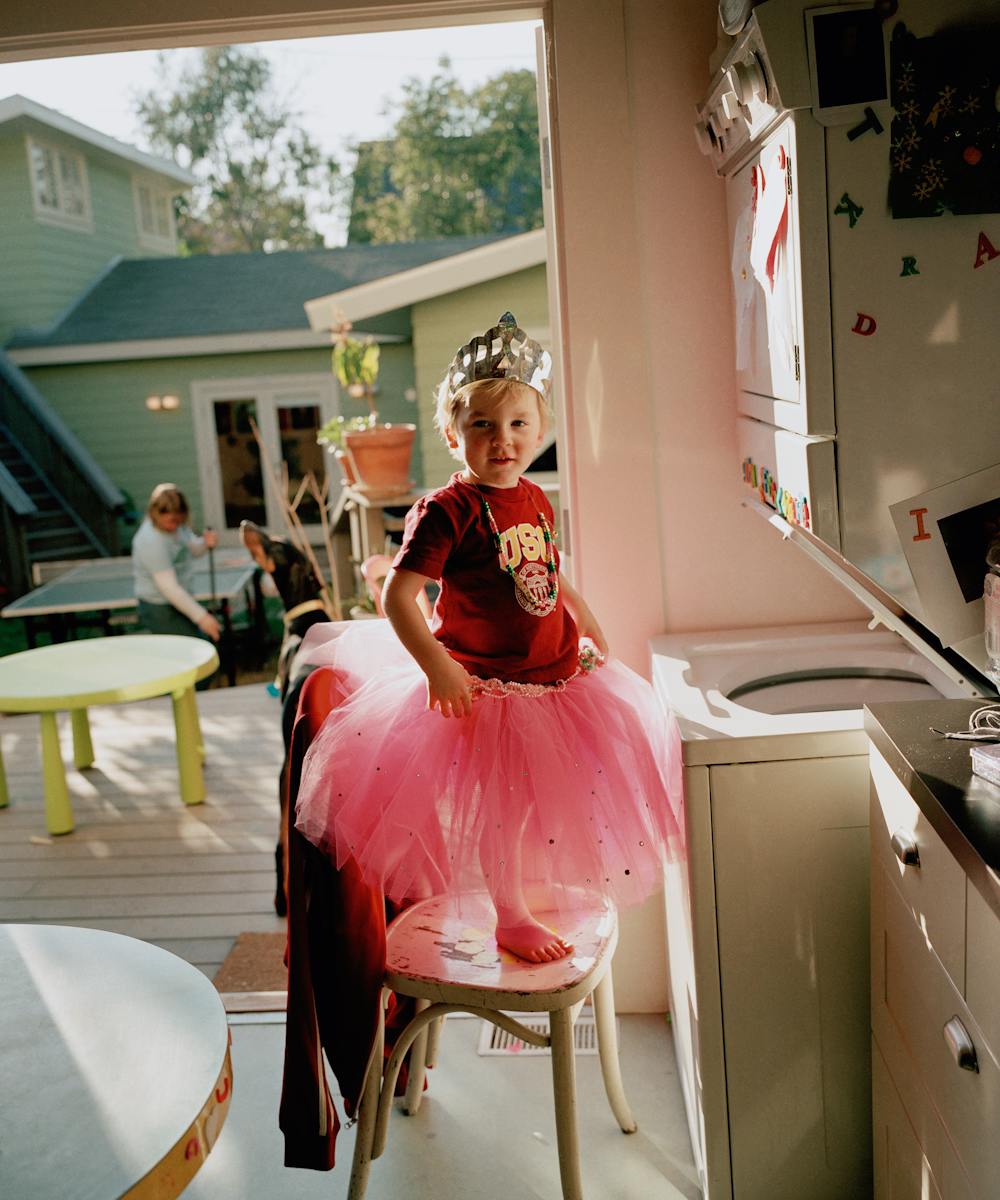
Oliver breastfeeding. Oliver at five dressed in a tutu. Oliver at ten with his pet mouse in his vest pocket, an exquisite re-staging of Leonardo da Vinci’s painting Lady with an Ermine from 1489.
These portraits of Oliver, the son of Catherine Opie, one of the world’s leading photographic artists, are among the highlights of Binding Ties, the first Australian survey exhibition of Opie’s work at the Heide Museum of Modern Art in Melbourne.
All three Oliver portraits use the art historical device of construing the sitter’s identity through allegory. Opie is expert in bringing out photography’s antecedents in the old masters or what we now call legacy media.
Drama and emotion
In the large-scale oval portraits of Opie’s friends and artistic peers, painterly references are repeated photographically. Sharp contrast of light and shadow - the chiaroscuro effect made famous by Caravaggio - creates drama and emotional effect.
In the magnificent Thelma and Duro (2017), an older African American couple are royally illuminated in black space, their eyes staring out of the frame in opposite directions as though they were at odds with each other. Thelma’s fingertips press hard on top of Duro’s right hand, his left hand free to assume the mannerist poise of a Renaissance prince.
In the oval portrait of Rocco (2012) we can see the trace of transition scars beneath “Tender Hearted”, the large breastplate tattoo that runs across the sitter’s chest. Rocco’s portrait visually mirrors the Opie self-portrait in which “Pervert” has been cut into her skin, a scarification ritual that brings out the innate capacity of the human epidermis to record change across time.
 Catherine Opie. Rocco (2012). pigment print.
Courtesy Regen Projects, Los Angeles and Lehmann Maupin, New York, Hong Kong, London, and Seoul, Author provided
Catherine Opie. Rocco (2012). pigment print.
Courtesy Regen Projects, Los Angeles and Lehmann Maupin, New York, Hong Kong, London, and Seoul, Author provided
Skin is on display in many of the Opie portraits, less as a metonym of race than as a thing that captures our difference from each other and ourselves as we wear and tear and toughen our way through life. Whether acne, stretchmarks and rosacea, or the piercings, tattoos and facial hair in which we electively dress our nakedness, Opie’s camera regards scars as signs of human dignity turned out for shared yet intimate apprehension.
For this reason, it is best to skim the didactic panels that point us towards symbolic meanings and simply look at the people and scenes before us in the way that Opie would have encountered them.
 Catherine Opie. Self-Portrait / Cutting
(1993)
Courtesy Regen Projects, Los Angeles and Lehmann Maupin, New York, Hong Kong, London, and Seoul, Author provided
Catherine Opie. Self-Portrait / Cutting
(1993)
Courtesy Regen Projects, Los Angeles and Lehmann Maupin, New York, Hong Kong, London, and Seoul, Author provided
Dykes, drag and trans portraits
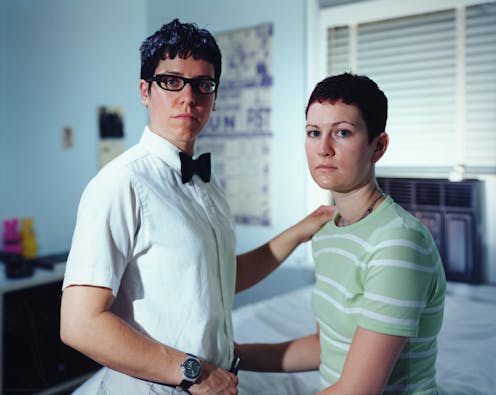
At the centre of the exhibition are the iconic portraits Opie created in the 1990s among her queer community in San Francisco and Los Angeles. Photographed against her signature brightly coloured backgrounds are leather dykes, drag performers and transgender friends, including her long-time collaborator Pig Pen.
Opie and her friends resist normative sexuality, gender stereotypes and the binary of gender categories. They use gesture, posture, dress and adornment to assemble ever-shifting identities for her camera.
While it would be easy to view these works with the casualness of contemporary understandings of queer sexuality and gender fluidity, these portraits were made in the 1990s when AIDS was the primary cause of death for Americans aged 25 to 44.
Like the earlier work of Robert Mapplethorpe and Nan Goldin, Opie’s portraits took a leading role in bestowing agency to the queer community by allowing them to see themselves as they wanted to be seen.
History and iconography
It is commonly thought that the most powerful portraits are made by photographers who know their subjects intimately.
While Opie’s photographs of her friends and family support this theory, how do we explain the portraits of high-school footballers that are among the most powerful in the Heide survey? These sweaty young athletes decked out in grid-iron armour with exposed midriffs and burgeoning six-packs are not obviously Opie’s fellow travellers but they each also testify to the ongoingness of transition.
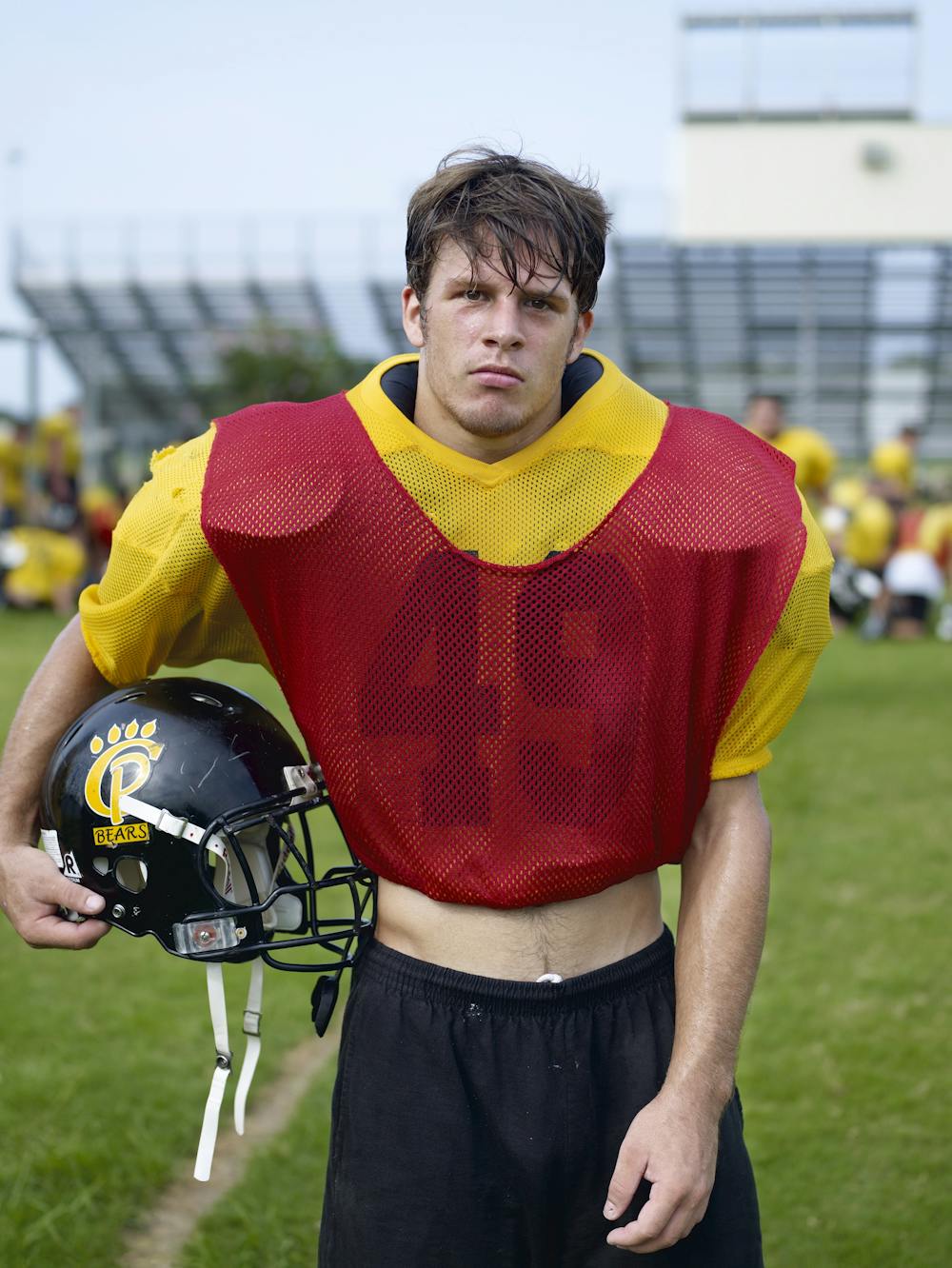 Catherine Opie. Kaine (2007)
Courtesy Regen Projects, Los Angeles and Lehmann Maupin, New York, Hong Kong, London, and Seoul, Author provided
Catherine Opie. Kaine (2007)
Courtesy Regen Projects, Los Angeles and Lehmann Maupin, New York, Hong Kong, London, and Seoul, Author provided
Other iconic inclusions are the three classical self-portraits that command the middle gallery. Saturated in art historical references and Christian iconography, each portrait subverts the traditions it exemplifies.
In Self-Portrait/Pervert (1994), Opie plays with the sumptuary codes of wealth and prestige by facing the camera half-naked, her head covered in a leather BDSM hood. The ornate tattoo across her bleeding chest is stylistically linked to the decorative floral curtain behind her, while her strong arms display 23 surgical needles pinned through her skin like ornamental jewellery.
In Self-Portrait/Cutting (1993), the artist’s back, also bleeding from a childlike drawing etched into her skin, shows a stereotypical family scene in which the stick figures roles of mother and father are taken by two mothers. Rather than celebrating rainbow families, the scarification records the deep grief Opie felt at the demise of her long-term relationship and with it her domestic hopes.
The next year we see her as Bo (1994), her mustachioed male alter-ego. Then, precisely ten years later, her familial longings are realised in the double portrait of Opie breastfeeding her immaculate son in Self-Portrait/Nursing (2004).
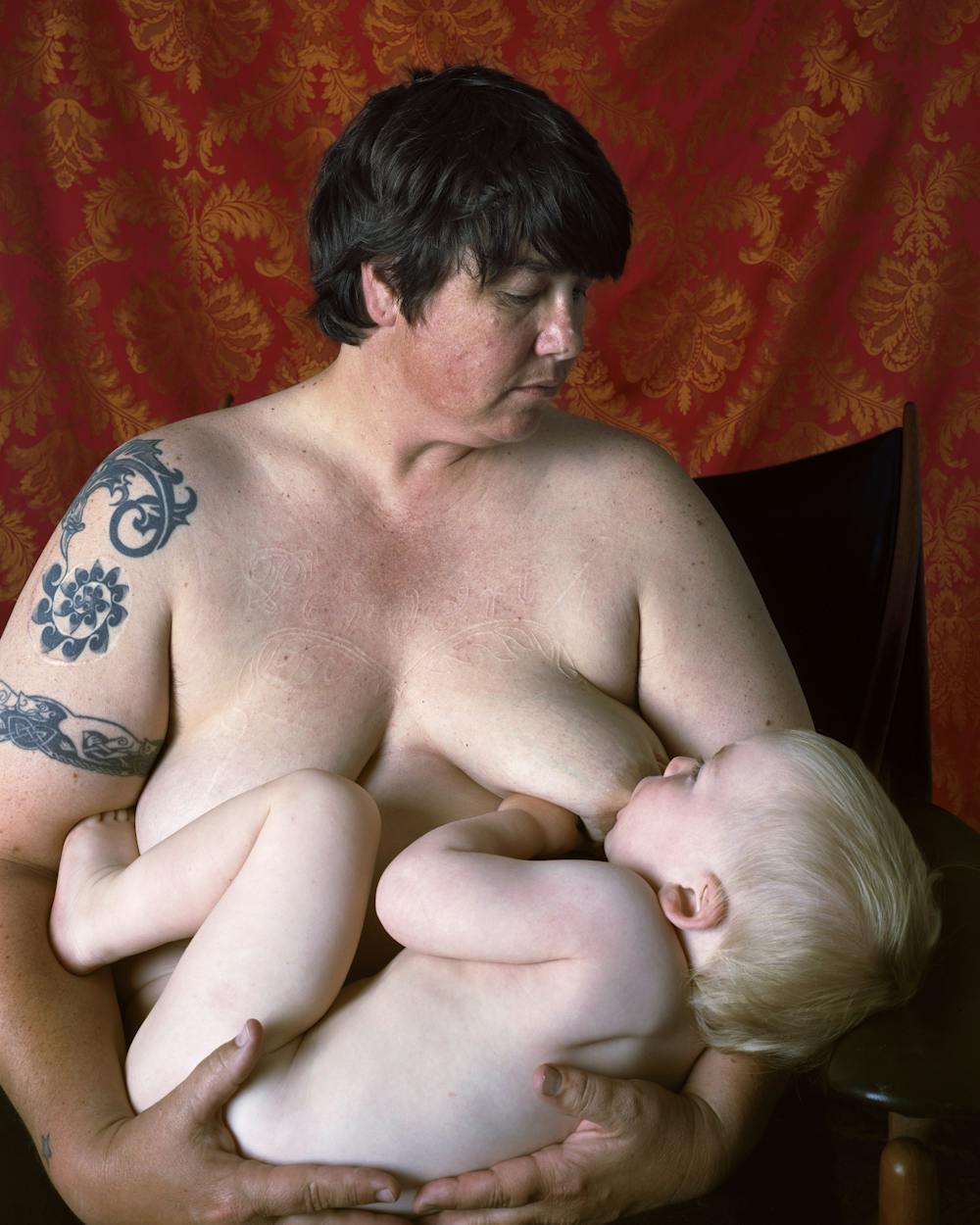 Catherine Opie. Self Portrait/Nursing (2004)
Courtesy Regen Projects, Los Angeles and Lehmann Maupin, New York, Hong Kong, London, and Seoul, Author provided (no reuse)
Catherine Opie. Self Portrait/Nursing (2004)
Courtesy Regen Projects, Los Angeles and Lehmann Maupin, New York, Hong Kong, London, and Seoul, Author provided (no reuse)
A bit of everything
The Heide exhibition has tried to capture Opie’s 40-year oeuvre by including a bit of everything. There are seascapes with surfers from 2003 and more recent large-scale photographs of monuments and sunsets, some of them deliberately blurred.
There are several landscapes of a swamp (look out for the hidden owl) and three stop motion animations that are political responses to global issues of the day.
None of these capture the aura of Opie’s portraits. Her gift is to photograph people. She has a way of lighting her subjects, making them glisten, appear electric or serene but always human. Given this is Opie’s first survey show in Australia, a more in-depth approach focusing on continuity rather than novelty might have been warranted.
 Catherine Opie. Untitled #7 (Swamps) 2019.
Courtesy Regen Projects, Los Angeles and Lehmann Maupin, New York, Hong Kong, London, and Seoul
Catherine Opie. Untitled #7 (Swamps) 2019.
Courtesy Regen Projects, Los Angeles and Lehmann Maupin, New York, Hong Kong, London, and Seoul
The most puzzling and unconvincing inclusion is The Modernist (2017), a grainy black-and-white film made up of 852 still frames that casts the now middle-aged Pig Pen in the unappealing role of an arsonist hell-bent on destroying the modernist architectural icons of LA. An odd exercise in ambivalence about artistic success, the film is at odds with Opie’s unassuming mastery of documentary photography and portraiture.
There is no doubt that Opie is a multifaceted artist. But given how much work was not on display, the spaces dedicated to the film, the surfers and the animations might have been better used to show more photographs from the oval portrait series or more domestic scenes with Opie’s family.
For not much more than the price of an Uber to and from Heide, you can purchase the artist’s monograph from the bookstore and explore the full breadth of the human photographic connections that have made her such a celebrated artist and recorder of life as transition.
Authors: Cherine Fahd, Associate Professor, Visual Communication, University of Technology Sydney


 Daily Bulletin


