

What actually is palliative care? And how is it different to end-of-life care?
- Written by: Samar Aoun, Perron Institute Research Chair in Palliative Care, The University of Western Australia
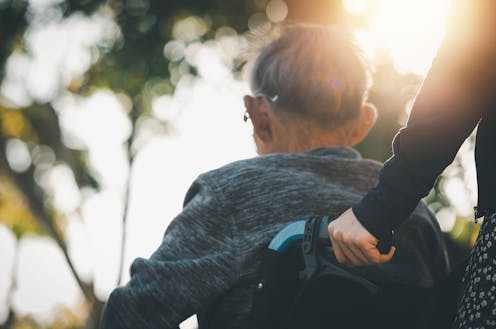
Although it is associated with dying, palliative care is an approach focused on improving quality of life – or how people feel about and respond to facing a life-threatening illness.
Palliative care aims to prevent and relieve physical, social, emotional, spiritual and existential distress. Palliative care also supports family caregivers during the disease journey and bereavement phase. You might have heard it mentioned for cancer, but it is beneficial for the majority of life-limiting conditions. It has been shown to reduce health-care costs by preventing unnecessary hospital admissions.
Palliative care is not voluntary assisted dying. It does not aim to hasten or prolong death. It is not just for people who are about to die and seeking palliative care does not mean “giving up”. In fact, it can be a profound and positive form of care that the World Health Organization (WHO) has recognised as a basic human right. But what does it involve?
Read more: How to choose a legal decision-maker as you get older – 3 things to consider
Not just for someone’s final days
Palliative care is often seen as a “last resort” rather than a service that empowers terminally ill people to live as well as possible for as long as possible.
The full benefit of this holistic approach can only be realised if people are referred early to palliative care – ideally from the time they are diagnosed with a terminal illness. Unfortunately, this rarely happens and palliative care tends to blur with end-of-life care. The latter is for people who are likely to die within 12 months but is often left to the last few weeks.
Palliative is not just for the very end of someone’s life.Read more: We all hope for a 'good death'. But many aged-care residents are denied proper end-of-life care
Palliative care can involve difficult conversations
Palliative care provides a time to ask some usually taboo questions. What kind of death do you want to experience? Who is in your personal network? How will they respond to your life ending? What kind of support can they offer?
Palliative care can be provided at home, hospital, hospice or residential aged care facility, depending on the preference and circumstances of patients and their family carers.
In general, patients are referred by their treating specialist, health professional or GP. Patient preferences for care and what matters most to them are discussed with their doctor or other health professionals and with their loved ones with advance care planning. These discussions can include information on their preferred place of care, preferred place of death, personal care needs such as dietary preferences and religious and spiritual practices.
This helps those caring to make decisions about the patient care when the patient cannot anymore. However, advance care planning can start at any time in life and without a diagnosis.
How palliative care delivery has changed
Once upon a time, we were born at home and we died at home. Death was a social event with a medical component. Now it is close to the opposite. But research indicates a solely clinical model of palliative care (mainly symptom management funded through the health system) is inadequate to address the complex aspects of death, dying, loss and grief.
A public health palliative care approach views the community as an equal partner in the long and complex task of providing quality health care at the end of someone’s life. It promotes conversations about patients’ and families’ goals of care, what matters to them, their needs and wishes, minimising barriers to a “good death”, and supporting the family post-bereavement.
These outcomes require the involvement of family carers, friendship networks and not-for-profit organisations, where more detailed conversations about life and death can happen, instead of the “pressure cooker” rushed environment of hospitals and clinics. Investment could develop stronger death literacy and grief literacy in the community and among health professionals, who may be reluctant to raise or discuss these topics. This would likely see the take up of advance care planning increase, from the current low levels of less than 15% of Australians (25% of older Australians accessing health and aged-care facilities).
One such successful approach is the Compassionate Communities Connectors Program in Western Australia, using trained community volunteers to enhance the social networks of terminally ill people.
Our research trial trained 20 community volunteers (“connectors”) and 43 patients participated over 18 months. In sourcing others to help (who we called “caring helpers”), connectors built the capacity of the community and social networks around patients in need. Caring helpers assisted with transport, collecting prescriptions, organising meals and linked clients to community activities (such as choirs, walking groups, men’s shed). And they helped complete advance care planning documentation. About 80% of patients’ needs were social, particularly around reducing feelings of isolation.
Patients in the trial had fewer hospital admissions and shorter hospital stays.
Read more: Passed away, kicked the bucket, pushing up daisies – the many ways we don't talk about death
Tailored to need
Palliative care should be tailored to each person, rather than a one-size-fits-all clinical model that doesn’t respect autonomy and choice.
Many people are dying in a way and a place that is not reflective of their values and their end-of-life is interrupted with preventable and costly admissions to hospital where control and even dignity are surrendered. Palliative care hospitalisations have increased in recent years compared to all hospitalisations, with 65% of such admissions ending with the patient dying in hospital.
It is unrealistic and unaffordable to have a palliative care service in every suburb. There needs to be a shift to a more comprehensive, inclusive and sustainable approach, such as Compassionate Communities, that recognises death, dying, grief and loss are everyone’s business and responsibility.
Authors: Samar Aoun, Perron Institute Research Chair in Palliative Care, The University of Western Australia


 Daily Bulletin


