

Read The Times Australia

Daily Bulletin

NASA's Psyche asteroid mission: a 3.6 billion kilometre 'journey to the centre of the Earth'

  • Written by: Hrvoje Tkalčić, Professor, Head of Geophysics, Director of Warramunga Array, Australian National University
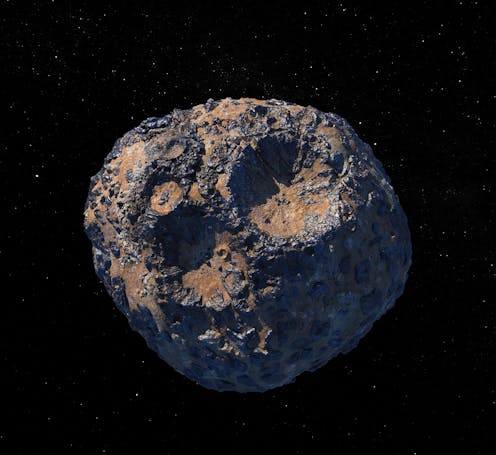
NASA's Psyche asteroid mission: a 3.6 billion kilometre 'journey to the centre of the Earth'

Psyche was the Greek goddess of the soul, born a mere mortal and later married to Eros, the God of love. Who knows why the Italian astronomer Annibale de Gasparis gave her name to a celestial object he observed one night in 1852?

Psyche was only the 16th “asteroid” ever discovered: inhabitants of the Solar System that were neither the familiar planets nor the occasional visitors known as comets. Today we know the asteroid belt between the orbits of Mars and Jupiter contains millions of space rocks, ranging in size from the dwarf planet Ceres down to tiny pebbles and grains of dust.

Among all these, Psyche is still special. With an average diameter of around 226km, the potato-shaped planetoid is the largest “M-type” asteroid, made largely of iron and nickel, much like Earth’s core.

Last week NASA launched a spacecraft to rendezvous with Psyche. The mission will take a six-year, 3.6 billion kilometre journey to gather clues that Earth scientists like me will interrogate for information about the inaccessible interior of our own world.

Natural laboratories

M-type asteroids like Psyche are thought to be the remnants of planets destroyed in the early years of the Solar System. In these asteroids, heavier elements (like metals) sank toward the centre and lighter elements floated up to the outer layers. Then, due to collisions with other objects, the outer layers were torn away and most of the material was ejected into space, leaving behind the metal-rich core.

These metallic worlds are perfect “natural laboratories” for studying planetary cores.

Read more: Nasa's Psyche mission is set for launch – here's how it could unveil the interior secrets of planets

Our current methods for studying Earth’s core are quite indirect. We sometimes get tiny glimpses into the Solar System’s early history – and hence our planet’s own history – from metallic meteorites, parts of asteroids that fall to Earth. However, this view is very limited.

Another way to study the core is using seismology: studying how the vibrations caused by earthquakes travel through the planet’s interior, in much the same way doctors can use ultrasound to see the inside of our bodies.

However, on Earth we have fewer seismographs in the oceans and in the Southern Hemisphere, which restrict what we can see of the core.

An animation showing Earth dotted with seismographs and a model of the core.
A simplified version of how seismic waves ‘see’ Earth’s inner core. Hrvoje Tkalčić / National Computational Infrastructure, Author provided (no reuse)

What’s more, the core is buried beneath the planet’s outer layers, which obscure our view even further. It is like looking at a distant object through an imperfect lens.

As well as seismology, we learn about the core through lab experiments attempting to recreate the high pressures and temperatures of Earth’s interior.

We take the observations from seismology and lab experiments and try to explain them using computer simulations. In a recent paper in Nature Communications, we discussed the current challenges in studying Earth’s core – and the ways forward.

What the Psyche mission hopes to discover

We can think of NASA’s mission to Psyche as a journey to the centre of Earth without having to travel down through the planet’s rocky crust, the slowly moving mantle and the liquid core.

The mission aims to find out whether Psyche really is the core of a destroyed planet, that was initially hot and molten but slowly cooled and solidified like the core of our planet. On the other hand it’s possible Psyche is made of material that was never melted at all.

Read more: What are asteroids made of? A sample returned to Earth reveals the Solar System's building blocks

NASA also wants to discover how old Psyche’s surface is, which would reveal how long ago it lost its outer layers. The mission will also investigate the asteroid’s chemical composition: whether it contains lighter elements alongside iron and nickel, such as oxygen, hydrogen, carbon, silicon and sulphur. The presence or absence of these could give us clues about our own planet’s evolution.

Information about Psyche’s shape, mass, and gravity distribution will also be gathered. Also, the potential for future mineral exploration should be studied.

All of this will be possible with the broad-spectrum cameras, spectrometers, magnetometers, gravimeters and other instruments the spacecraft carries. Scientists like me will follow with impatience the mission’s long journey through space.

Authors: Hrvoje Tkalčić, Professor, Head of Geophysics, Director of Warramunga Array, Australian National University

Read more https://theconversation.com/nasas-psyche-asteroid-mission-a-3-6-billion-kilometre-journey-to-the-centre-of-the-earth-215707

Business News

The Rise of Digital Marketplaces in the Australian Trade Sector

For decades, the Australian trade and construction sector operated almost entirely on word-of-mouth recommendations and local community networks. Small business owners typically relied on local newspa...

Daily Bulletin - avatar Daily Bulletin

How Immigration Lawyers Can Help

Introduction Visa decisions can shape employment, family life, study plans, travel, and future residence. A small omission can lead to delay, added expense, or refusal. Immigration lawyers assess l...

Daily Bulletin - avatar Daily Bulletin

How Industrial Drying Equipment Supports Efficient Processing

Many industrial processes require moisture to be removed from compressed air, products or process materials before they move to the next stage. Excess moisture can affect equipment performance, produc...

Daily Bulletin - avatar Daily Bulletin

Practical Ways a Whiteboard Can Improve Workplace Communication

Effective communication helps teams stay organised, share ideas and keep track of important information. While digital tools are now common in many workplaces, a whiteboard continues to provide a simp...

Daily Bulletin - avatar Daily Bulletin

Designing Eco-Friendly Custom Water Bottles for Your Next Event

The Evolution of Sustainable Event Merchandise Event planning has undergone a massive transformation over the last decade. Gone are the days when organizers could hand out cheap, single use plastic...

Daily Bulletin - avatar Daily Bulletin

Why Choosing a Professional Florist Melbourne Makes Flower Delivery Impactful

Flowers have a great power to speak when humans cannot express their feelings with right words. Flowers are the best gifts when you are celebrating a birthday or welcoming a newborn child into your fa...

Daily Bulletin - avatar Daily Bulletin

The Business Case for Choosing Australian Fabricators Over Imported Alternatives

For a long time, you might have defaulted to overseas suppliers when sourcing fabricated metal components for a project. The unit price was lower on paper, and the maths seemed straightforward. That...

Daily Bulletin - avatar Daily Bulletin

Australian organisations are relying on business continuity plans built for a far more predictable world

Tariff escalations, supply chain fragility, geopolitical events, and the ongoing threat of cyber disruption have reshaped the risk environment facing Australian organisations. The problem is that ma...

Daily Bulletin - avatar Daily Bulletin

How to Rent a Car for Uber in Melbourne: What Every New Driver Needs to Know

Starting out as an Uber driver in Melbourne is not as complicated as it sounds but getting the vehicle right is where most new drivers get stuck. Uber has strict requirements around vehicle age, condi...

Daily Bulletin - avatar Daily Bulletin

The Daily Magazine

Microsoft Surface For Business (Microsoft 365 E3, E5, E7) And Modern Workplace Requirements

Understanding Business Device Requirements Microsoft surface for business (microsoft 365 E3, E5, ...

Choosing the Right Split System for Melbourne Homes

Why Split Systems Suit Melbourne Conditions Choosing a heating and cooling system starts with und...

What Happens to Remaining Sperm Stored in the Vas Deferens After the Procedure

Deciding to undergo a permanent contraceptive procedure is a significant life step for many men. Whe...

Top Tips on Combining TMS Therapy with Comprehensive Adult ADHD Care in Sydney

Managing attention-deficit hyperactivity disorder (ADHD) alongside co-occurring mental health condit...

What To Expect Before, During, And After Laser And CRP Hair Loss Treatments

Hair thinning affects millions of Australians, leading many to seek advanced, non-surgical solutions...

What To Ask During A Consultation For Men's Hair Loss Treatment And PRP

Walking into a clinic to address thinning hair can feel daunting, but preparation builds confidenc...

How to Ensure Safe and On-Time Building Material Delivery with Sydney Cargo Transportation Services

Managing a construction site requires precise coordination, where even a minor delay can stall an en...

What to Ask Your Cosmetic Surgeon About Liposuction and Thigh Lift Reduction in Perth

Establishing the Surgeon’s Credentials and Local Experience Your safety depends heavily on the cred...

Top Ergonomic Tips to Enhance Your Neck Pain Treatment and Prevent Back Pain In Sydney

Many office workers in New South Wales spend upwards of eight hours a day hunched over a keyboard, l...